
Hiroshima: a video not to forget
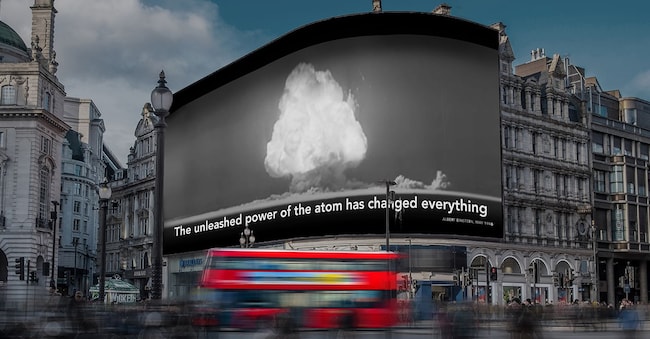
The ten-minute film was projected on the giant screen in Piccadilly Circus

2' min read
2' min read
I saw the world end: this is the title of a monumental digital artwork commissioned by London's Imperial War Museum from artists Ed Devlin and Machiko Weston to commemorate the 80th anniversary of the atomic bombing of Hiroshima on 6 August 1945.
The ten-minute film was projected on the giant screen in Piccadilly Circus.
"I saw the world end" is a digital diptych, with the screen split in two to show the two points of view: the Western one of the designers, creators and makers of the atomic bomb, edited by Devlin, and the Japanese one, of the victims, witnesses and survivors, edited by Weston.
The ten minutes mark the ten seconds it took to completely destroy Hiroshima on 6 August, and Nagasaki three days later, causing the immediate death of over one hundred thousand people, mostly civilians, and the excruciatingly delayed death of thousands more, either fatally injured or victims of the effects of radiation.
"We wanted to explore this moment with the time sequence of the physical impact of the bomb, from one millionth of a second to three seconds to ten seconds, the moment when the physical destruction was complete," Devlin and Weston explain. "We also followed the time sequence of the mythological impact, from our grandparents to our parents to our perception of the event, which shaped the concept of the end of the world in both British and Japanese cultural traditions."

