
Historical Italian design desired by the Americans, but threatened by duties
Rising prices in the last two years, sought-after 1930-40s pieces

4' min read
Key points
4' min read
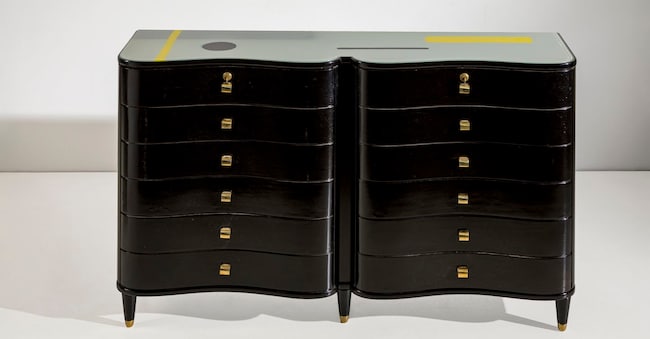
Uncertainty prevails and the duty variable, now suspended by Trump for 90 days, is also a serious threat to the collector's design market. The US, in fact, is one of the main trading venues for historic pieces of Italian design, as shown by the turnovers of domestic auction houses. "Our design department was born in 2007," says Guido Wannenes of the Genoese auction house of the same name. "At that time we were among the first in the sector; today, it is a winning bet, in fact, design represents 15-20% of our annual turnover. Design has not suffered from the art market crisis of the last two years; on the contrary, interest has grown and so have prices, which have increased by 20-30%, up to 50%. The audience, especially the international one, has expanded. In the United States we sell up to 80 per cent of the lots sold, the rest go to Europe (less to Asia), that is why we are concerned about possible duties'. On 10 April, Wannenes held its most important auction of the year, 'Forme', which took place in Milan during the week of the Salone del Mobile with 170 selected pieces and estimates from €1,200 up to €80-120,000 for a 1950s Osvaldo Borsani chest of drawers with a top by Lucio Fontana, which fetched €100,150. The catalogue closed the sale with white gloves and a total sold for EUR 1,029,030. "It is important because it testifies to Borsani's collaborations with artists of the time, such asRoberto Crippa, Fausto Melotti, Bruno Munari, Adriano Spilimbergo, which recently have also yielded good results abroad," explain specialists Giacomo Abate and Andrea Schito. "An important nucleus of the auction with tables, chairs, lamps came from a two-storey villa in Pavia almost entirely furnished by Osvaldo Borsani, to whom the family also turned to furnish other homes". From lot 15 to 33 all the pieces were awarded, even with significant rises, and competition in the hall, on the phones and from the web, confirming the great interest in historical design. Among the most significant adjudications was the pair of armchairs (lot 24): starting at €6,000 it rose to €25,150. The rare hanging lamp mod. 4673 (lot 15) produced by Fontana Arte also did well, fetching €17,650, the wall sconce (lot 23) sold for €6,390 and the chaise longue (lot 29) fetched €9,900.
"Today, the 1930s and 1940s are very much in vogue: the classic is coming back into fashion, with softer lines that cite the neoclassical past and zoomorphism reinventing them, rather than the geometric lines of the 1950s," continue Giacomo Abate and Andrea Schito. "We are dealing with a mature collector, who is certainly looking for production furniture, but above all he is looking at commissioned furniture, singular and rare objects. And naturally, historical design is at the top of buyers' desires in auctions such as the armchair mod. 811. (lot 52) by Gio Ponti sold for 18,070 euro. Excellent results were also achieved for the floor lamp mod. Sasso by Luigi Caccia Dominioni (lot 109) and Max Ingrand's chandelier mod. 1563 Dalia (lot 144), which sold for €22,650 and €20,000 respectively. In fact, names such as Ignazio Gardella, Luigi Caccia Dominioni, Franco Albini and BBPR (at Wannenes, the large pendant lamp variant of mod. 2045/d by studio B.B.P.R., fetched €93,900), are increasingly sought after. Of the latter group, several ceiling lamps have been offered for sale in recent years and have multiplied their estimates, reaching 374,000 euro from 30-40,000 in the last Wannenes auction.
Demand widens
.On the other hand, however, the enlargement of the market also leads to a widening of the offer, which is not at all easy to navigate, as can be seen these days in Milan, with the Salone del Mobile and the Fuorisalone taking on increasingly disproportionate dimensions every year. "We are witnessing a real split in the market," says Milanese gallerist Rossella Colombari, specialising in historical design. "On the one hand there is vintage, with extraordinary pieces by masters such as Gio Ponti and Borsani at 20-30-40 thousand euro, which retain their value over time even when one day you decide to resell them at auction, because they have historical content. On the other hand, we are faced with an invasion by fashion houses, which are trying to cross-sell into the furniture market, making limited editions in materials such as bronze, steel and mother-of-pearl, which respond to a tacky taste for the new rich in emerging countries. Especially after Covid, with European economies in trouble, they are the main buyers. Paradoxically, names such as Asnago and Vender are unknown to most, so the connoisseur collector can make great bargains'.
In addition to looking back to the 1930s-1940s, today we are increasingly turning to the 1970s-1980s, with names such as Gaetano Pesce, Andrea Branzi, Alessandro Mendini, Nanda Vigo, Gio Colombo, Ettore Sottsass, who for years were neglected in favour of Minimalism. On the contrary, there is now a return to Maximalism, to the playful and ironic approach, to bold colours, from acid green to electric blue, purple, fuchsia, synthetics, neon, reflective surfaces and soft sofas. At Piasa's next auction on 23 April in Paris, the top lots are a 'Cornaro' sofa by Carlo Scarpa from 1973 estimated at €6-9,000 and a 'Camaleonda' by Mario Bellini (1970), estimated at €12-15,000, a must-have model that interior designers have brought back to the crest of the wave in recent years.

