
Norway: history, lighthouses and nature amongst the islands of Kristiansand
In the south of the country, this town, founded in the 17th century, is the perfect base from which to explore unspoilt countryside

Key points
Until a few years ago, the fate of museums seemed sealed, as Dan Hicks wrote (The Brutish Museums: the Benin Bronzes, Colonial Violence and Cultural Restitution) in the face of the rise of ‘TikTokable’ experiences. Fortunately, however, things are turning out differently, and it is often the new museums that create a destination or highlight places that already have so much to tell in their own right. This is certainly true of Kristiansand, Norway’s fifth-largest city, overlooking the stunning southern fjord. The life, traditions and character of its people – lobster fishermen, intrepid sailors and successful traders – are shaped by the rhythms of the sea. Here, on the harbourfront, a 38-metre-high white building has been given a new lease of life, telling a story of transformation: from a grain silo dating back to 1935 to one of Europe’s most innovative contemporary art museums.
From a barn to an innovative museum of Nordic art
It is Kunstsilo that, in 2025, was awarded the title of ‘World’s Most Beautiful Museum 2025’ by the Prix Versailles in Paris, and just a few weeks ago, the RIBA International Award for Excellence 2026 from the Royal Institute of British Architects. A landmark for lovers of Nordic art and repurposed industrial architecture, it is a project born of the vision of Nicolai Tangen, a Norwegian hedge fund manager and art collector who donated his extraordinary collection of Nordic modernist art – the largest in the world – to his hometown.
The Tangen Collection, together with works from the Sørlandets Kunstmuseum and the Christianssands Billedgalleri, forms the core of the museum’s permanent exhibitions: over 7,500 works that trace the evolution of Scandinavian art from the 20th century to the present day. But the building itself is also a work of art: the architects Mestres Wåge, Mendoza Partida and BAX have retained the 30 original silos, integrating them into an exhibition layout that plays with natural light and spacious areas. The museum is also a cultural centre, as it will host conferences, digital installations, concerts and workshops.
In the heart of Kristiansand
Behind Kunstsilo lies a bustling city, a fishing town with a long history (founded in 1668 by Christian IV, King of Denmark and Norway, as a strategic hub for the timber trade) and where, for at least four months of the year, daylight stretches from 4 am to 10 pm, illuminating golden beaches, numerous city parks and the cobblestones of the historic Posebyen district on the banks of the River Otra. The streets of Gyldenløvesgate, Skippergata and Rådhusgata are lined with white wooden houses, many of which are original and survived the great fire of the 19th century, making this one of the largest areas in Northern Europe with perfectly preserved historic buildings. Some now house cafés, vintage shops and exquisite bakeries where bread is baked as it was in days gone by, using strictly local grains. It is well worth leaving the sea behind and strolling through these streets, where there are numerous charming views offering a glimpse into 17th-century life.
Three thousand islands to explore
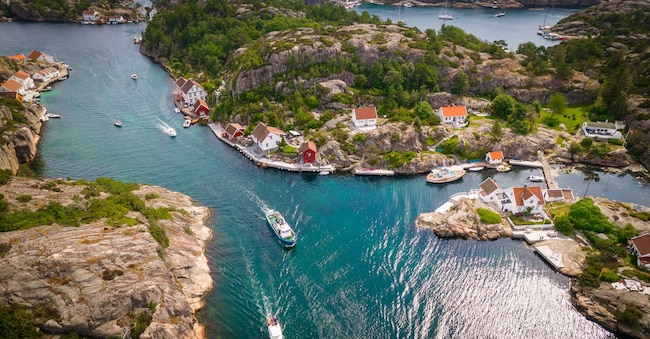
From the top of Kunstsilo, the vast archipelago (one of the largest in Norway) appears in all its majesty; then, after a stop at Reinhartsen to savour authentic wild salmon, you leave the jetty and set off for those 3,000 islets where nature is nothing short of astonishing. The landscape is perfectly preserved, featuring exclusive cottages made of white or red timber. Where once tools were stored or sheep were sheltered, there are now places to relax. These cottages, originally built as fishermen’s huts (known as Rorbu) or farm sheds, now represent the very soul and identity of the landscape.


