
Holographic glasses got it right. From Spectacles to Ray-Ban Meta: the guide
After the failures of Google Glass, here are the devices that stand to enable generative Ai

3' min read
3' min read
You are no longer in the dark and you are not wearing a visor, but simple glasses. Holograms appear in front of you that you can manipulate with your bare hands. Nothing invasive, you play with digital artefacts that augment the reality around you. Let's say right away that Snapchat's Spectacles aren't something new, but they've got it right. We tried them out for just under an hour, but they immediately convinced us.
Now in its fifth generation after its September launch in the US, it has also arrived here to be in the hands of the developers. During the test we played chess in multiplayer mode, drew with our fingers and learnt the rules of sailing. We are in the vicinity of Microsoft Hololens, a Microsoft project that was born for business but has not had any luck. Compared to Redmond's visor, Snap's idea is to create real glasses.
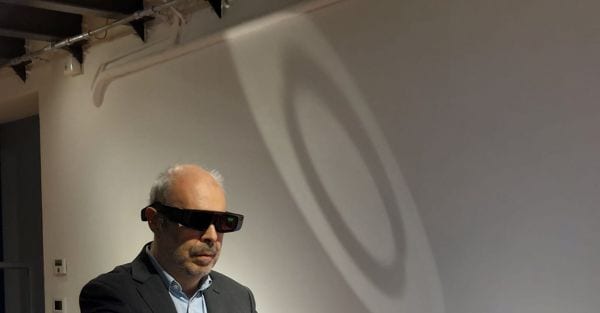
The look is like a politician from the First Republic, they weigh just over two ounces - half the weight of a normal VR helmet - they have four cameras that allow precise tracking of your fingers and silicon-based liquid crystal micro-projectors that allow holograms to take shape on your lens. The developers also explain that there is the possibility of integrating LLM and machine learning models: OpenAI is the first of the AI giants to collaborate with them to study new augmented reality experiences based on what is seen and heard.
It should be remembered that the technology industry has been trying for almost a decade to develop such glasses, with the aim of superimposing images or text on the real world. But at this height and after the failures of Google Glass (2012) and Amazon Echo Frames (2020) - and perhaps also thanks to these flops - new market-ready products have emerged. In November, Meta announced Project Orion, their first holographic glasses prototype, which they describe as 'the most advanced' ever made. It will join - we don't yet know when - the Ray-Ban Meta glasses made with EssilorLuxottica and launched in 2021, which do not integrate augmented reality technologies but seem to focus on the ability to interact with voice through generative artificial intelligence. Italian support arrived in November, but functionality is still limited due to the 'complex European regulatory system', which Meta says is holding back the implementation of this technology. Recall that Meta's AI is not yet available in Europe, but it is probably only a matter of time and willingness to adapt to our rules.
Also because this time there is more clarity on the potential market and technological potential. We are talking about glasses that look like glasses, with or without holograms, but all with the promise of being able to answer questions about people, objects and texts seen by the camera. This will translate into the ability to translate texts into different languages, provide directions to places and more information about what you are looking at. Thanks to the integrated microphones and cameras, we will talk to our glasses as we are learning to do with our smartphones through earphones.


