
House of women, not housewives
'Sentimental value' and 'The sound of a fall' bring out a new spiritual, non-new age femal gaze that binds the protagonists to their homes

Key points
The silver screen, especially horror, loves houses. Between the creaking floorboards, the mischievous spirit (Beetlejuice), the demon (Suspiria), the psychosis (Psycho, Shining), the social contest (Parasite), the comedy (Animal House), the sentimental-affectionate escape (Up) all creep in. Two films, one a multiple Oscar nominee, Joachim Trier's Sentimental Value, now in cinemas, and the other, Mascha Schilinski's The Sound of a Fall, in cinemas from 26 February, change the outlook on the subject of the reappropriation of the home on the female line.
Emotional Hereditary Axis
It is a feeling that passes through an emotional hereditary axis - mothers, aunts, grandmothers - or through the environment, always in the muliebral way, whose walls bend those who inhabit them to an ineluctable destiny. The reason is easy to guess: the natural, and obligatory, path over the centuries of women to become 'angels' of the hearth. The sentimental groove is that of The House of the Spirits by Bille August, based on the book of the same name by Isabel Allende, but less esoteric and less veined with magical realism. Indeed, there is little magic in either film. There is rather a scientific, epigenetic vein that reveals how the environment influences the evolution of the individual in the case of The Sound of a Fall.
"Sentimental value"
And of how trauma, but also gifts and beauty, are passed down from previous generations (Sentimental value), like chemical traces written on our DNA. Trier and Schilinski's films mark a generational turning point and, not coincidentally, won similar prizes at Cannes, where they were competing for the Palme d'Or last year: Sentimental value received the Grand Jury Prize, while The Sound of a Fall received the Jury Prize (ex aequo with Óliver Lax's remarkable, psychedelic Sirāt). It means that we recognise a new femal gaze, spiritual but not new age, widely participated in, different from the frivolous festive, albeit licit, sexuality-clothing-makeup combination a la Sex and the City, or the frustrated Desperate Housewives. There is a different way of depicting characters, with new shots and colours, regardless of the gender of the person behind the camera. It starts from a context, on the one hand, of the occupational and social segregation of women. On the other, of the greater openness or receptiveness to places of those who are forced by social roles to inhabit rooms for longer.
"The Sound of a Fall"
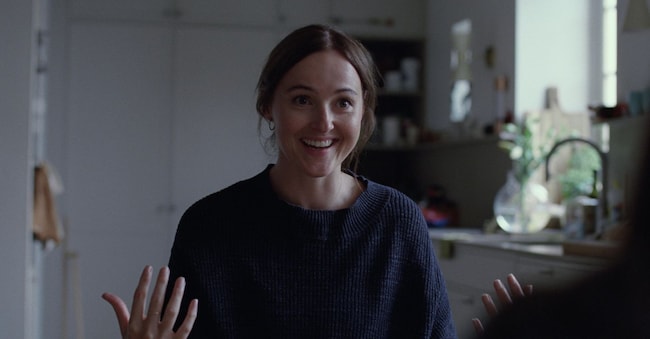
Not that the feeling of "hereditary sensitivity" is an exclusively female feeling, but both directors, who are generationally close - Trier, 51, and Schilinski, 42 -, felt the need to reveal it through female protagonists. It means that there is a common feeling, also shared by the Cannes jury, led by Juliette Binoche, who felt the need to award these films. Trier expressed himself through a very special actress like Renate Reinsve, who plays Nora (from A Doll's House?), an established theatre actress. The film begins with a look at a wooden house in Oslo, where she and her beloved younger sister Agnes grew up. Every place in that house has built a piece of her persona: the stove that sent her back to her psychoanalyst mother's patient conversations, the empty rooms when her father abandoned them, the back room from which she escaped when she was late or when she wanted to evade an obligation. It is also the place where her paternal grandmother left an indelible mark in her father's grief and, by inheritance, in Nora.
The value of feelings or the value of environments
The value of feelings or the value of environments. This is also what Schilinski translates to us, who, with a mobile and wild camera, tells the story of four girls who spend their youth, at different times over the course of a century, on the same farm in northern Germany. We move from Nazism to the present day, in the midst of the Cold War, where the ever-changing house is located in the East. Between ghosts and obligatory paths, mistakes and impulses, the four lives end up mirroring each other and, at times, coming together. The film seems like a fall (falling, in fact) into an imaginative and phantasmal limbo, with codes, at times violent and tribal, in which echoes of the past continue to resound from the walls. It seems at some points a legacy of Haneke (The White Ribbon) and Malick (The Tree of Life). The small, formidable protagonist Alma, Hanna Heckt, is of considerable weight to the film's success.


