
Honda E-Clutch, how the new electronically controlled clutch that changes the way you ride goes

3' min read
3' min read
It has been 14 years since Honda introduced the Dct dual-clutch system, an innovative technology that over time has won over motorcyclists, so much so that today, in the models in which it is available, it equips more than half of the units sold. Now Honda is back to impress with a simpler, but decidedly revolutionary system, which we had the opportunity to test on the new version of the naked Cb650R, one of the two bikes (the other being the sporty Cbr650R) on which the Japanese manufacturer has decided to launch the new device.
The clutch is no longer a problem
.The use of the lever clutch is one of the automatisms that a person starting out on a motorbike has to learn: when starting off, it has to be dosed so as not to shut down the engine, it has to be pulled for each gear change, and at traffic lights or when queuing, it has to be kept pulled if you don't want to put it in neutral each time. The Honda engineers must have thought: "If all these operations were handled automatically by the bike, wouldn't it be a relief for the rider who would not see the pleasure of riding affected?". Those who do not like the Dct, in fact, complain about the sacrifice of having to delegate the shifts to the electronics, delegating some control of the bike (a debatable statement, we know: there is always the manual 'M' mode and the handlebar controls). The alternative solution found by Honda is called the E-Clutch and has the advantages of lightness and economy: it weighs 2 kg and costs 400 euros more (at the moment it is offered as an option; in the future it will also equip other Honda models).

How the E-Clutch works
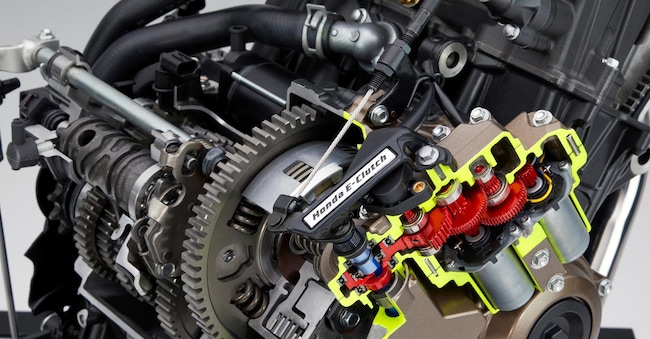
.In practice, it is an automatic system that makes it possible to start, change gear and stop with the engine running with the gear engaged without using the clutch lever (which is in any case present on the handlebar). The device is mounted on the right hand crankcase of the motorbike: two electric motors, controlled by the electronic control unit, manage the clutch actuation shaft, which is connected to both the engine and the traditional cable, allowing both electronic and manual operation. In practice, it is a middle way between a traditional transmission and the Dct, because the rider's intervention is always needed to downshift or engage gears, but it offers greater fluidity and speed in shifting than a manual and also an electronic quickshifter.
Our test
.In practice, the electronic E-Clutch is very simple: to start, once the gear is engaged with the gearstick pedal (without recoil, even when the engine is cold), all you have to do is give the throttle a little or a lot of gas, depending on the desired cue, and the bike performs a perfect clutch release, 100% eliminating the possibility of the engine stalling. In gear, simply raise or lower the gearbox pedal for quick, precise shifts and downshifts. The electronic management operates the clutch, cuts the fuel injection and controls the ignition to perfection. And, when you need to stop, you downshift and stop; the E-Clutch 'pulls' the clutch, so you stand still with first gear engaged. On a motorbike it sometimes happens, when travelling along a long straight stretch and with a red light 300 metres away, that you want to take advantage of the thrust by disengaging the engine; with the Dct the system downshifts the gears, always keeping the engine in traction: with the E-Clutch, on the other hand, you simply pull the clutch lever and 'sail' up to the traffic light, exploiting the bike's buoyancy. In fact, manual operation always takes priority over electronic operation to give the rider maximum freedom: the system deactivates and only becomes operational again when the clutch is released; a green light on the display shows when the E-Clutch is operational. Honda has also thought about the possibility of adjusting the contrast force on the gearstick pedal, depending on the force you wish to apply to both gear changes and downshifts (three levels: Hard, Medium and Soft).

