
Honda Wn7, how the Japanese giant's first electric motorbike looks and rides
The first electric model from the House of the Golden Wing is a naked with city DNA that does not disdain short trips outside the city

With 518 units registered in the first five months of 2026, the market for electric motorbikes is not exactly bubbling (scooters, to put it more clearly, numbered 2,464). And yet Honda has chosen to enter this segment with the Wn7 (the acronym stands for "Wind naked", while 7 represents the power delivery level on the Honda scale, which goes from 0 to 9), a model that is not a style exercise to sound out the market, but a true naked, designed to compete with medium thermals and the new electric players. With the newborn Honda wanted to translate its DNA into an electric key, maintaining proportions, ergonomics and everyday usability; it is no coincidence that the Wn7's chassis proportions derive from those of the sporty Hornet 750, softened to make the bike more comfortable and 'easy'.
What it looks like
The Wn7 is an eye-catcher, as we realised at traffic lights during our two-week test ride. The aesthetics are indeed successful, with the battery pack acting as a stressed member: the Wn7 does not have a classic frame, but has a steering column and rear frame - both in aluminium - bolted to the battery pack (there are no welds), a construction defined as 'frameless' by Honda. Also made of aluminium are the cradle that embraces the electric motor and the beautiful single-sided Pro-Arm swingarm that leaves the rim with its unusual design exposed. The Showa fork has 43 mm upside-down stanchions, while the monoshock is adjustable for preload. At the heart of the Wn7 is the liquid-cooled electric motor with 50 kW of peak power and 100 Nm of torque (there is a depowered 11 kW version for A1 licence), values that place it in the area of sporty medium naked bikes, although the power delivery is decidedly different, as we will see in the road test. With a power rating of 18 kW, however, the Wn7 can be ridden by A2 licence holders.
Weight in running order is around 217 kg, which is not light in absolute terms, but is compensated for by the mass distribution typical of electric vehicles, with a very low centre of gravity.
The battery pack is about 9.3 kWh, a choice that highlights the compromise between weight, cost and dimensions; the declared autonomy is up to about 140 km, but the real strong point is recharging: thanks to compatibility with rapid DC systems, the Wn7 can go from 20% to 80% in about 30 minutes, while a full domestic recharge (the Shuko cable is standard) requires between 2.5 and 5 hours depending on the system. This is a strategic choice: Honda has not focused on the huge battery, but on the 'rapid rotation' of recharging, bringing the concept of use closer to that of a thermal in daily use.
How's it going
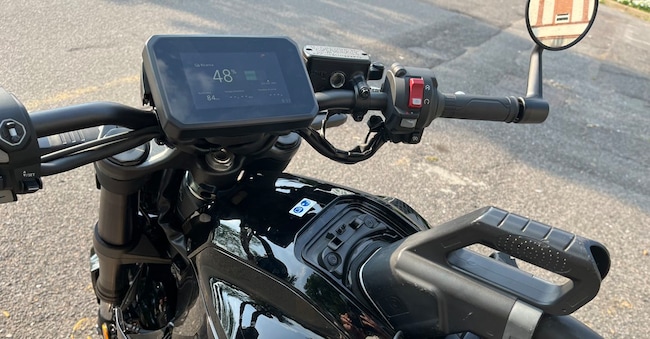
The Wn7 is a very compact motorbike: the seat (with rather hard padding) is 800 mm from the ground, but the narrow sides allow everyone to put both feet on the ground. Trying an electric motorbike is an experience we recommend to all motorcyclists, because it marks the entry into another way of riding, in which silence reigns. Already the start-up is a revolution: you press a button on the left side of the bike, pull the front brake lever and press a button; the only clue that the bike is ready to go is the word 'Ready' in the 5-inch tft display with which you also manage turn-by-turn navigation and see average and instantaneous consumption, speed, residual range and recharging time. The only thing to do, since everyone else will not hear you coming, is to pay more attention to the traffic, although this is already a common practice now that - let's face it - motorists are generally acoustically distracted.

