Cars

Hongqi EHS4: the Leapmotor B10 gets a premium makeover – it costs more, but what does it actually offer?

The new electric SUV from the Chinese brand FAW, distributed in Italia by EMC Auto, was unveiled in Venice. It shares the same architecture as the Leapmotor B10, with a 218 CV motor and a battery pack of almost 69 kWh. The higher price, a distribution network that still needs to be consolidated and an unconvincing launch campaign raise questions about the brand’s European strategy.

7' min read

Translated by AI
Versione italiana

7' min read

Translated by AI
Versione italiana

Venice has a centuries-old connection with China, dating back to Marco Polo’s travels and trade along the Silk Road. It provides an evocative setting for the launch of the Hongqi EHS4, the new electric SUV from the premium brand of the state-owned FAW Group. Less convincing, however, is the choice of the lagoon as the setting for a car launch: a prestigious location, but one ill-suited to allowing journalists to fully assess the driving dynamics of a product that aims to win over European motorists.

Hongqi means ‘Red Flag’. Founded in 1958, the brand has been manufacturing limousines for China’s political leadership for decades. This is a significant historical legacy, though it does not automatically translate into brand recognition or commercial prestige in Europe, where Hongqi remains virtually unknown to the general public.

Loading...

The manufacturer claims to have a strategy summed up in the slogan ‘In Europe, Understanding Europe, For Europe’. But to gain a real understanding of its ambitions, it is best to start with the car itself.

Hongqi EHS4: 218 CV, 470 km range and LFP battery

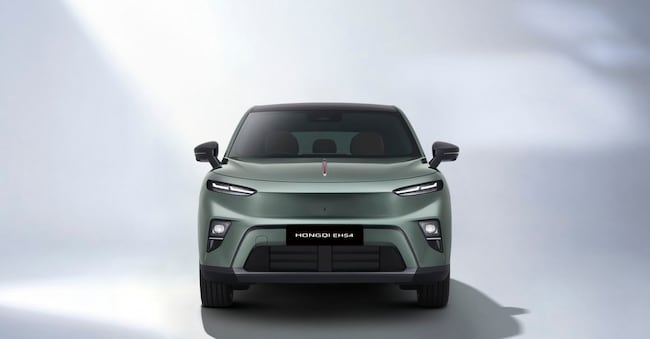
The EHS4 is a 4.54-metre-long electric SUV, characterised by clean lines, slim headlamps and a red decorative element on the bonnet that reflects the brand’s identity.

The interior follows the minimalist design now common among Chinese electric cars: an 8.8-inch digital instrument cluster, a 14.6-inch central screen and very few physical controls.

The rear electric motor produces 160 kW, equivalent to 218 CV, and 240 Nm of torque. The 68.9 kWh lithium-iron-phosphate battery provides, according to figures released at the launch, a range of up to 470 kilometres. Fast charging from 30 per cent to 80 per cent takes 18 minutes under optimal conditions.

Features include seven airbags, driver-assistance systems, 360-degree cameras and a Yamaha audio system with twelve speakers plus a subwoofer. The manufacturer also highlights the contribution of its design centre in Munich and the chassis tuning tailored to European requirements.

Interesting features, certainly. But the real question is how much of this product is actually new.

The partnership with Leapmotor: two brands, the same technical platform

The EHS4 is the result of an industrial partnership between FAW and Leapmotor, which began in 2025 and was subsequently strengthened by the state-owned group’s acquisition of a stake in the Chinese manufacturer.

The platform is based on the LEAP 3.5 architecture used in the Leapmotor B10, with which Hongqi shares many of its key features.

Loading...

The power output of 218 CV and the torque of 240 Nm are identical, as is the rear-wheel-drive layout. The batteries have virtually the same capacity, at around 69 kWh. The two displays in the cabin are also the same size.

The B10 claims a WLTP range of 450 kilometres, compared with the Hongqi’s 470. This is a modest difference, which is not enough to demonstrate technological superiority. The claimed charging time from 30 per cent to 80 per cent, however, is identical: 18 minutes.

Changes have been made to the front end, certain bodywork details, the interior customisation and specific equipment. The Yamaha sound system is a standout feature, but the Leapmotor B10 Design also comes with twelve speakers, heated and ventilated front seats, a panoramic sunroof and a wide range of driver-assistance systems.

Hongqi also offers a five-year or 100,000-kilometre vehicle warranty, compared with Leapmotor’s four-year or 100,000-kilometre warranty: a small consolation for a customer who certainly cannot rely on the extensive coverage of the Stellantis service network.

Platform sharing is an established industry practice and does not in itself constitute a limitation. However, when a product is marketed as ‘premium’, differentiation must be evident in perceived quality, materials, comfort, dynamic tuning and the overall experience. These are areas in which the static presentation in Venice failed to provide sufficient evidence. It is unlikely that colleagues who had the privilege of testing it (we were not offered this opportunity) would have noticed any substantial differences compared with the already familiar B10.

Prices: the premium surcharge remains to be proven

In Italia, the Hongqi EHS4 is available in two trim levels: the T1 at €35,900 and the T2 at €37,900. The launch offers reduce the prices by €3,000, to €32,900 and €34,900 respectively.

The Leapmotor B10, with a 68.7 kWh battery, starts at €33,400 for the Life version and rises to €35,400 for the Design version. The Hongqi price premium is therefore €2,500 on the list price, when comparing the respective trim levels.

Taking into account the promotions announced in November, the difference can be as much as 4,500 euros, although the terms and conditions must be assessed on a case-by-case basis.

The problem is not that Hongqi is asking for more. It is that, at least based on the specifications that have been disclosed, there does not appear to be a commensurate increase in technical features or equipment.

The brand’s historical prestige in China cannot automatically be transferred to a market where consumers are unfamiliar with it. And a premium positioning cannot be established simply by charging a higher price for a product that is essentially the same as others.

The Stellantis paradox: an ally’s technology powers a competitor

The story takes on an even more interesting industrial dimension when one considers Stellantis’s role. The Italian automotive group holds a stake of around 21 per cent in Leapmotor, following an investment of 1.5 billion euros, and holds a 51 per cent stake in Leapmotor International, the joint venture set up to expand its presence in overseas markets.

Leapmotor, however, retains its industrial independence and also collaborates with FAW, which has become a shareholder.

The result is that a technology developed by a strategic partner of Stellantis is being used to market, via an independent distributor, a car that competes with the B10.

A paradox only at first glance. The widespread adoption of Leapmotor technology can generate economies of scale and benefits for all shareholders. On the market, however, the two cars inevitably end up competing against one another.

And it is not out of the question that this competition could work in Leapmotor’s favour: the Hongqi, which is more expensive and technically very similar, could make the B10’s value for money even more apparent.

The situation could become even more complicated. According to reports from Reuters, FAW has also been exploring possible European production partnerships with Stellantis. These are industrial discussions, not a production agreement that has already been finalised.

Sales network: Leapmotor has a head start

For a car brand that is still relatively unknown, distribution and, above all, after-sales service are crucial factors.

In Italia, Hongqi is imported exclusively by Eurasia Motor Company, a firm headed by Federico Daffi, in which the Intergea Group holds a 50 per cent stake.

EMC Auto reports a total network of 93 dealerships and 209 authorised sales and service outlets, spread across 80 provinces. However, this refers to the importer’s entire sales organisation, not the network specifically dedicated to Hongqi.

The latter is still at the development stage, with an initial network of around fifteen dealerships planned.

The comparison with Leapmotor is telling: as early as February 2026, the brand reported 125 sales and service outlets in Italia and over 800 across Europe, benefiting from its integration into the Stellantis commercial ecosystem.

This difference has an impact not only on the ability to view and purchase a car, but also on customer confidence in after-sales services: maintenance, the availability of spare parts and the handling of warranties.

Hongqi has announced the CARE365 customer care programme and an ambitious expansion of its presence in Europe. However, to assess its true competitiveness, it will be necessary to distinguish between the announced objectives and the geographical coverage actually available.

An evocative presentation, but one that left too many questions unanswered

The launch in Venice certainly provided a spectacular setting. The manufacturer also spoke about the Discovery Tour, a European journey of around 3,000 kilometres with stops in Munich, Paris, Milan, the Dolomites and Venice.

A useful initiative to demonstrate a focus on the European market. Less effective, however, was the choice of a city where cars are not allowed on the roads to unveil a model for which it would have been important to assess comfort, soundproofing, road handling and how it actually differs from the B10.

The commercial announcement has raised further questions. For Italia, monthly instalments of 299 and 329 euros have been announced, with a nominal annual interest rate (TAN) of 6.49 per cent. However, the presentation did not specify the down payment, the term of the loan, the number of instalments, any final lump-sum payment and, above all, the annual percentage rate (APR).

Without this information, it is not possible to assess the actual cost of the transaction or to compare it properly with other offers. Simply stating the nominal annual interest rate (TAN) does not, in fact, cover all the charges that make up the total cost of the loan. Will they be more precise in their marketing communications? Certainly they will – not least because the law requires it!

Even the press material distributed in Venice seemed rather sparse given the ambitions of the launch: the materials were predominantly descriptive and commercial in nature, insufficient to properly contextualise a ‘completely’ new product or to systematically clarify the engineering and equipment differences between the EHS4 and the B10, as well as the details of the Italian range.

For a brand seeking to build credibility in a mature and competitive market, this is precisely the information it needs.

A challenge that hinges on credibility

The Hongqi EHS4 is by no means a substandard product. It offers a modern platform, decent performance, a battery with an impressive capacity and a competitive range of technology features.

The point is quite another: much of this functionality is already available on the Leapmotor B10, at a lower price and through a more established sales network.

Hongqi will have to prove that the higher price tag is justified by superior quality, better service and/or a genuinely different driving experience. For the time being, the launch in Venice has mainly highlighted the brand’s ambitions, leaving little room for the evidence needed to back them up.

The beauty of the lagoon is beyond question. The added value of the EHS4 compared with its industrial counterpart, however, remains to be seen.

Copyright reserved ©
Loading...

Brand connect

Loading...

Newsletter

Notizie e approfondimenti sugli avvenimenti politici, economici e finanziari.

Iscriviti