Climate

Tornado and hailstorm: Cremona brought to its knees. Damage to 10 churches and 10,000 cars

The fifth heatwave of the summer has reached its peak. Over the weekend, the whole country will see a drop in temperatures

by Pietro Menzani

Aggiornato il 29 agosto alle 10.15

Aggiungi Il Sole 24 Ore
ai preferiti su Google
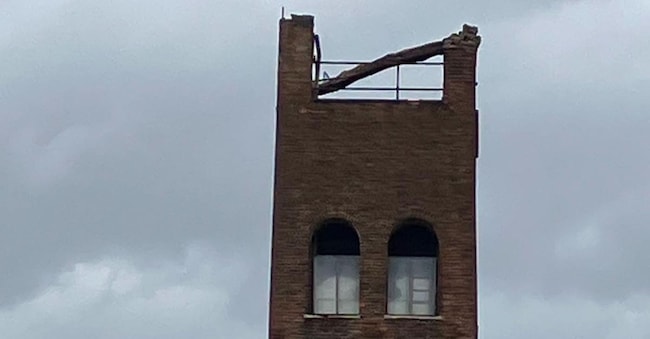
Danni provocati da una tromba d'aria che si è abbattuta nel                  pomeriggio su Cremona, con grandine e forti raffiche di vento. Danneggiati anche il                  Duomo e il Palazzo comunale. Sono crollati la copertura di una                  guglia della Cattedrale e il tetto della torre civica del  municipio. Cremona 28 agosto 2026. CR1  ANSA

4' min read

Translated by AI
Versione italiana

4' min read

Translated by AI
Versione italiana

The subtropical high continues to scorch the country. In Sicily and Sardinia, temperatures have reached as high as 45 degrees, with some mathematical models not ruling out extreme peaks of 48 degrees. In Calabria, Puglia and Campania too, thermometers are showing readings well above 40 degrees, whilst 39 degrees are forecast for the capital. These are the effects of the fifth heatwave of 2026, which has hit the centre and south of the country with particular intensity, whilst the north-west has been spared, to some extent. Over the weekend, however, according to forecasts from iLMeteo.it, the situation is set to improve slightly.

Tornado hits Cremona; the Cathedral and Town Hall also damaged

Cremona has been left scarred following Friday afternoon’s tornado accompanied by hail, which, in the space of 10 minutes, kept the fire service busy with a hundred call-outs and mobilised civil protection volunteers. More than forty people have been confirmed injured: none are in a serious condition. Dozens of houses and buildings have had their roofs torn off, and at least eight families left homeless have been evacuated from their homes. The stability of other buildings will need to be assessed. At least ten churches have been damaged, starting with the cathedral. Thousands of trees have been felled and at least ten thousand cars have been damaged by the hail.

Loading...

Red stickers

Bari, Cagliari, Campobasso, Catania, Latina, Messina, Palermo, Reggio Calabria and Rome. These are the nine cities currently under a ‘red alert’ – the highest level of heatwave warning – which indicates an emergency situation with potential adverse effects on the health of both at-risk groups and healthy, active people. The municipalities in question are all located in central and southern Italy, confirming that the situation is most critical in these areas.

There are also numerous orange alerts today, found in Ancona, Bologna, Bolzano, Civitavecchia, Florence, Frosinone, Naples, Perugia, Pescara, Rieti and Viterbo. Brescia, Genoa, Milan, Venice and Verona are on yellow alert, whilst the alert level remains at zero – and therefore green – only in Turin and Trieste.

The situation is expected to improve over the weekend, however. On Saturday 29 August, there will be six cities on red alert (Bari, Catania, Messina, Palermo, Reggio Calabria and Rome), and on Sunday 30 August, only four will remain on red alert, with Rome and Bari returning to yellow. Over the weekend, the number of ‘green’ zones will also rise sharply: there will be eight on Saturday, and on Sunday this figure will double, reaching 16.

The Fifth Wave

According to Lorenzo Tedici, media manager at iLMeteo.it, from a meteorological point of view, today could go down in history as one of the toughest days ever for much of the country. With September just a few days away, the heatwave shows no sign of letting up, with temperatures a full ten degrees above average.

Tedici explains that ‘three extraordinary events will turn this date into a veritable manifesto on climate change’. Firstly, yet another super-tropical night with minimum temperatures above 25 degrees across almost the whole of the South, along the central coast and in Romagna. During the day, then, until late afternoon, temperatures reached ‘levels typical of the Algerian hinterland’, with peaks well above 40 degrees in various regions of central and southern Italy. Finally, whilst much of the peninsula will be scorched by record-breaking heat, ‘the north will experience the violent flip-side of the accumulated energy. Severe thunderstorms will sweep across the Alps, starting in the western sectors before moving towards the Triveneto region, with sudden downpours that will also extend into the high Po Valley plains north of the River Po’.

The improvement over the weekend

Tedici, however, forecasts a ‘welcome’ drop of 3–4 degrees in the maximum temperatures expected for Saturday in central and northern Italy. The drop will also reach the south, but only on Sunday. The fall in temperatures will therefore affect the whole of Italia over the weekend, albeit to varying degrees. According to iLMeteo.it, the greatest differences will be seen in Emilia-Romagna – where temperatures will drop from today’s 35–36 degrees to 32–33 on Sunday – and in central Italy, with temperatures falling by as much as 5–6 degrees between today and Sunday.

However, “we must not delude ourselves into thinking that summer is over: following the passage of a minor Atlantic disturbance in the very first few days of September, forecasts indicate that the relentless African high-pressure system will once again take centre stage”, concludes Tedici.

Extreme temperatures: Sardinia

The peak of the fifth heatwave of the year was therefore reached today. Among the regions hardest hit is Sardinia, where temperatures have reached record levels. In Cagliari, temperatures of 40.8 degrees were recorded, whilst in Jerzu, in Ogliastra, the mercury rose to figures as high as nearly 46 degrees (45.8).

Loading...

The situation is critical across much of the island’s eastern coast: 45.7 degrees in Bari Sardo, 44.9 in Osini and 43.9 in Tortolì. In Oliena, in the Nuoro area, where a daily record of 45.8 degrees was set yesterday, temperatures are just over 43 degrees, whilst in the south, Domus de Maria is recording 41.7 degrees. The figures, which have not yet been validated, were released by Arpas, Sardinia’s Regional Agency for Environmental Protection.

Copyright reserved ©
Loading...

Brand connect

Loading...

Newsletter

Notizie e approfondimenti sugli avvenimenti politici, economici e finanziari.

Iscriviti