
Houses, prices per metre rise more in the suburbs and 'out of town'
In the last 5-10 years, the biggest increases in value have been in the secondary destinations of the most dynamic cities for university and work. Services, schools and transport make the difference
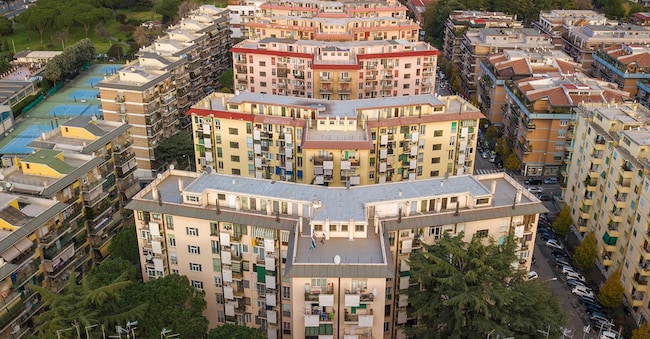
if in Italian cities, not only in Milan, prices per square metre of residential property are 'rejecting' - almost always 'look but don't touch' when the income bracket is not at the top - in recent years the greatest increases (not in absolute value but as leaps forward) have not occurred in the centre, but in the suburbs. Both in the first-tier areas, usually the 'out-of-town' or just beyond the ring roads that lap the centre (which is why it is also called semi-centre) and, in some cases, in the second-tier areas, a little further away from the historic core of the city. And this also explains the worsening housing discomfort even in areas that until ten years ago were able to absorb the middle class, young workers, families and students.
This is revealed by data from Scenari Immobiliari, which has photographed the 20 districts throughout Italia in which prices per square metre have risen the most in the last five years. Milan reigns supreme. It is followed by Rome and, at a distance, Florence, Turin and Naples.
In the last year alone, there has been a considerable leap in Bologna (with areas ranging from Saragozza to Via del Mille, but also more decentralised areas such as Corelli-Marcello and Scandellara-Spiraglio). While a summer survey by Wikicasa found that the manufacturing context has favoured attractiveness (and increases in prices per square metre) over the years even in medium-small towns such as Treviso and Bolzano. And in Modena, a city with zero growth in terms of population but with a dynamic property market, where the academic context is integrally linked to the automotive industry.
"In a country that is (and will increasingly be) affected by the demographic decline," explained Mario Breglia, president and founder of Scenari Immobiliari, "the cities that are attractive for their economic dynamism, academic liveliness and therefore attract incoming flows are winning. Over the past five years, in the sample districts, the average nominal increase has been around 40 per cent, the real value (the erosion of inflation) has been around 20 per cent, while the average Italian values for all residential property are +10 and -7 per cent respectively. It means that the national heritage is, on average, depreciating'.
However, adds Breglia, 'in the long run, if we look at the top 20 neighbourhoods over 20 years, it is interesting to note that the greatest increase in prices per square metre remains in the historical centres or in the most central areas, where identity and history are concentrated'.
Brand connect


Newsletter RealEstate+
La newsletter premium dedicata al mondo del mercato immobiliare con inchieste esclusive, notizie, analisi ed approfondimenti
Abbonati