Scenarios

How artificial intelligence will change the world of cycling

The use of A.I. in the two-wheel industry will soon involve the development of new products and production lines. This was discussed at the Fsa Bike Festival in Riva del Garda

by Giacomo Petruccelli

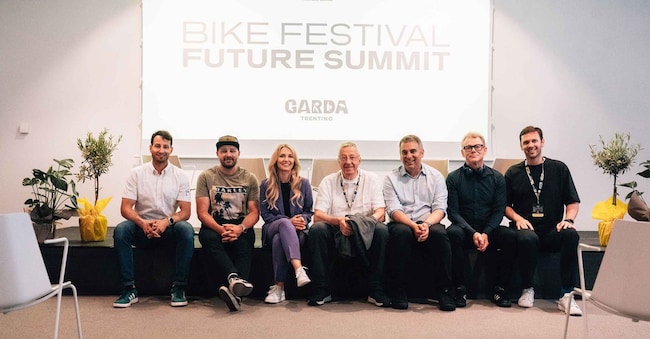
I relatori del Future Summit sull’intelligenza artificiale nell’industria delle due ruote

4' min read

4' min read

How can artificial intelligence positively impact cycling? This was discussed at the Future Summit, the pre-inaugural B2B event at the recent FSA Bike Festival Riva del Garda, one of Europe's leading mountain biking happenings that for 31 years has been the official opening event of the fat-wheel season.

The panel discussion, moderated by German sports journalist Petra Bindl, hosted a panel of speakers from the AI sector: Claudius Zick, former Amazon manager, Hannes Neupert, mobility specialist, e-bike pioneer and president of ExtraEnergy e.V. (among the world's most recognised non-profit organisations for information, consumer protection and the promotion of light electric vehicles), Andrea Ziliani, content creator and bike tester, and Ciro Malacarne, mechatronic engineer specialising in additive manufacturing, the industrial process that creates objects, layer by layer, from 3D models.

Loading...

From training programmes to Formula 1, the presence of AI in sport 

The fields of application of artificial intelligence in sport are manifold. Speaking of performance, for example, AI is one of the new frontiers of modern training. One only has to think of the use that can be made of an athlete's personal data (heart rate, power, cadence, hydration, hours of sleep, etc.) obtained from a simple sportswatch and analysed closely to monitor parameters such as rest, daily stress and approach towards the target race, and to construct specific tailor-made training plans that include all these factors that are fundamental to the success or failure of a performance.

In cycling, artificial intelligence has already been around for a couple of years. Teams like the Ineos Grenadiers, for example, use it to do aerodynamic tests and predictions on race courses. Or, as in the case of mathematician Vittoria Bussi (who a few days ago, in Mexico, signed the new hour record by breaking the 50 km wall), to explore its use in the management of complex data that cannot be processed with classical statistical models. But in the list of sports that have started to use AI there is also NBA basketball, which derives innovative solutions from it to optimise ball-throwing techniques and, above all, prevent injuries. Nor are Formula 1 and sailing missing from the list, among the most complex and technologically advanced sports, where artificial intelligence is playing an increasingly significant role in the evolution of single-seater and boat performance and in the analysis of data and race strategies.

AI in cycling, from product development to safety 

The use of artificial intelligence in cycling could also involve the development of production lines in the near future: 'AI can be used from a product development point of view, although the impact is very limited at the moment. However, I think it is something that can change quickly. I think that in a couple of years there will be no new product on the market that hasn't taken advantage of AI to optimise its development, shorten it and achieve better results,' Hannes Neupert said during the Future Summit debate, also emphasising the importance and possible scenarios on the topic of safety, which, however, at this stage, still remain top secret: 'Currently, many companies are working on pre-development projects that are obviously secret, but certainly the safety of cyclists and the prevention of accidents is one of those topics that could have a great evolution with artificial intelligence.

And then there is the simpler but no less important issue of communication. Companies in the bike world work a lot with Asia. Thinking about working relationships where Europe and the Asian continent talk better with the help of artificial intelligence could make everything much easier. An example of this 'language factor' was given to the audience present at the Future Summit, who, in line with the theme of the round table, had access to a simultaneous translation entirely created by artificial intelligence. Through a QR code and a web App, in fact, all participants were able to listen in headphones (and in real time) to the translation in their own language or read it transcribed on the screen of their mobile device.

A sports tourism that began in the 1990s 

The Bike Festival Riva del Garda 2025 welcomed more than 80,000 visitors in four days (from 1 to 4 May) and more than 2,500 bikers engaged in the various races on the programme. Numbers that confirmed how the event, born in the mid-1990s from a vision, has in recent years become a reference point for sports tourism as well. Stefano Barbieri, an entrepreneur from Mantua who owns a historic ice-cream parlour in Riva del Garda together with his wife, told Il Sole 24 Ore: "The history of Riva del Garda is inextricably linked to sailing, but the Bike Festival has in a way replaced sports such as windsurfing in terms of importance. In 1994, during the first edition, I ran a noodle shop. I saw a group of bikers arrive looking for something to eat but they didn't want sandwiches or sweets. I offered them spaghetti and lasagne. They were enthusiastic. Here today, no one is surprised if at 11:30 p.m. the streets are deserted, because everyone knows that the next day, from 7 a.m. onwards, people will already be riding, climbing in Arco or trekking along one of the many trails of Garda Trentino. The Bike Festival has profoundly changed the concept of sports tourism in the Upper Garda region. Those who participate, then come back in June, July and August'.

Copyright reserved ©
Loading...

Brand connect

Loading...

Newsletter

Notizie e approfondimenti sugli avvenimenti politici, economici e finanziari.

Iscriviti