
How the Camino de Santiago unites Europe and the world
From the Pyrenees to the Atlantic, 900 km in the footsteps of medieval pilgrims to the tomb of St James, among mesetas, vineyards and great silences

5' min read
5' min read
The path is the measure of all things. Of going and stopping, of solitude and breathing. If it is the Camino (one m, it is Spanish) of Santiago, all that remains is to set off, one step at a time, to the tomb of the apostle James. You can start from the Pyrenees, in Saint-Jean-Pied-de-Port, or from Seville, Lisbon or Irun, because all roads lead to Compostela, where, according to legend, between 813 and 830, the apparition of a star led the hermit Pelagius to the tomb of the saint, who in the 6th century - so the sources record - had been on a mission in the Iberian peninsula only to be beheaded by Herod once he returned to Palestine (44 AD). It was his disciples who buried him where he was later found, in the field of the star (Compostela, precisely), and where the bishop Theodomierus had a first church built in his honour.
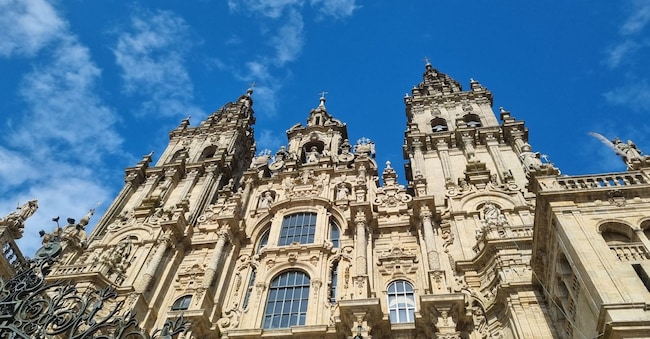
That church is the postcard that millions of eyes each year add to their memories, because setting off is an act of faith, the need to embed pieces of life or see the effect it has. The Camino Francés is the most classic one, the historical one, from the Pyrenees to the Atlantic, 800 kilometres, and another 100 to the Ocean to collect the scallop, the 'concha de romeros', symbol of St James. The rucksack must be enough for a little over a month and on the first stage, towards Roncesvalles to climb the Pyrenees, it makes itself felt. We are in Navarre, from Pamplona to Puente la Reina, where 'todos los caminos se hacen en uno solo' (all the paths become one). Every day a new hostel, a new bed, a new café con leche, new encounters, all of Europe is represented but by now Santiago is an international star and is United Nations of Caminos: at dinner you listen to Irina from Moscow and Darya from Kiev talking, or Joy from Taiwan and Kim from Shanghai planning the next stage. Politicians would have a lot to learn if they listened to the travellers and their desire for peace.
On to Logroño and Santo Domingo de la Calzada, where in the cathedral there are still some white roosters celebrating the miracle of the hanged man, also recalled by the sweet ahorcaditos (literally, the hanged men), to arrive in Burgos, luminous in its cathedral that welcomes El Cid, hero of Spain, and his wife Doña Jimena. La Rioja is vineyards as far as the eye can see and the 180 kilometres of mesetas remain the most introspective part of the journey. On the other hand, Peter, a 60-year-old London insurer, emphasises many times that 'in each of us lives a monk'.
In the mesetas, San Nicolás de Puente Fitero is worth a stop: here the Brotherhood of San Jacopo runs the chapel that has become a dormitory and refectory. Time stands still and Eduardo reminds me that 'the most difficult path is the one that goes from the head to the heart'. Nothing ahead, only silence and the certainty that every horizon admits the impossible. And we are the impossible that becomes life and arrives in León, founded by the Romans in 68 AD and immense in its Gothic cathedral that touches the sky. In front of these white peaks, Terri, an Australian from Brisbane, is moved: 'I had been thinking about the roads of Spain for years because I wanted to walk in history and culture. How often we forget our good fortune to be Europeans, nourished on bread and art. On the other hand, everyone walks the path they want and can. Antonio Machado wrote it best: 'Caminante, no hay camino, / se hace camino al andar' (Wayfarer, there is no path, / the path is made by going).
Some monumental towns and endless pueblos, with a few houses, small Romanesque churches (too often closed), the intense flavour of slow life and people offering you water or fresh tomatoes. After Astorga, we climb towards Foncebadón and the Cruz de Hierro, which rises on the heap of billions of pebbles carried over the centuries by pilgrims. The place is magical, and even Luna, a Greek from Athens, who has a certain familiarity with beauty, melts: 'I set out in search of me and every day I find wonderment galore that makes me serene'. The mountains of Léon are oceans coloured by cysts, heather and flowering broom, which would have pleased Van Gogh, as would the vineyards of the Bierzo. Before the summit of O Cebreiro begins Galicia, expanses of fragrant eucalyptus, chestnut trees and centuries-old oaks. The destination is 100 kilometres away and, after Sarria, many pilgrims without much motivation but also a beautiful person like Diana, who walks for herself and to make the Fondation Frédéric Gaillanne, which trains guide-dogs for blind children, known. Portomarín, Mélide, Pedrouzo and finally from Monte do Gozo the spires of the cathedral can be glimpsed. The yellow arrow pointing the way everywhere is no longer needed, because it is the sound of the gaita, the Galician bagpipe, that 'takes you by the hand' as far as Praza do Obradoiro. The Romanesque cathedral, dominated by the statue of St James, melts fatigue into tears and the Pórtico de la Gloria, made by Master Matthew between 1168 and 1188, is tears as well: in the centre is Santiago, on which Christ the Redeemer towers, and at the foot of the column, the root of the tree of Jesse, you can see the handprints. After the 2018 restoration, it is forbidden to lay one's own, but that shine reminds one of St Francis, who arrived here in 1214 and millions and millions of wayfarers after him. All that remains is to pray at Santiago's golden tomb and wait for the pilgrims' mass to witness the ritual of the Botafumeiro, the immense silver censer that blesses us all. And he also invites us to discover the city, a Unesco heritage site since 1985, among narrow streets, monasteries and churches. Without forgetting to visit Father Fabio, who is enveloping and profound: if all don were like that, the churches would certainly be fuller. Every day, he says mass for the Italian pilgrims in the Church of Santa Maria del Camino, which was the last one, in the Middle Ages, before the Cathedral of Santiago, and here the wayfarers promised to return again to the tomb of James: "Now you will return richer to your homes," says Father Fabio, "because along the Camino you have met so many people and so many different ideas".


