Technology

In Jeffrey Epstein’s emails: Jmail, the web-based project that allows you to explore the files

A new digital tool that organises and makes Epstein’s emails, photos, flight details and court documents accessible via an interface similar to Gmail.

2' min read

Translated by AI
Versione italiana

2' min read

Translated by AI
Versione italiana

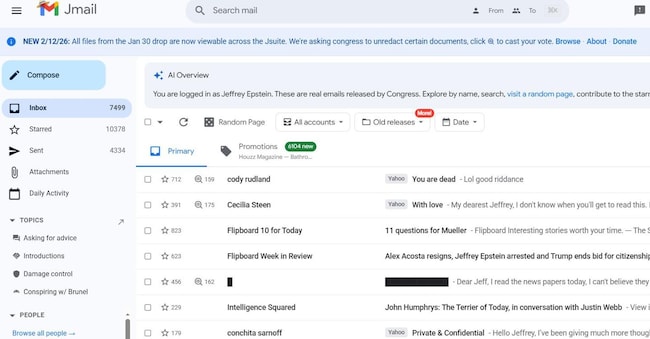
The interface is similar to that of Google Mail; the difference is that there is a ‘J’ instead of a ‘G’, and that this service allows you to browse through the correspondence of Jeffrey Epstein.

It’s called Jmail (CLICK HERE AND SCROLL THROUGH THE NAMES ON THE LEFT until you reach Prince Andrew) is the project created by Kino AI’s CEO Luke Igel and Riley Walz, a software engineer whom the New York Times has described as “the tech jester who mocks San Francisco”.

Loading...

Behind Jmail, however, there is more than just a taste for irony. For those familiar with the Google suite, the site looks just like a Gmail inbox: in the top right-hand corner is Epstein’s profile picture, and in the inbox are all the emails that you can view and search through, just as you would with your own email.

For every message you open, there is, of course, the option to download the original file. There is also a section that replicates Drive, the storage space, where all documents released by the US Department of Justice are available.

And a section for the photos, which can also be searched by subject: a feature that allows you to very quickly view the (many) photos of former President Bill Clinton and the (few) of the current President, Donald Trump, contained within the Epstein Files.

That’s not all: in the JFlights section, you can retrace all the flights mentioned in the documents seized from the paedophile financier, on JAmazon the purchases made on Jeff Bezos’s platform, on JeffTube the videos, and on Jotify an audio version of the interrogations, which, however, seems more like an artificial intelligence reading out the texts found in the archives.

A page Jacebook allows you to view images in chronological order, as on Meta’s social network, whilst jMessage displays the text message conversations Epstein had, for example, with the far-right strategist Steve Bannon.

For anyone struggling to make sense of this jumble of names, here is Jwiki, a portal modelled on Wikipedia that contains information on all the names mentioned in the files released by the US Department of Justice.

And indeed, the question of how to analyse this enormous volume of documents is currently a topic of public debate, particularly in niche communities such as those of developers and journalists.

In fact, there are several online projects dedicated to collecting and distributing these documents. Epsteingraph.com is a portal that allows you to view and download the documents using a search term; the portal epstein-docs.github.io, which also offers a series of summaries of the documents generated by artificial intelligence.

Loading...

In Italia, journalist Alberto Puliafito, editor-in-chief of SlowNews and editor of Internazionale’s AI newsletter, has announced that he is building an archive of the Epstein files using Pinpoint, a tool developed by Google for journalists, with the aim of making it publicly available. These are all attempts to make it possible to read these documents and uncover the secrets they hold.

Copyright reserved ©
Loading...

Brand connect

Loading...

Newsletter

Notizie e approfondimenti sugli avvenimenti politici, economici e finanziari.

Iscriviti