
How does Google's Lyria 3 music generator work? Here's our test
Google trying to make its way into AI music. Competition or ally for the musician of the future?

When technology advances, the human mind rejoices and trembles. While nobody forces us to leave our creative process, we have more and more people who are permanently incorporating artificial intelligence into their work. The idea of being able to accelerate certain phases appeals to me, but I still think that the direct confrontation with the producer on duty or physically getting on any DAW to realise the ideas that go through my head remain steps that I like to take. That is why I decided to write this piece: to explore how technology is changing the rules of the game, while remaining convinced that artistic intention is the essential ingredient for the whole production of a song.
Lyria 3: the technology engine under scrutiny
To see whether this artistic 'intention' can be replicated by a machine, we put Lyria 3, Google's latest model, to the test. The name, which recalls the Lyre of Apollo - the symbol of excellence of music for ancient Greece -, identifies a model capable of generating complete songs even from a simple image. Each creation, based on prompts or JPG files, also automatically generates video content. Both have a maximum duration of 30 seconds: crumbs, if we think of the lengths offered by competitors such as Suno or Udio. However, to test its structural limits, we subjected the algorithm to three stress tests aimed at verifying the presence of a real musical syntax; experiments based on specific visions that, with a common DAW, would take days to produce.
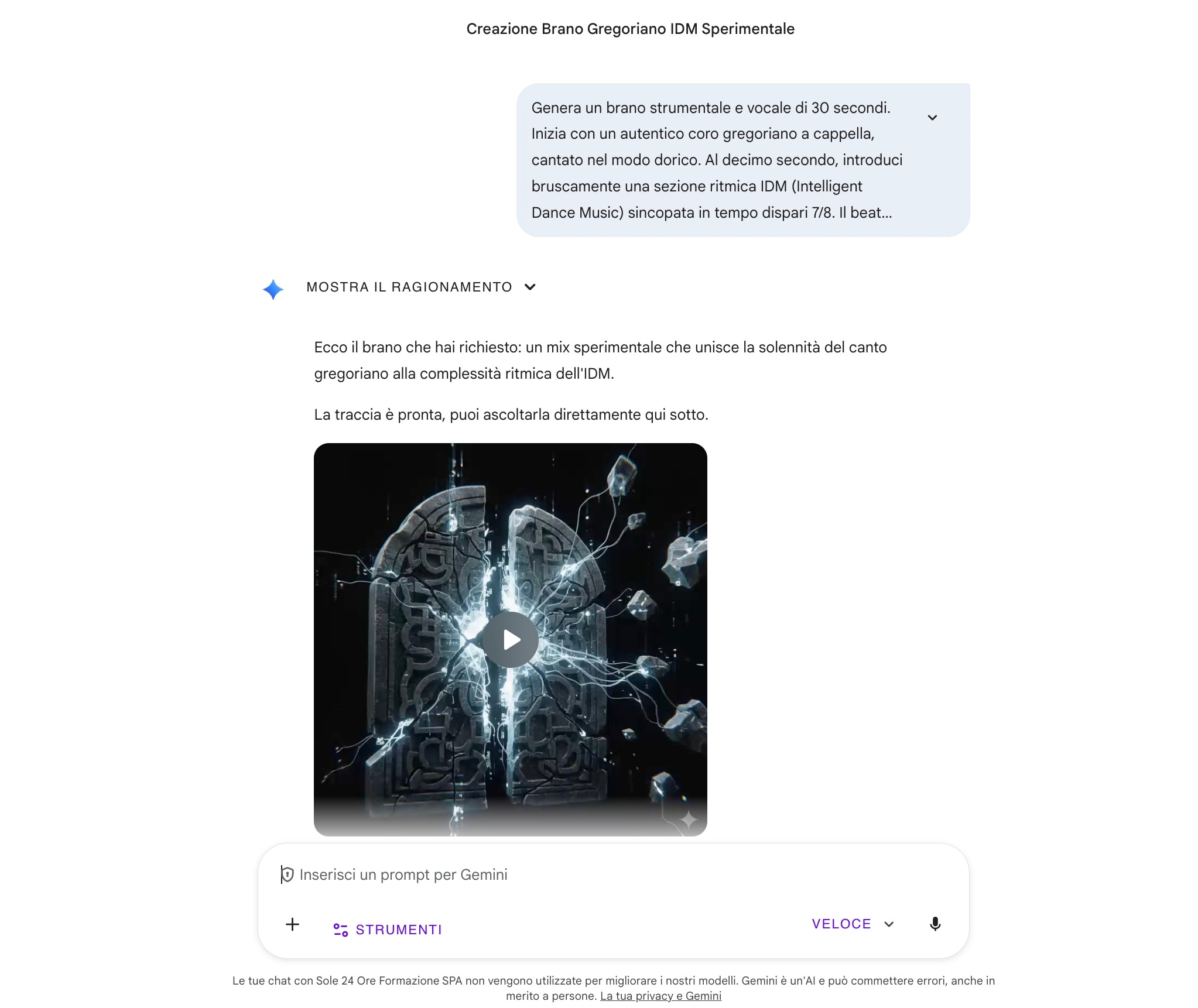
First test: the rigidity of the sacrum and odd time
The first test concerned the Middle Ages and the rhythm trap. We asked for a Gregorian chant in Doric mode fused with an electronic beat in 7/8. Lyria responded with millimetric precision, but although the odd time is mathematically respected, analysis of the timing reveals a clinical coldness. The timbre of the choir seemed very contrived, with no real amalgam between the various voices, an essential component for a choir. In essence, Lyria did the melodic 'homework', but failed to take care of the harmony.

Second test: the conflict between Baroque and Metal
The second challenge focused on Baroque and sound architecture. We requested a harpsichord fugue counterpointed by metal 'Djent' riffs in 5/4. Lyria demonstrated an understanding of the required Bach style, but again the harmonic part was a sin. The main instrument of the Baroque, the harpsichord, was lost in both timbre and harmonic counterpoint, while the Metal riff ended up swallowing the piece whole, leaving no breath for the seventeenth-century voice.
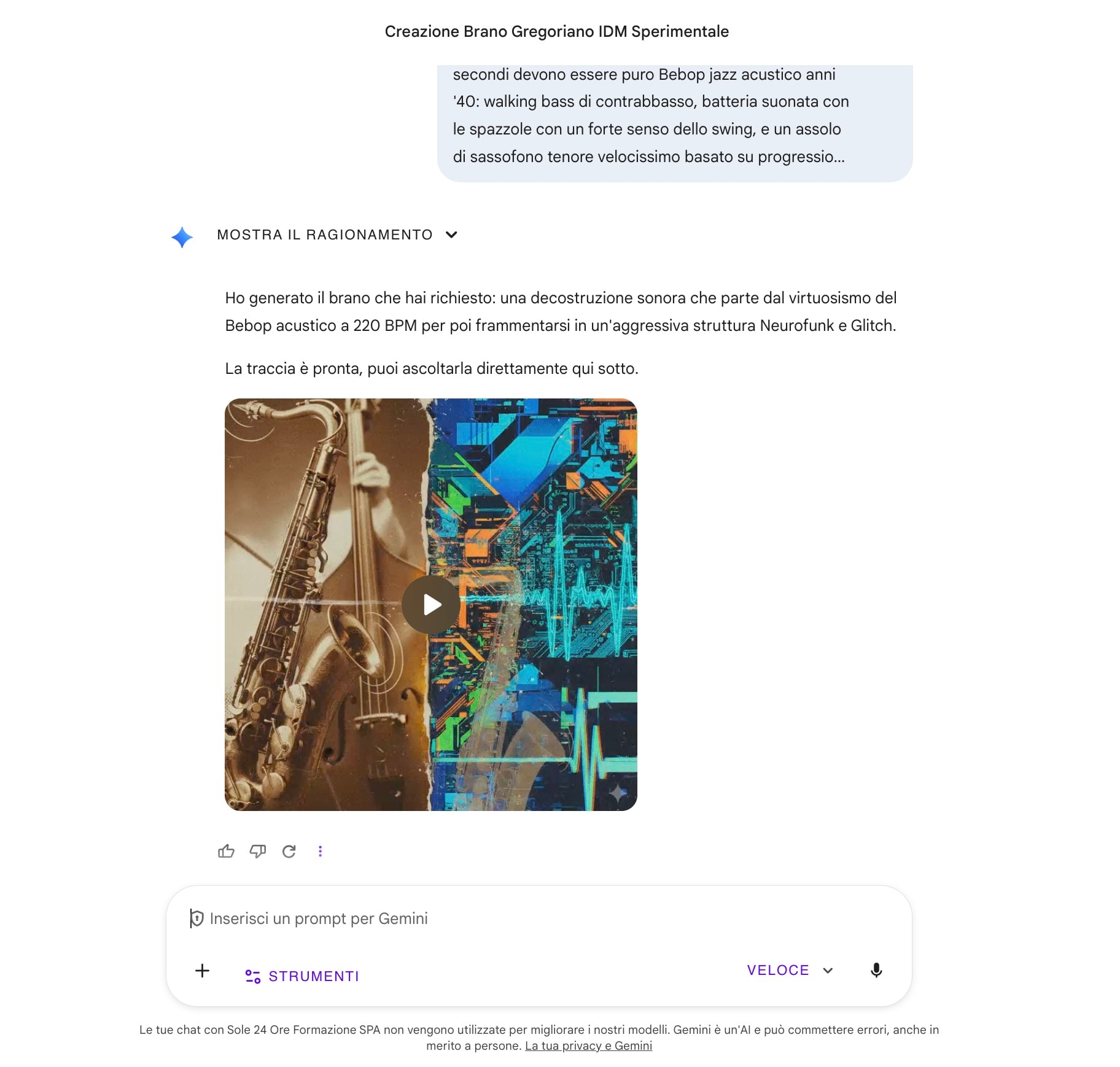
Third test: the lack of groove in contemporary jazz
Finally, we tested twentieth-century and missed 'Swing' through Bebop jazz at 220 BPM with a transition to Neurofunk. Although Lyria was able to generate 13th chords and fast solos, the swing appeared 'frozen' and the subsequent electronic part almost absent. We were confined to the Jazz world without being able to land in the funk world of bass and guitar.

