
How many hammers to build a dream
Simona Balducci is the first woman in charge of set construction at Cinecittà. With her team she has to translate a set into reality

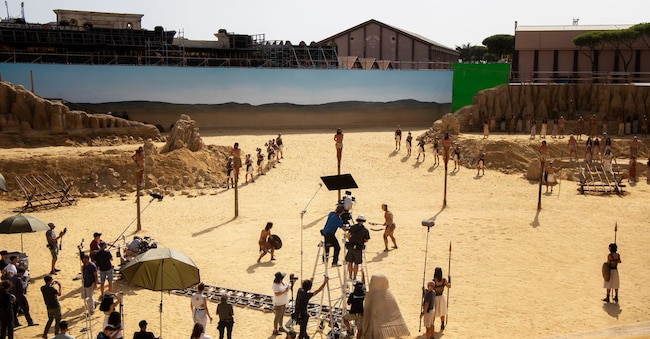
Never wipe fingerprints on the switches and better to leave dust on the shelves. On the sets of Cinecittà, many concepts are counterintuitive: the industry of dreams and shadows must cultivate the imperfections of life. To do this, behind the scenes, there is a very concrete machine: 32 people, including carpenters, painters, electricians, stagehands, assistants, warehouse workers, and machine maintenance workers, at whose direction since 2020 there is Simona Balducci, the first woman in charge of set construction.
The Forge of Cinecittà
Cinecittà has been and still is the home of thousands of films since 1937: here8½ and Amarcord, Ben Hur and Cleopatra came to life. But, above all, it is a cornerstone of the cinema industry in Italia today, chosen by international productions for its in-house professionalism - many studios only offer the sound stage - and for some avant-garde systems, such as one of the largest ledwalls in Europe, inaugurated by Angelina Jolie for Without Blood. Forty hectares in which there are 20 studios, which with the Pnrr have grown to 25. Twenty-five are also the metres in height of theatre 22, which, allowing the construction of imposing sets, convinced Mel Gibson to shoot in Cinecittà The Resurrection of the Christ, the sequel to The Passion, snatching it away from the flattery of the Maltese studios.
Simona Balducci's role
"Inside, there is a motorised trapdoor that makes it possible to build, for example, the cellar of a multi-storey building," Balducci points out. Twenty years earlier, for La finestra di fronte (Ferzan Özpetek, 2003), Teatro 10 had to physically excavate it. "We mix technical skills and safety - we are likened to construction sites - with an artistic vein of sensibility, flavours and material choices. In fact, Balducci's job is to translate the set designer's drawings into numbers and to be able to quickly find competent professionals for difficult projects. "First a budget is identified, then the number of weeks needed for realisation". In the case of Mel Gibson, the installation was finished six months before the original deadline.
Venusia's head
Over these complex magics and illusions at the entrance to the Roman citadel of cinema watches over the enormous black head of Venusia from Federico Fellini's Casanova, which was at home in the now restored Teatro 5. Mighty, in rain and sunshine, it fools the visitor: it looks stony but is made of polyurethane, forged by the Corradini company to a design by Giantito Burchiellaro in 1975. Not far away, there is the laughing Buddha from Martin Scorsese's Gangs of New York (2002) (set design by Dante Ferretti and Francesca Lo Schiavo) and the carriage of the fairy in Benigni's Pinocchio (2002). All signed Cinecittà.
Carpentry
The carpentry workshop, led by Paolo Perugini, is an airy room from whose windows the warm Roman light rains down: it is all a hissing of blades, buzzing, ticking, planing and hammer blows. Here plaster, wood, polystyrene, glass and resins are transformed into ancient frames and beams, mosaics, roof tiles, tiles, marble, engraved tombstones. Balducci, a 64-year-old architect, is the only woman - together with an employee in the painting department - in her department. She arrives at the building site at 7.30am like her craftsmen, since 1999, the year Cinecittà sucked her out of the opera house, to which she had come from David Zard's forge of great concerts. It starts every day from scratch, because every project requires the finalisation of a prototype. Behind this is a well-established manual skill, which is learnt on site, 'stealing' from those who know more and experimenting. "Our job is a bit like that of the tightrope walkers: you balance yourself to try not to fall".


