How much does investing in art and luxury pay today
There is no homogeneity of performance in collectibles, even though overall the numbers go back to 2025. Knight Frank's Wealth Report analysis

Key points
Considering them as investments, how much did collectibles at auction return in the four quarters of 2025? The summaryKnight Frank Luxury Investment Index (Kflii) closed last year with -0.4%. In spite of the minus sign, this is not a negative figure, but a recovering one: in the first quarter of 2025 it was -5.3%. As previous editions of the Knight Frank's Wealth Report show - this is the 20th - between 2020 and 2022 the index had marked its highest level since 2013 (19.1%), only to fall due to rising interest rates, which made it cheaper to allocate liquidity elsewhere. But looking at the long term, i.e. the last 10 years, the Kflii remains more than positive: +38.6 per cent.
(Very) erratic performance
The decline in returns on collectibles is, therefore, slowing down; but by crunching the average over the past year, a patchy distribution of performance emerges, with the obvious effect of US tariffs on certain asset categories. For example, the exploits of certain art sub-categories were counterbalanced by the meagre performances of contemporary art, collectible wine, prints and whisky.

Artworks on the rebound, but...
The least homogeneous segment is perhaps the art segment (but the vintage car segment is no joke either, as we shall see). One fact: sales in the over $10 million segment rose by 19.4%, further confirming the polarisation taking place in the art and luxury segment. The segments of Impressionist Art (sales +80.4%, to $1.04 billion), Modern Art (+19.4%, to $1.38 billion), Old Masters (+68.7%, to $282.5 billion) all performed well.
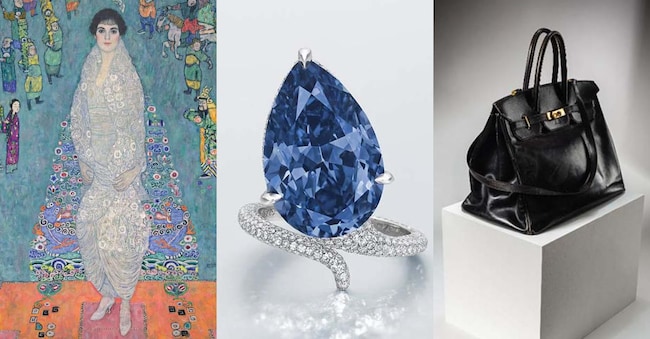
Collectors are willing to spend (a lot) only in the presence of: rarity, illustrious provenance, high relative value. The phenomenon cuts across all asset classes, but is particularly visible for art: from trophy works to the more affordable and properly priced segments. After the heavy post-2022 contraction, the Impressionist and Modern art segment in fact drove the entire segment, giving it an 11% growth of $4.56 billion in auction transactions. At the top of the trajectory was the top lot of 2025: the magnificent "Portrait of Elisabeth Lederer" (Bildnis Elisabeth Lederer) by Gustav Klimt (1862-1918); a $236.4m trophy work (Sotheby's New York, November), the most expensive Impressionist and Modern artwork ever at auction, and the jewel in the crown of the Leonard Lauder collection. This collection (which included other Klimts) was joined by others of equal lineage. Those of Pauline Karpidas (Surrealist art, which was released at the end of September: Magritte, Dorothea Tanning, Yves Tanguy) and of Jay & Cindy Pritzker (the same as the prestigious architecture prize: Van Gogh, Matisse and Gauguin), which was released at the end of November. But sales are still 42% below their 2022 peak, which had exceeded pre-pandemic levels, and the Contemporary art segment continues to contract for the fourth consecutive year (-12.3% to 1.6 billion). Finally, the specialised index MyArtBroker MAB100 reports that prices for prints and multiples fell by 6.6%. However, even in the mini-multiples segment, what Knight Frank's Wealth Report 2026 calls "conscious collecting", i.e. directed towards the big names, is on display: reference is made to Roy Lichtenstein and David Hockney, who were able to surprise with their revaluations at auction (the former even during a daytime sale at Sotheby's).
Automobiles: that Diablo of German fever. But the Red doesn't stand idly by
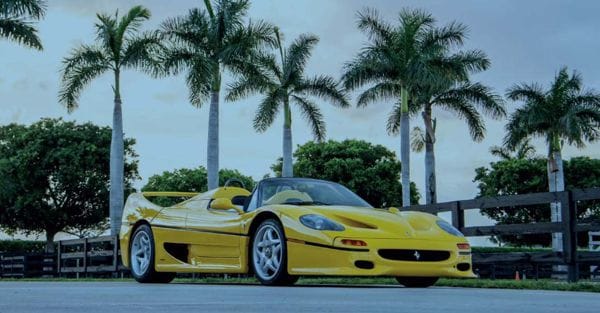
Turning to collector cars, the report shows the HAGI (Historic Automobile Group International) index at -3.7%, compared to +1.2% in 2024. Digging into the granularity of the sub-indices, however, one discovers that demand for BMW (especially for M3 E30 and 850 CSI; the HAGI BMW CI Index rose by 22%) and Lamborghini (especially for Miura Countach Diablo) increased during 2025. Moving into 2026, it turns out that in January a 1962 Ferrari F250 GTO was sold for $38.5 million, followed by a 2003 Ferrari Enzo for $18 million, not forgetting the 1995 Ferrari F50, which sold for $12 million (all three by Mecum on 17 January). A yellow 1996 Ferrari F50 stood out in 2025 ($9.2 million). A clear sign that US hnwi (high net worth individuals) and uhnwi (ultra high net worth individuals) are not holding tight to the purse strings if they move into territory untouched by tariffs. The US, in fact, where the largest global auctions of vintage cars are held.