How much energy does Ai consume? One Gemini prompt is equivalent to 9 seconds in front of the TV
Google comes out and proposes to the market a method to measure the energy footprint of artificial intelligence models. But is 0.24 Wh a lot or a little?

4' min read
4' min read
There are two questions that chatbots can never answer accurately and unambiguously: "Who told you, are you sure?" and "How much energy do you consume?". On the first two they are working on, but on the third we finally know something concrete.
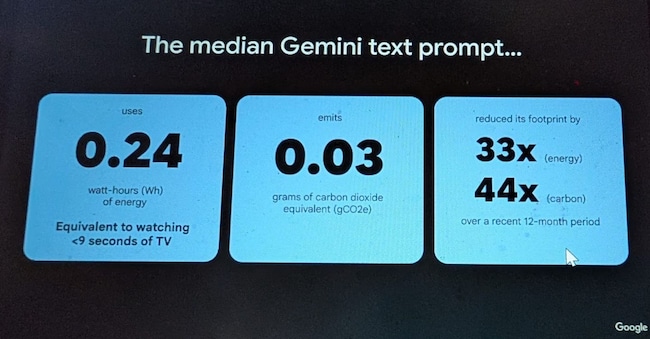
An average Gemini text query consumes 0.24 Wh and produces 0.03 grams of CO₂. This is comparable to the energy required to watch TV for less than 9 seconds. These estimates - much lower than other research from universities and research centres - were presented at a meeting for journalists to present a study on the environmental impact of AI queries, with a focus on the Gemini model.
This is the first time since the advent of AI in 2022 that Google has come 'out of the closet' with numbers. The reason, it was explained at the event, is also to help bring other AI providers such as Microsoft, AWS and OpenAI, which have so far never spoken out on their own power consumption, out of the closet.
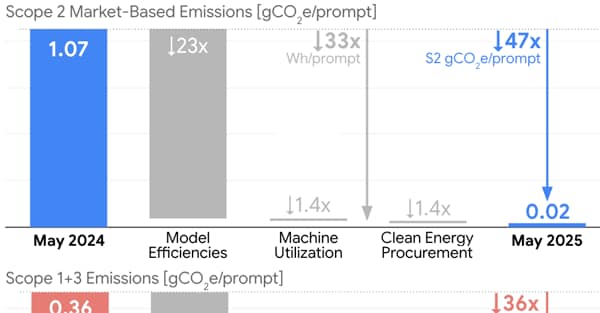
As Partha Ranganathan, Engineering Fellow and Vice President at Google, explained: 'To develop a comprehensive methodology and share the results, with the ultimate goal of encouraging industry-wide consistency in measuring the environmental impact and relative efficiency of AI inference'. The goal would then be to propose a standard shared with the AI industry.
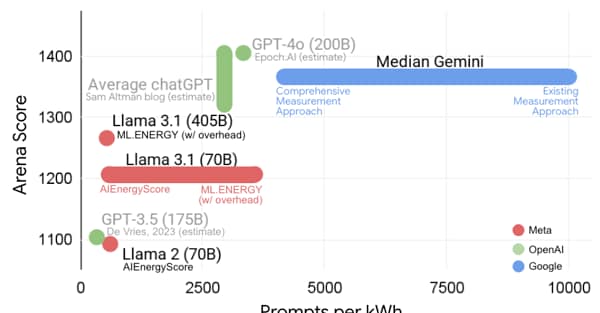
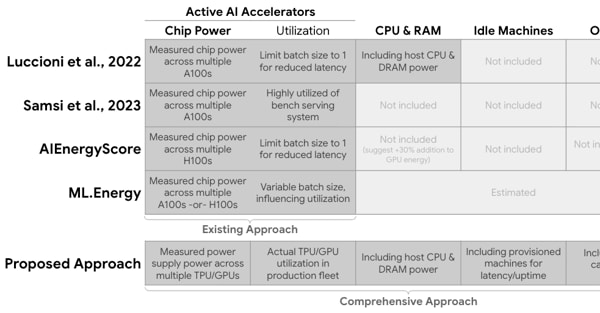
Many of the current calculation methodologies in the industry overlook several critical factors and do not take into account every level of the AI stack, from the underlying hardware and data centres to the model itself. To remedy this, Google has developed a comprehensive methodology that includes idle machine consumption, CPU, RAM, cooling and power distribution, not just chip power.