
Here is how the ancient village of San Bernardino is reborn
Located in the canton of Graubünden just under two hours from Milan, it is famous for being a spa and health resort
4' min read
4' min read
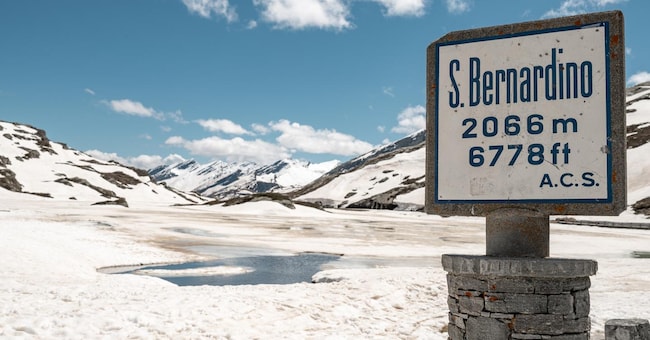
Peat bogs, fir and larch forests and lush flora provide an atmosphere you don't expect when you arrive in San Bernardino. The wet meadows surrounding the village are home to an extraordinary diversity of species, making it a true treasure trove of biodiversity south of the Alps. We are in that corner of Canton Graubünden that is perhaps less well known than the famous Saint Moritz, Pontresina, Davos and Arosa, but with a very ancient history, less than two hours from Milan, easily reachable by the road from Lugano to Bellizzona and Chur and up to the pass. It is precisely from this bulwark (the San Bernardino Pass is 2066 metres above sea level) that one of Switzerland's mountain roads has a centuries-old history, since it was frequented as early as the Middle Ages, strategic for transit over the pass. The Romans took advantage of this passage to connect the Po Valley with the territories of the Roman province of Rhaetia, building a road that is still visible today. The road crosses a landscape at high altitude, with a mysterious character and dotted with spectacular small lakes and glacial streaks such as the magnificent Moesola mountain lake. But it is not the only one. When the landscape turns red in autumn, starting from the small hamlet of San Bernardino an easy route leads to the discovery of two enchanting alpine lakes, the small, bathing Lagh Doss and the Lago d'Isola, at the edge of which, in winter, there are cross-country skiing tracks and hiking and snowshoeing routes.
The original name Gualdo de Gareda, forest of healing, together with the discovery of wooden tubs and other spa objects dating back to Roman times, tells us a lot about the place. Here there are springs of water rich in iron, magnesium and sulphur already known and exploited in antiquity that have always made it a place of healing and wellbeing. This is why the name of the village, as evidenced by the beautiful late 15th century church that still exists, was dedicated to the patron saint of lungs, St Bernardine of Siena. The reputation of the village as a spa and tourism-oriented resort continued into the 1800s and even into the last century, when people from noble backgrounds went there attracted by the therapeutic qualities of the water. The high mountains and abundant snow made it a popular ski resort in the 1980s. But, although San Bernardino has many attractive features (nature above all, it is easily reached by direct motorway or train, the village is at an ideal altitude of 1600 metres and the slopes reach up to 2700 metres, so there is always snow) something over time has broken down. But now the village is about to experience a revolution that should lead it within a decade to become a green and environmentally sustainable tourist resort with a range of state-of-the-art services.
Recovery green
.The San Bernardino Swiss Alps Group has been working for a year on a project to rehabilitate existing structures (ski lifts, hotels, housing, etc.) and to expand real estate that will transform the face of this resort..
"We are currently in what we call our 'phase 0', i.e. in the phase that has seen the first investments concentrated on restarting the ski facilities (already operational since last year), modernising and renovating buildings in the centre of the country," explains Flavio Petraglio, CEO of the San Bernardino Swiss Alps Group. - Atthe start of the next season (this winter) out of five open construction sites, three will already be completed. Five ski lifts have already been reopened and are in operation, four are in the Confin area and one ski lift more towards the centre. At the level of accommodation, we have a completely renovated Brocca & Posta hotel with 50 rooms, the Brocco & Posta Lodge (2 stars), i.e. larger rooms (doubles and triples) designed for a younger public, 35 of the 70 flats under hotel management under the name San Bernardino Alpine Apartments will be completed. We have started work on the Hotel Ravizza, which will be ready in a year. At the end of this phase we will have a total of 100 flats under management. We saw strong potential in San Bernardino. It is an easily accessible location, from Milan. It has a unique landscape and nature that makes it possible to exploit the location not only during the winter period but tend to do so throughout the year. The village is located at an ideal altitude of 1600 metres and the slopes reach up to 2700 metres. As a developer (San Bernardino Swiss Alps), we aim to create content within this potential, such as new sports facilities (for indoor sports as well), wellness and relaxation areas, recreational areas and the revival of summer sports. Our goal now is to create a point of attraction that is liveable and attractive throughout the year. The all while respecting nature as much as possible. At this zero phase, we have aimed at recovering the old and therefore have made investments aimed at restoring what was there. The zero phase saw a total investment of 80 million Swiss Francs. In total, the investment at the end of all phases will be 300 million Swiss Francs over a ten-year plan. A museum dedicated to its history, a spa and thermal centre will also be built. And the San Bernardino Mineral Spring should also be back in operation. Among the "green" projects is the construction outside the village of a car park with 600 parking spaces so that people can move around San Bernardino only by electric bus, completely eliminating the use of cars.


