Advice for students

How to prepare for the maths exam

The exam consists of solving one of the two problems set and answering four of the eight questions provided; the time allowed is 6 hours.

by Carmine Fiore

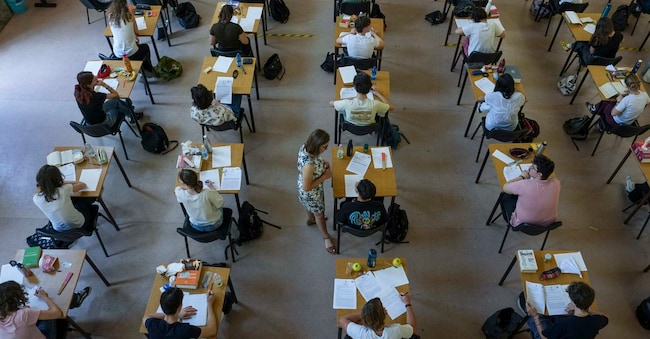
Studenti Liceo Tenca svolgono la prima prova delll’esame di Maturità 2026 , Milano (Italy) June 18, 2026 (Photo Claudio Furlan/LaPresse) LAPRESSE

4' min read

Translated by AI
Versione italiana

4' min read

Translated by AI
Versione italiana

The Ministry of Education, by Ministerial Decree 132026, has designated Mathematics as the subject for the second paper of the school-leaving examination for the scientific stream. The exam will take place on 19 June. Despite the recent changes introduced for the oral examination, nothing has changed regarding its structure: it consists of solving one of the two problems set and answering four questions from the eight provided; the time allowed is 6 hours. It should be noted that candidates must only complete the required number of problems and questions; any additional exercises will not be marked. The exam is worth up to 20 marks.

The aim of the second exam is to assess the skills, knowledge and abilities acquired by students throughout their secondary school education and is therefore not limited to the topics covered in the final year. In fact, the topics covered do not relate solely to mathematical analysis (the study of functions, differential and integral calculus) but also to topics from previous years. This is demonstrated by the consistent inclusion of questions relating to Euclidean geometry, analytical geometry in space, optimisation problems, probability and combinatorics. Naturally, as the subject in question is Mathematics, there will be no references to or questions on Physics.

Loading...

How to choose a problem and questions

Don’t panic or get anxious if, at first glance, the exercises seem ‘tricky’. To make the right choice, read the text of both problems carefully to interpret and understand every detail; highlight the information provided – not just the figures, but also the conditions and constraints set out in the question. Identify the topics the problem relates to and outline the procedure to follow and the strategy to apply for the solution. A careful reading will make the problem seem less complicated than it appears. Follow the same procedure when choosing which questions to attempt. Do not worry if this analysis takes a little time; it is better to make a careful and decisive choice than to rush into an exercise only to realise, whilst working on it, that it is more difficult than expected. This is a pointless and risky waste of time.

Which exercise should I start with?

Once you’ve chosen the problem and the questions, start with the ones you feel are most within your reach, so that you can relax and build your confidence. If you think it’s better to tackle the questions first because they seem easier, go ahead; you’ll approach the problem with greater determination and a calmer mindset.

Usually, the two problems are divided into several parts, and each part serves as a prelude to or is related to the next one. Often, however, the following point provides guidance on the previous one, so that the candidate can still continue with the exercise. Therefore, if you encounter difficulties in solving a particular point, carry on with the others and return to the previous point later, with a clearer mind and greater determination.

How it works

Once you have finished the problem or question, carefully check the procedure and the calculations you have carried out, in order to avoid transcription errors, typos or calculation errors. Also pay attention to the format and presentation of your work.

It is also essential to justify the choices you have made, setting out the various steps and referring to the theorems used. Be clear and rigorous in your explanations, and present your reasoning in a way that makes it easy to understand; any shortcomings in your reasoning could penalise you and have a negative impact on your mark.

Using the calculator

Using a graphing calculator effectively can help you check that your chosen method is correct; it allows you to plot the graph of the function accurately, providing a cross-check on the accuracy of your calculations and the consistency of the expected result. Of course, you need to familiarise yourself with using the calculator a few weeks before the exam: many functions are not immediately obvious, and on the day of the exam there will be no time to improvise. In any case, Mim Note No. 78833 of 16 March 2026 contains the updated list of permitted calculators.

Time management

Another key factor is time management. Organise the time available by deciding how much to devote to the problem and how much to the questions; bear in mind that each question takes an average of 30–45 minutes. As part of this planning, set aside sufficient time to copy out your work, review it and check that everything is presented clearly and neatly. Of course, if you realise that a question or part of a problem is taking longer than planned, move on to the next one and perhaps come back to it later. Take breaks between questions to take your mind off complex reasoning. Use this time to have a sip of water or a small snack to recharge and start again with a clear head.

How to prepare for the exam

To approach the exam with confidence, you need to draw up a revision plan covering the main topics covered over the five-year course. Trying to cram for two or three days before the exam will only serve to confuse you and increase your anxiety. Instead, start a few weeks beforehand, deciding which topics to revise in each week; prepare summary and review sheets. Go through and revise past papers from previous years and the mock exams you’ve done during your fifth year. Analyse the structure of the questions set and identify the most effective techniques for tackling them. Practise, in particular, on the types of questions set in previous years: the study of families of parameter-dependent functions; the qualitative analysis of graphs, which is fundamental both for deriving the analytical expression of a function and for deducing the graph of its derivative or integral; calculating the area of the finite region in the plane defined by the function; questions on analytical geometry in space, optimisation problems, probability and combinatorics; the application of theorems on differentiable functions, and so on.

It’s best to practise for the exam with a few classmates; comparing notes is always useful and helpful for gauging how well prepared you are. So avoid cramming the day before: it’s tiring and pointless; it’s better to take a break and go into the exam feeling calm and determined. Good luck to you all!

Mathematics teacher at the Liceo Newton in Rome

Copyright reserved ©
Loading...

Brand connect

Loading...

Newsletter Scuola+

La newsletter premium dedicata al mondo della scuola con approfondimenti normativi, analisi e guide operative

Abbonati