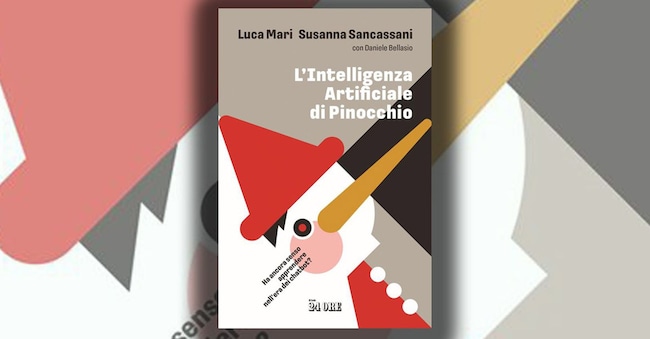
The book on newsstands with Il Sole from Saturday

Human learning in the AI era: from survival to well-living

Artificial intelligence challenges traditional motivations for learning, proposing training focused on adaptability and quality of life in a complex society

by Luca Mari

“L’Intelligenza artificiale di Pinocchio” di Luca Mari e Susanna Sancassiani, edito da Il Sole 24 Ore

4' min read

Translated by AI
Versione italiana

4' min read

Translated by AI
Versione italiana

Why devote our time and effort to learning, when there could be artificial entities more capable than us in generating and processing information, and eventually also in intervening effectively in the empirical world? Is artificial intelligence making human intelligence less and less relevant? We feel these questions are so radical because they capture a dimension that seems constitutive of our humanity: we are made to learn.

Unlike what happens to individuals of many other species, when we are born we have practically no specific skills, so that for many years the pups of Homo sapiens remain in a condition of dependence, which social development has prolonged. Yet our species has proven to be very effective in surviving in a competitive environment. It is plausible that the explanation for this apparent paradox lies in the evolutionary advantage that the ability to learn offers over innate specialisation: being born knowing how to learn to solve problems, rather than knowing how to solve specific problems, has made us adaptable. We have plenty of evidence that this produces important benefits, especially when living in a changing environment such as ours.

Loading...

And so we have incorporated this condition into the structure of human societies and in particular into the learner-learner relationship, in the various forms it has taken and continues to take.

In the past, the evolutionary advantage of learning was obvious: it increased the likelihood of individual survival and that of one's family/tribe together: without the acquisition of skills, even instrumental ones, to procure food, defend oneself from wild animals and so on, one was more likely to die. Reflection on how to live well and what one needs to learn to live well was already present, but only some individuals could afford to practise things, such as philosophy and art, that are not immediately functional to survival.

Industrialisation has changed the conditions of survival and for many people has replaced the goal of survival with the goal of well-being: we want to live well, in fact, as made possible by the tools our technology produces. And the fact that tools only function when activated or controlled by human beings, instead of completely autonomously, has generated a new social justification for learning: to make people capable of operating, maintaining and improving those producers of well-being that are tools. People learn not so much to produce what directly serves their own well-being, but to contribute to collective processes of value production.

The spread of increasingly sophisticated behavioural artificial intelligence systems leaves us with scenarios in which even this reason could lose its relevance. But then, if 'study you'll get a good job' is a motivation that may be less and less valid, what reasons remain for training?

A Unesco document suggests that the change brought about by artificial intelligence could be so radical as to challenge the very idea we have of humanity: 'The ability of artificial intelligence systems to perform tasks that previously only living beings could accomplish [...] gives artificial intelligence systems a new and profound role in human practices and society, as well as in their relationship with the environment and ecosystems, creating a new context in which children and young people can grow up, develop an understanding of the world and themselves, critically understand media and information, and learn to make decisions. In the long term, artificial intelligence systems could challenge humans' special sense of experience and capacity for action, raising further concerns about, among other things, human self-understanding, social, cultural and environmental interaction, autonomy, capacity for action, value and dignity" (UNESCO, Recommendation on the Ethics of Artificial Intelligence, 2022.

Intelligenza artificiale e professionisti, le dimensioni dello studio contano

In the Golden Age of the origins, there was no need for school and training, because the condition described by those myths is of human beings who live in harmony with nature, do not have to fight to survive, do not have to compete, produce, accumulate. Of human beings who understand the world without mediation and in fact know how to 'name things'. This intuition leads us to interpret the tension towards knowledge, which we see in children who playfully learn, as an attempt to recover an original unity between life and knowledge: we are born knowing how to learn because by learning we come closer to harmony, and therefore to a good life. Culture is what is needed to live well, but what is needed to live well is no longer obvious: it must be learnt. Therefore, society has organised itself to teach it. From this perspective, the literacy we need and which must become the goal of education is no longer merely functional. If we use artificial intelligence to build, and not to destroy, we may find that, in an increasingly complex society, the first objective of education is to teach good living.

Luca Mari, together with Susanna Sancassiani, is the author of the book 'L'Intelligenza artificiale di Pinocchio' (Pinocchio's Artificial Intelligence), on newsstands with Il Sole 24 Ore from Saturday 18 April.

Copyright reserved ©

Brand connect

Loading...

Newsletter

Notizie e approfondimenti sugli avvenimenti politici, economici e finanziari.

Iscriviti