
Human rights: at Fifdh the most beautiful stories of resistance and the most terrible denunciations
The true story of an Afghan child bride, an artist extraordinaire, who tries to arrive clandestinely in Europe, the struggle of the Banjima aborigines against asbestos, or the dockworkers of Genoa who refuse to take on board weapons are some of the most interesting films seen in Geneva
by Lara Ricci
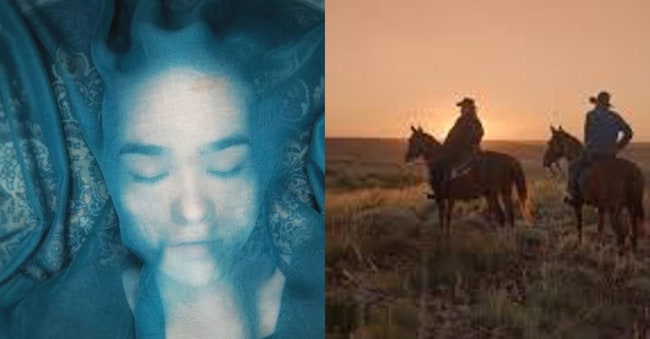
A girl films herself with her mobile phone during attempts to arrive illegally in Europe. We barely see her, in the darkness of a van where she is crammed together with many others. Someone shouts: "You are crushing my children!". Then they are abandoned on the side of a road, at night, in the cold. The first images of A fox under a pink moon are an unmediated testimony of what happens to those who try to cross our borders illegally. But what starts out as a crude documentary slowly allows a second narrative line to emerge, made up of the beautiful drawings and sculptures that the girl, Soraya, creates between escape attempts. Or from the mud bas-reliefs glued to the walls of a crumbling, bug-infested house in a no-man's-land between Turkey and Greece where human traffickers have left her. Works that depicta rich, colourful and welcoming world, sad, often, but full of warmth and tenderness, where one can take refuge when everything around collapses, as the fox does by coiling in its long tawny tail.
The chronicle is thus intertwined with fantasy, comparing the reality we suffer and the one we can imagine, which we could perhaps realise, in the splendid documentary by Iranian director Mehrdad Oskouei and Afghan artist Soraya Akhlaghi, a girlfriend of rare talent: she is barely 16 when she starts sending videos to Oskouei, lives in Iran with a husband who beats her, as did the uncle who raised her after her father died and her mother fled to Austria when she was 7. A mother of whom she is very nostalgic and whom she hopes to reach. A film that restores dignity to that "dark stain that crosses borders on maps and dissolves their shapes", as Derek Walcott called it in Migrants, and to all abused girls and women. Which brings before our eyes the inner richness of the women whom we did not let board the planes leaving Kabul in August 2021, whom we reject at the borders, whom we let sink into the sea, whom we accept die under a man's fists or a president's bombs.
The feature film that gives an account of the last five years of Akhlaghi's life, and also of his dreams, remotely realised by Oskouei from almost half a million videos, won the Grand Prix de Genève and the youth prize of the Festival of Human Rights Film and Forum (Fifdh) in Geneva, directed by Laura Longobardi and Laila Alonso Huarte. Ten days of screenings and meetings in conjunction with the UN Human Rights Council, in which a selection of the most recent films on humanitarian issues are discussed with highly qualified experts, while some of the invited guests can be received at the UN (Johnnell Parker, vice-president of the Banjima Aboriginal Community, star of Yurlu | Country, by Yaara Bou Melhem, a film about the Wittenoom asbestos mine in the native Banjima territory and the serious health and ecological damage that Australia refuses to acknowledge). At Fifdh, denunciation films were screened, but also films about resistance to imperative militarisation, the normalisation of hate speech, the crisis of mutilateralism, the repression and continuous erosion of individual freedoms, and authoritarian and technocratic drifts. For the first time in 20 years, according to a study by the V-Dem Institute, there are more autocracies than democracies in the world, said Alonso Huarte.
Set in Sudan, although shot elsewhere because of the conflict, the film that won the prize for fiction: Cotton Queen by Suzannah Mirghani. It is not about genocide, but - with irony and lightness - about an ancient war: a teenager stubbornly trying to defend her body from all those who want to marry her and claiming her right to fall in love (even with the wrong person). In the background, the colonial and neo-colonial violence - also represented by GM cotton, which does not give seeds and therefore generates addiction - and the fairy tales about her strong-willed, very old and feared grandmother who is said to have defeated the British. An award also went to Letters from Wolf Street by Arjun Talwar, an intimate tale of an Indian woman's emigration to Warsaw and the invisible borders erected by racism
Italia is also in the spotlight with two documentaries. One is the world premiere of Le cas Meloni, the Meloni Case, by Anna Bonalume and Jeremy Frey, a film that analyses the ascension to the presidency of the Italian Council, for the first time since the post-war period, of the representative of a party that originated in the neofascist movements, underlining the ambiguity, like a two-faced Janus, of its political discourse. The other is Portuali, by Perla Sardella, which films negotiations and strikes by some sindacalistas at the port of Genoa for a fair wage and a safe job, and which, as of 2019, also begin to concern therefusal to embark weapons for Yemen. Battles joined by one to convict the two men who attempted to rape Martina Rossi, the daughter of one of them, who fell from the sixth floor of a Palma De Mallorca hotel in 2011. A rough and powerful documentary that refuses spectacularization and succeeds in bringing due attention to trade union and political battles, but also to the intersectionality of the struggle.


