Humanoids versus exoskeletons: who will take the (working) place?
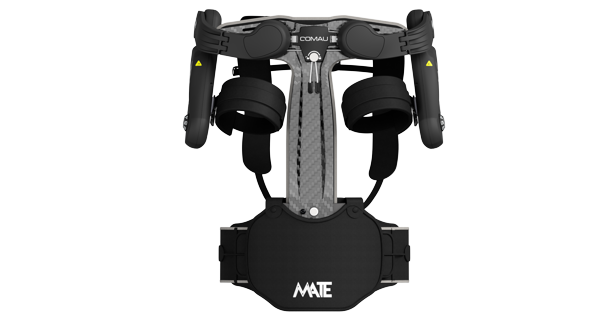
We tested MATE-XT GO, the new wearable exoskeleton designed by Comau to relieve the fatigue of manual workers.

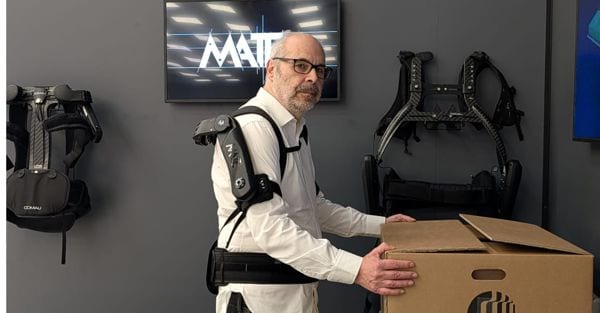
In the Grugliasco factory, robotic arms and industrial machines welcome you. While waiting to see humanoid robots with heads, legs and arms ready to welcome me here too, the mission is to see the link between man and robot up close. Very close up. So I wore and tested MATE-XT GO, the new wearable exoskeleton designed by Comau and presented a few days ago. Designed to support workers' arms and shoulders during repetitive tasks or above shoulder level.
-U27224430813WKW-600x313@IlSole24Ore-Web.jpeg)
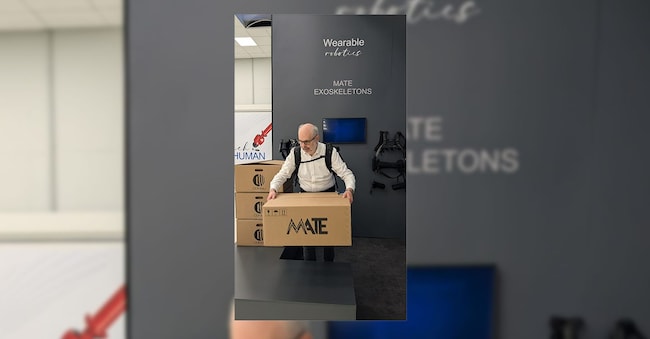
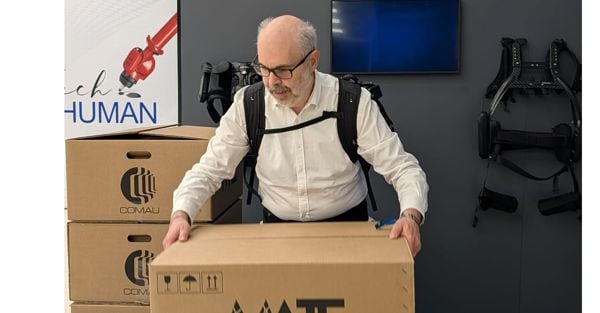
To be honest, I only unloaded and loaded four crates weighing 5 kilograms. So I did not simulate the experience of a blue collar, i.e. a manual worker. But those few movements convinced me that between us, the cyborgs and the humanoid robots, there are intermediate steps, where you are not a part of a machine but just use physics to make less effort. The feeling is that of a bicycle with gentle, never violent pedalling assistance. Where there is no replacement but integration with the machine.
We know the context of robotics. There is talk everywhere of the invasion of humanoid robots. So much so that the question is no longer 'if' robotics will enter our lives, but 'how'. And this is where the chess game between the humanoid robot and the exoskeleton comes into play. Who will win? Who will arrive first in the workplace and, more importantly, in our homes?
The exoskeletons,' explains Duilio Amico, head of wearable technologies at Comau, 'have three macro-components: a man-machine interface made of textile components, developed with Ferrino (the company that makes backpacks), to be breathable; a carbon fibre part to guarantee lightness and resistance; and the actual support system. How do they work? "They 'accumulate energy during a phase of movement in favour of gravity' and release it when needed. They are called passive exoskeletons precisely to differentiate them from those with batteries. "The passive ones," Duilio explains, "are easier to use, easier to maintain and are more accepted by workers (blue collar) who want to be 'assisted and not controlled by the machine'." They have applications for repetitive work but in non-standard environments, in the sense that they are not designed for assembly lines but, for example, for warehouses, for decorating buildings, for painting or for craftsmen. Those with batteries, on the other hand, are used in healthcare to relearn how to walk after a stroke, where guidance is needed.
To get specific, the Mate-XT GO weighs less than 3 kg, can be put on in 30 seconds and you have nothing electrical on you. Just springs that accompany your movements. The project was born in the pre-Covid era, out of an 'open innovation' with a startup from the Scuola Superiore Sant'Anna in Pisa called IUVO (from the Latin for 'help'), born as a spin-off of the Institute of Biorobotics in 2015. In 2017, Comau acquired a majority stake in IUVO through a partnership with the Icelandic company Össur, a leader in orthopaedic prostheses. The final product is the result of the combination of these competencies.