
Hyundai: 100 new models by 2030 and a focus on extended-range technologies
The target is to achieve global sales of 5.55 million units by 2030, whilst also improving profitability. Over 100 models will be launched, including the first extended-range electric vehicle, and the global market for autonomous driving will be monitored.

Key points
Hyundai aims to build on the results achieved in the first half of 2026. The brand delivered two million units, generating revenue of 95,200 billion won – up 2.7 per cent on 2025 – with an operating profit margin of 5.6 per cent. By 2030, Hyundai will launch or refresh over 100 vehicles globally, including 58 in North America, 49 in Korea, 41 in Europe, 26 in India and 22 in China. Many will be new models or will be introduced into new market segments. The first of these models will arrive shortly, including the eagerly awaited Ioniq 3, the Tucson and the Tucson Hybrid, as well as the first extended-range Santa Fe and, finally, a new global B-segment SUV and another B-segment SUV for Europe.
Tucson is the most successful model globally
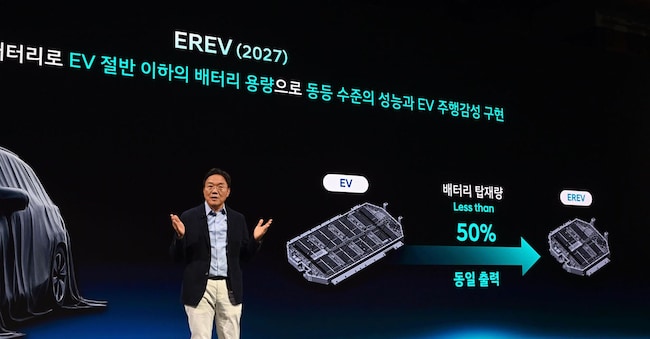
The new Tucson and Tucson Hybrid will be launched in the fourth quarter of 2026. With over 10 million units sold, the Tucson is Hyundai Motor’s most successful model globally. The new Santa Fe EREV, meanwhile, will arrive in the first half of 2027. The Santa Fe EREV is expected to offer a total range of over 965 km. The car will be produced in the United States at the Hyundai Motor Manufacturing plant in Alabama. However, Hyundai also aims to enter market segments where it is not yet well represented, which account for 29 per cent of all car sales. These include body-on-frame vehicles, including a mid-size pick-up and light commercial vehicles. Finally, the high-performance N range will be expanded with new models in the coming years, with the stated aim of selling 100,000 units a year by 2030.
Local growth to ensure global success
In Europe, Hyundai will cover 85 per cent of the market with an electrified range that will include five new SUVs and light commercial vehicles. Hyundai Motor aims to expand sales of electric vehicles in Europe to over 420,000 units by 2030, up from 116,000 in 2025. The Ioniq 3 will go on sale this month, offering a total range of 497 km. It will be the first model in Europe to feature Pleos Connect, the Hyundai Group’s next-generation infotainment platform for connected cars. The brand will also launch new products, including an EV and an EREV, in 2027. It will also draw on technology partners, innovative designers and, above all, the collaboration of its dealerships to reach the target of 500,000 units sold by 2030.
The luxury brand Genesis at the start of a new decade
Genesis has grown rapidly over its first 10 years, selling one million vehicles faster than any other luxury car brand. Genesis is starting its second decade with great momentum. The all-new GV90 flagship reveals what the brand has to offer in terms of luxury and technology. The GV80 Hybrid, the brand’s first hybrid model, sets new standards in both power and efficiency. Genesis will also add an EREV SUV in early 2027. The GV90 and the new powertrain options across the range will enable Genesis to tap into some of the key segments of the rapidly growing luxury vehicle market. Genesis currently operates in more than 40 markets, with the aim of selling around 350,000 vehicles a year by 2030. As part of this strategy, Genesis is targeting over 270 retail outlets globally, an increase of 50 per cent. Following launches in Italia, France, the Netherlands, Tunisia and Morocco earlier this year, Genesis will launch in Spain in the fourth quarter, bringing the total number of new markets added to five by 2026.
From the strategic value of hardware to that of software
Hyundai Motor is building a data ecosystem to enhance its software-defined vehicle capabilities, in which data collection, data analysis, improvements to artificial intelligence and services, and the implementation of over-the-air updates form a virtuous cycle. This ecosystem will deliver a better customer experience and enhance Hyundai Motor’s vehicles. Starting with the revamped Grandeur, the brand is rolling out the Pleos Connect infotainment system and Gleo AI, its generative artificial intelligence agent. The data collected is analysed to improve Gleo’s artificial intelligence and to develop new features for Pleos Connect. The results are then fed back to customers via OTA updates. The same cycle is currently being developed for autonomous driving. Hyundai Motor Group is standardising its sensor architecture around the NVIDIA ecosystem so that data collected by Hyundai Motor, Kia, 42dot and Motional can be integrated and utilised according to a single, consistent standard. From 2029, when autonomous driving data is expected to grow rapidly, Hyundai Motor will bring the Saemangeum AI Data Centre online – a 100-megawatt facility capable of housing more than 50,000 GPUs. By linking the data accumulated from its global mass-production system, its integrated in-house artificial intelligence and the infrastructure that supports them, the brand intends to compete in both SDV and autonomous driving.

