
Hyundai debuts the Ioniq3 electric sedan
With the new five-door, the company expands its range of battery-powered cars

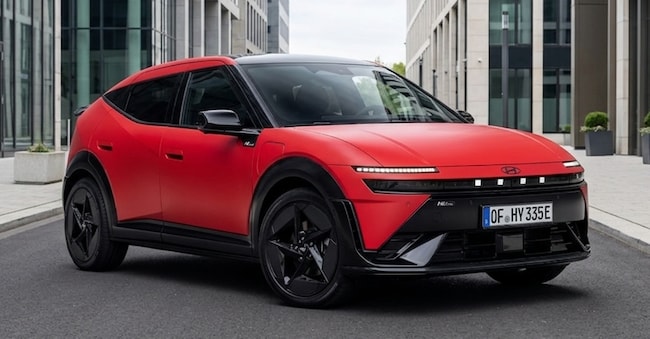
The expansion of Hyundai's native electric Ioniq range begins with 3. In fact, the Ioniq 3 arrives: a streamlined hatchback sedan, which takes its place at the bottom of the line-up in terms of size, powertrain power and, certainly, pricing, which will be known in the autumn. The Ioniq 3, which paraded in public for the first time at Milan Design Week last week, fits into an ever-expanding sector while confirming the strategy of Hyundai's category brand dedicated to electric cars that is not suv-centric like those of so many rivals. In fact, the Ioniq 3 broadens the range of proposals, joining the Ioniq 5 crossover, the large Ioniq 6 saloon and the mammoth Ioniq 9 SUV.
In addition, it opens up a new stylistic course that will influence future Hyundais with thermal engines and raises the bar when it comes to digital technologies.
The architecture and electric grid are those the Korean group has defined for compact-sized battery cars. It is based on the smaller variant of the 400 volt E-GMP architecture and will be offered in two versions. A standard range version with 146 horsepower and 250 Nm of torque powered by a 42.2 kWh Lfp battery that promises a range of 335 km, and a long range version with 136 horsepower and 250 Nm of torque with a 61 kWh Nmc battery for a range of up to 490 km. The batteries can be recharged either in alternating current at 11 kW or in direct current at 350 kW from 10 to 80 per cent in half an hour.
Designed in Europe and produced in Turkey, the Ioniq 3 has compact car dimensions: 4.15 metres long, 1.80 metres wide, 1.50 metres high and a wheelbase of 2.65 metres. The line defined by soft surfaces modelled according to the Art of Steel stylistic course that highlights shapes through plays of light and sculpted volumes is well-proportioned, aerodynamic and winks at that of a coupé thanks, in particular, to the long, sharp front end and the tapered tail in which the light signatures are complemented by batteries of squares that are somewhat of a trademark of the Ioniq family. The sporty N trim is distinguished by specific body superstructures and a rear spoiler.
The passenger compartment, thanks to the balanced relationship between body design and dimensions as well as the rather horizontal design of the roof, is also spacious at the rear.

