
Hyundai Ioniq 3: we took it for a test drive ahead of its launch – what the new electric car is like and how it drives
With the new Ioniq 3, which has a range of between around 340 and almost 500 km, Hyundai is entering the B-segment saloon market – a sparsely populated but strategically important market segment
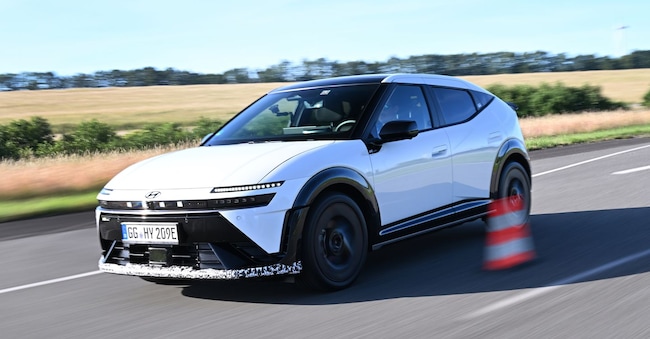
It aims to shake things up in the important but emerging sector of B-segment five-door electric saloons, where the range of models is limited, focusing mainly on SUVs and a few models such as the Peugeot 208 or Renault 5, as well as upcoming models such as the Volkswagen ID.Polo.
Here is the Hyundai Ioniq 3. We first saw it make its debut at Milan Design Week last April, and now it’s time to take a closer look at this compact, battery-powered hatchback, developed in Europe for the European market. In fact, we had a sneak preview of it in Germany, near Frankfurt, during a short track test drive reserved for the judges of The Car of the Year.
Let’s start with a key point: the beauty of the Ioniq 3 lies precisely in the fact that it isn’t your typical city SUV, prioritising driveability and originality instead. But before we discuss how it drives and what it’s like to be on board, let’s go over some key features – albeit preliminary ones, given that the car is in pre-production and undergoing type-approval. The Ioniq 3 is 4.15 metres long and 1.80 metres wide, with a height of 1.5 metres, and features a silhouette that Hyundai has grandly dubbed the ‘Aero Hatch’, precisely to emphasise the aerodynamics of this compact car with its truncated tail and sloping, almost coupé-like roofline, which is somewhat reminiscent of the old Veloster. It is based on the 400-volt E-GMP modular architecture, as are the Kia EV2, EV4 and EV5. There are two battery variants, differing in chemistry: a standard-range 42.2 kWh LFP battery and a long-range 61 kWh NMC battery, which power a front-mounted motor producing 147 cv (107.8 kW) for the former, with a range of 344 km, and 135 cv (99.5 kW) for the latter, which achieves a range of nearly 500 km. DC charging takes around half an hour to go from 10% to 80%, and the maximum DC input power is 119 kW for the smaller battery and 110 kW for the larger one.
Once on board, you immediately appreciate the spaciousness: the front feels like that of a car in a higher class, and even in the rear seats there is no shortage of space or comfort, and no sense of claustrophobia. The driver’s seat is comfortable, the upholstery is well-made, and the seat provides good support without feeling restrictive.
But the star of the show on board – nestled in a hammock-style dashboard that is pleasantly reminiscent of the first Fiat Panda, the one designed by Giugiaro – is the infotainment system, which marks the debut of Pleos: an Android-based user interface that utilises touch controls, physical buttons and offers customisation options. This is a clear step forward compared to Hyundai’s older systems, and one we’ll see rolled out across other models. The test car featured a 14.6-inch screen, but when the car goes on sale this coming autumn, versions with a 12.9-inch display will also be available. It uses a variant of open-source Android, and therefore does not include Google services; the sat-nav is based on TomTom, but Android Auto and CarPlay are available for smartphones, as are Google Maps (which, to be honest, have recently become less user-friendly, along with many other Google features).


