
"I am an eager echo, grateful for success. I love theatre, but every take is unique'
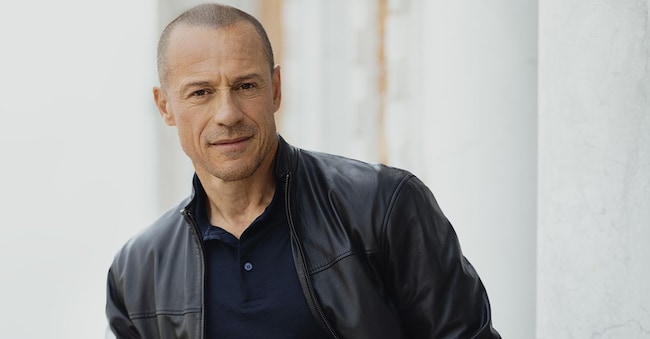
Stefano Accorsi. A fetish actor for Muccino and Özpetek, he is engaged in a campaign for the environment. From 26 to 28 September, in Florence, his 'Planetaria' brings together scientists and artists

7' min read
7' min read
"I have always been sensitive to environmental issues. As a lover of the mountains in summer, when I see the glaciers retreating so rapidly from year to year, I am invaded by an all-consuming anguish and this feeling of having nowhere to shelter you...'. It is what he calls eco-anxiety that drives Stefano Accorsi, an actor so loved by the public that he changes the box-office results of a film, to devote himself to protecting the environment. He, a workaholic, as he mockingly portrays himself in an episode of Call My Agent! ("I had the time of my life") decided to take three days, from 26 to 28 September, in Florence to give life to the second edition of Planetaria, an event conceived by Accorsi himself and Filippo Gentili, which hosts scientists, actresses and actors, singers and authors, in shows, events, talks, workshops, meetings and screenings, all with free admission, to tell the story of the future of the planet and explore the urgencies of climate change. "I don't believe in the effectiveness of journalism on this issue, because its nature is to grind out news and give a drumbeat response, when environmental change is a slow process. Catastrophist headlines alienate. Instead, theatre is the place to discuss because it is an empathetic place. Of course with a rigorous scientific basis'. Guaranteed by Planetaria's committee of physicist Giulio Boccaletti, climatologist Claudia Pasquero and economics and sustainability experts Stefano Pogutz and Francesco Perrini. "These are scientists who are very good at communicating, and while others transmit data that creates a terrible sense of impotence, theatre, as well as the world of culture in general, can address these issues in a constructive way, proposing future scenarios in which science and politics talk to each other to find solutions. Even if the world is going in the opposite direction, starting with Trump's policies, inclined to revive fossil fuels and halt the transition to clean energy. "There is, however, a whole part of the real economy that is already acting in favour of an environmental policy, because companies know that going green in the medium to long term is a very attractive investment. And also because young people have a strong environmental awareness and the best among them will choose to work with those who have a certain type of ecological approach, and I am not just talking about sustainability, but also inclusiveness'. At Planetaria there is a focus on young audiences. There will be, among others, Matilda de Angelis, Pilar Fogliati and Teresa Saponangelo, and for the little ones Lo Zecchino d'oro, games in English and lots of music. The days take place above all at the Teatro della Pergola, of which Stefano Accorsi was artistic director until a year and a half ago, now under the direction of Stefano Massini and at the centre of controversy due to the downgrading (it is no longer a national theatre) ordered by the Ministry of Culture with a significant decrease in public funding. "Massini won for Lehman Trilogy five Tony Awards, the most important theatre prize there is in the world. He did an exceptional season, so honestly it seems strange to me. Very strange."
Born in Bologna in 1971, Accorsi remains in his dry but gentle frankness a former provincial boy (he grew up in Bagnarola, a town in Emilia with a population of just over 300), cosmopolitan and lacking in snobbishness, despite boasting a wealth of palmares: the David di Donatello and the Ciak d'oro for Radiofreccia (1999), the Nastro d'argento and the Globo d'oro for Le fate ignoranti (2001), the Coppa Volpi at the Venice Film Festival for Un viaggio chiamato amore (2002) . Black t-shirt, hair almost shaved off, away from the curls with which she made her debut in Pupi Avati's film Brothers and Sisters (1992), she grew up in the years of videomusic (she took part in the 883 video A Love Song) and advertising. His freshness remains in the collective imagination for the Maxibon ice cream commercial, with the line in Anglo-Italian, which became a catchphrase, Due gust is megl che uan. He recounts his life and career in a table book, with beautiful portraits, Album Stefano Accorsi (edited by Malcolm Pagani, Editorial Group, 2021): shots of him as a child and those of his young parents in raw cotton shirts. "My parents were a bit of a hippie, a bit Sixty-eight, but concrete, in the sense that they worked as clerks, then they opened a bar. From my father I learned to listen to jazz, Lucio Dalla, Paolo Conte. My mother passed on to me the attention to nutrition, as important as physical activity'. Accorsi recently appeared on the cover of 'Men's Health Italia', where he talked about his courageous dawn workouts. 'It is a rigour that I have passed on to my children: they are all sportsmen'. Accorsi has four children, Orlando and Athena, born to former partner Laetitia Casta, and Lorenzo and Alberto, born to his wife Bianca Vitali. Since his debut, his part has often been that of Casanova, and also for this - as well as for his physical resemblance and certain acting style - Accorsi has been compared to Mastroianni, who hated this label. "Poor Mastroianni, every now and then they juxtapose someone with him. I don't think anyone can be compared to such a giant, an amazing actor, with a unique specificity, who always chose the directors he worked with very carefully'. And who would Accorsi choose? "I have always been a fan of Matteo Garrone and Paolo Sorrentino, who give extraordinary characters. But sometimes it happens that you make a film with a director from whom you expect nothing and the pearl comes out. Cinema is a mysterious process, no one has the certainty of success in their pocket'. Accorsi's training, however, was on the stage: after high school, he attended the Alessandra Galante Garrone theatre school in Bologna. "I couldn't be without theatre," he explains, so between one film and another in 2012 he managed to stage a reinterpretation of Orlando Furioso directed by Marco Baliani. In 2026, after finishing shooting the new film by Paolo Genovese, there will be the Odissea, still being written with Emanuele Aldrovandi. "It will be a monologue in which Ulysses is not described by others, but tells himself, starting from the fact that he does not want to go to war. A corporeality that will be missing on set.... "There are directors, however, who demand a major physical change. I am thinking of Veloce come il vento inspired by the life of rally driver Carlo Capone. Matteo Rovere demanded a fairly radical transformation. Gabriele Muccino certainly demands total involvement, bodily and emotional. Difficult, but fun and exciting. With him there is never an easy scene, not even one described in a few lines'. At one point in L'ultimo bacio, which consolidates the success consecrated with Radiofreccia, Giovanna Mezzogiorno wounds his hand. "It wasn't planned. Giovanna only had to threaten me with a knife. That scene was in sequence. We had rehearsed and rehearsed it with Giovanna. When the action started we were in a kind of impasse and to break it she accidentally touched my hand with the blade. It was the first take and it was the right one'. With Muccino Accorsi has made four films, the same number with Özpetek. "Ferzan has a different approach. With him you go on set and you never know what's going on. Sometimes you try your hand at a long dialogue, in others he just wants glances and situations. Then a small scene comes up that he hasn't yet focused on and he writes it on the spot. Directors who are confident in their means of expression are the ones who also have many surprises on set. They prepare, they study, but then they also confront the actor and when you find yourself in front of the camera it is totally different from what you had imagined. From action to stop you know that something unrepeatable is going to happen for you and for the whole crew: it is a suspended moment, each take is unique. Filmmaking is quite an incredible craft: a huge machine in which so many people work to prepare the set design, staging, costumes, acting, and then everything converges in a single shot. And if the film ends up with a take that for the actor is not the best one? "I rely a lot on the directors, the monitor is their land, they see things we don't capture, they rarely make mistakes". Accorsi's first starring role was Jack Frusciante è uscito dal gruppo by Enza Negroni in 1996, based on the book by Fausto Brizzi, which changed generation X to which Accorsi belongs. "In fact, it also changed the world of cinema, because the boys, as children, took on a leading role, the first time a young generation narrated itself". Three years later came Radiofreccia by Ligabue. "It is a film that kept time wonderfully, Ligabue did a great job on the province and music. It was a time when an artist grew slowly, first he performed in front of four people, then he formed his own following. I listened to the most classic rock, Led Zeppelin, Pink Floyd, U2. Nirvana, Vasco. Today there is a lack of interpretation, success arrives immediately and then a void. It's hard'. And does fame weigh on Accorsi? 'No. If a person does my job and is lucky enough to be recognised, you just have to be grateful'.


