
'I am the seventh generation of Maraschino. My lesson from poverty'
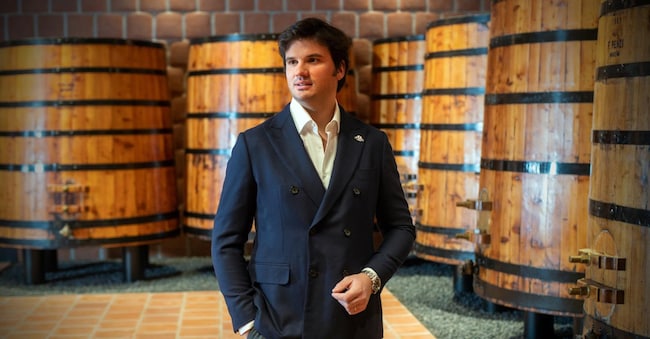
Nicolò Luxardo. The family business as the fulcrum. Today he travels the world but always returns to Torreglia, where the family rebuilt the company after the many storms of the 20th century.
6' min read
6' min read
It is a pleasant October day: green, thanks to a rainy autumn, shines on the hills south of Padua. Seated at the table of the 'Antica Trattoria Antenore', robust and traditional Venetian cuisine 'since 1890' says the sign, Nicolò Luxardo is seated in front of a plate of fettuccine with porcini mushrooms (the speciality of the house, even in summer). 'Before we opened the company canteen, we used to come here every day and go to the kitchen to ask for the dishes of the day,' the young man begins. The 33-year-old, scion of the family that produces Maraschino, a liqueur of (not the) cherry, is an anomaly: this former rugby player is the seventh generation of the Luxardo family. That's more than double the theorem about family businesses so much in vogue in emblazoned business schools. Not only has the third generation of Luxardo not destroyed the company, but the descendant Nicolò has left sport to work in the family business in Torreglia, a village on the slopes of the Euganean Hills, surrounded by hills, 20 minutes from the city of Sant'Antonio and the Scrovegni Chapel. The geographical detail, Google Maps-style, later turns out to be relevant.
As a child, Nicolò was already rambling in the forecourt of the family business where 'in the summer, and after school, I used to help clean, complete with reflective overalls'. The Luxardo factory, which looks like something out of a 1950s Neorealism film, is right at the foot of the heights: it was here, in the immediate post-war period, that Giorgio Luxardo escaped poverty, hunger and persecution. But even this is not the beginning, albeit a rocambolic one. The history of the Luxardo family, and of the unmistakable cherry liqueur, is 200 years old and intertwines that of Italy between wars, diasporas, ethnic cleansing, age-old recipes, cherry trees and the economic boom. The year is 1945: 'My grandfather fled Dalmatia to escape Tito's persecution. He made it to Italy, others did not. My great-grandfather Pietro, his brother Nicolò, whose name was the same as mine, were shot but we only found out about it two years ago. Nothing is known, even today, about his wife, Bianca'. The Italy of '45 was not the promised land, but simply the land of the ancestors. The 'x' in the surname is misleading: it might look Venetian but instead comes from Genoa, where it is common for many families: the most famous is Bixio. The founder Gerolamo was an ambassador of the then Kingdom of Sardinia. In the mid 19th century, he was sent to Zara, which until a few decades earlier was a Venetian city but after Napoleon's victory, and the end of the Serenissima Republic, had passed under the Austro-Hungarian Empire. In those years, on the other side of the world, in the United States, the first cocktails were being invented. In Zadar, on the other hand, the ambassador's wife 'distilled home-made liqueurs, a custom of the times'. In the city, for centuries, a rosolio was produced from the indigenous cherry variety 'marasca', which only grows there: hence the name maraschino. Five years passed and the artisan liqueur became a factory, with an imperial licence from His Majesty Maximilian Ferdinand Joseph of Habsburg. Girolamo's rosolio, who later had a second wife and a total of 21 children, became so famous that the term 'Luxardo' became synonymous with 'liqueur' in general. But tragedy befell the family: in 1943 Zara, which was annexed to the Kingdom of Italy after the First World War, was the most 'Italian' city bombed by the Allies: 50 air raids. The beautiful factory overlooking the harbour was destroyed. "For almost five years, Luxardo no longer produced half a bottle. It was only the beginning: the worst would come later: Mussolini's government was defeated, Italy lost the war. The entire Istrian-Dalmatian coast ended up under the control of the Slavs: Tito's communist partisans began a ferocious ethnic cleansing. The Luxardo family were persecuted, because they were Italian, therefore defeated; and because they were well-to-do, therefore even more hated: Giorgio's brothers, Nicolò (Senior) and Pietro, were killed.
The family's diaspora began: Giorgio took refuge in Torreglia, 'far from possible attacks and there they rebuilt the company from scratch'. But starting again, as refugees and very poor, is a titanic undertaking. The first and biggest problem is raw material: 'Luxardo was a factory, but everything depended on the land, or rather agriculture. To start making the incomparable distillate again, first of all cherry trees were needed, 'but morello cherry trees only grew in Zara' not in the deep Veneto region. Success also fed on luck: someone in the family remembers that in the 1930s 'a botany professor from the University of Florence had gone to Zara to study marasca cherries and grandfather had given him some seedlings'. Giorgio went to retrieve those morello cherries and cloned them: the company could start up again. The year, irony or mockery of history, is 1947, the same year in which the Peace Treaty in Paris makes Italy, by then a Republic, a punished nation: Dalmatia and Zara are Yugoslavia.
From Nicolò's office, the view sweeps over the hills and below the windows you can see a few rows of cherry trees, bound by a family mantra: 'We only grow 35,000 plants, through trusted farmers in the north-east, and the amount of liqueur produced varies according to the harvest'. They call it, today, sustainability. Luxardo is a story of rebirth: Maraschino is now sold in 102 countries, but the horizon has remained the Piccolo Mondo Antico of Torreglia, where 'our DNA of family capitalism' is rooted. Born in the village, Nicolò graduated in Padua, and like any self-respecting scion, he also did a master's degree, but always without straying too far: at the CUOA in Altavilla Vicentina. And from there, he did not go to a multinational abroad, the dream of many: 'I returned home, to Torreglia. I would never move from here: this is my microcosm'. As head of foreign markets, 'I travel all over the world for work, but my place is here: there is no country more beautiful than Italy'. It may sound like chauvinism or, worse, provincialism, but it is just the (Calvinist) work ethic and the religion of the factory, of which the Veneto, the engine of Italy, is steeped. His biography is the exact opposite of the 'bamboccioni' stigmatised by Tommaso Padoa Schioppa. But again, the reason lies in the family's tormented past: 'My grandfather was born a 'lord' and came to Veneto very poor'. In reality, he brought a treasure, the most precious one, with him from Dalmatia: 'The desire to start again, to roll up his sleeves'. That same spirit that, more than any Marshall Plan, invoked at every opportunity, was the real spark of Italy's boom. Of course, the days of Maraschino Luxardo, mentioned in novels from Antonio Fogazzaro to Gabriele D'Annunzio, who renamed it 'Sangue Morlacco' are sadly gone: 'Today we are one of the many alcohol companies on the market, where competition is fierce. In the small but sublime museum next to the factory, 'we have also exhibited all the imitations of our maraschino': there is even a Slavic, now Croatian one. Perhaps it is the 'fake' that hurts the most because the old factory in Zadar belonged to the family, but no one has ever paid him back. Luxardo is an anomaly in the increasingly globalised world of multinationals: 'We are a small company, debt-free, unwilling to make compromises to sell more: in short, a white fly'. Perhaps the famous paradox of the bumblebee would fit better:
it is yet another case of successful family capitalism, against all odds.
From Lucia Cannes, a beach establishment on La Croisette, to the Coral Room at London's Bloomsbury Hotel, all the world's most exclusive venues serve Maraschino made in the Euganean Hills. World authority David Wondrich, William Shakespeare's former professor turned cocktail expert, said that he judged the level of a bar by the presence of Luxardo Maraschino.

