
Jonathan Sacks' balm books
"Alliance and Conversation", a volume by the authoritative voice of Judaism for Giuntina types, frees us from centuries-old cultural encrustations

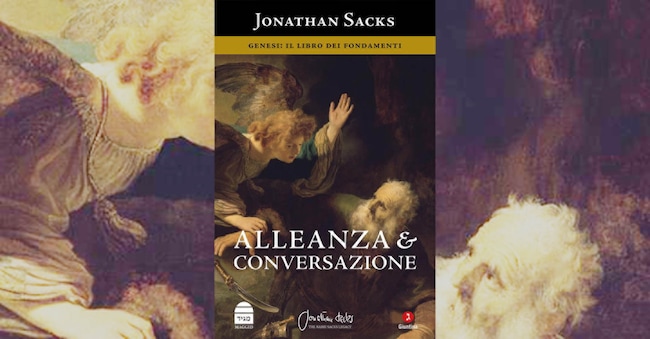
Given the current times, the book by Jonathan Sacks, one of the most authoritative voices of contemporary Judaism who recently passed away, Covenant and Conversation, Genesis (Giuntina) is a balm for those interested in Jewish thought. Contrary to a current narrative, which, after the terrible war in Gaza, repeats for Judaism the same mystifying score seen at work in the aftermath of 9/11 towards Islam, it turns out that the Torah, the five books of the Pentateuch, contains an ethical message of peace, brotherhood and solidarity.
An ethical horizon is formed in the Book of Genesis through the events of the patriarchs Abraham, Isaac and Jacob, already contained in nuce in the previous characters. From the first, uncertain moves of Adam and Eve and their sons Cain and Abel, unable to withstand the limits imposed by any relationship, to Noah, who is described in the story as a "just man and upright in his generations". The first veteran, who will not be able to overcome the upheaval induced by the catastrophe he experienced. Like many veterans, he will drown his despair in alcohol. Abraham will redeem him, capable of transforming the trauma he has suffered into an egalitarian ethical path, antithetical to the models of the great Middle Eastern empires, well symbolised by the Babylonian towers and the Egyptian pyramids, where the summit crushes the base. This passage is even more significant when the midrashic commentary informs us that Abraham was among the children locked in the furnace of Ur Kassdim, chosen to be sacrificed to the sovereign Nimrod. It is certainly no coincidence that Abraham's tenth and final test, the hardest, is to deliver his son Isaac to Transcendence, in the form of the most complete gift, known as the 'holocaust', a term rightly rejected to describe the tragedy of the Shoah. A loss of parental authority, an institution that resulted in a repressive mechanism of parents over their children, which the patriarch's mind, so corrupted by the pagan societies in which he lived, had confused with the duty to sacrifice that son, whom God himself had given to him when all hope of having him was gone. Thus, in this book by Sacks, which takes the form of a collection of homilies on the weekly biblical pericopes, the figures of what for the Christian tradition is the First Testament, are not presented as incomplete characters, whose beginnings will find fulfilment in a later path, as desired for centuries by the theology of substitution later abolished by the Second Vatican Council, but very human persons who share the faith in a possible change. In a path, certainly a difficult one (according to an etymological reading, the very name of the third and last patriarch Jacob means tortuous) of emancipation from the present condition, even when this seems to preclude any way out. But again, following the oxymoronic nature of Jewish thought, equality, as the story of Babel shows, is given in difference, freedom is never separated from responsibility. Just as any simplifying reading that separates good and evil, just and unjust, guilty and innocent, is excluded a priori. A book-balm, we said. Not only because it frees us from centuries-old cultural encrustations, but also because it prevents that representation of the Jewish God as vengeful, punitive, insensitive to compassion, which is still reflected on the entire Jewish people today.
Jonathan Sacks, Covenant and Conversation - Genesis. The Book of Fundamentals, Giuntina, pp. 464, euro 28

