
'I explain how to revive Italy's inland areas'
"We need a formula, supported by institutions and private individuals, to protect and bring life back to these places, favouring rents for those who move in."

6' min read
6' min read
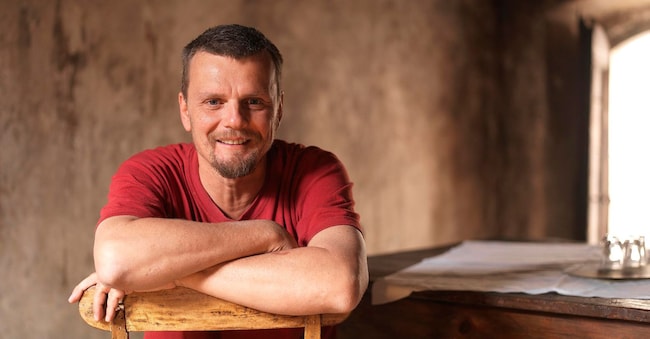
Immersed in a blue autumn mist, Pier Paolo Pasolini observes the outline of the town of Orte together with Ninetto Davoli. It is 1974, in May Italy has celebrated progress with the referendum on divorce and suffered the tragedy of the Piazza della Loggia massacre. The director is the protagonist of the RAI documentary "Pasolini e ..la forma della città", in which he tells the actor and the audience about his aesthetics of counter-development. Walking along 'a bumpy and ancient pavement' he notes that 'it is a humble thing, it cannot even be compared to certain works of art, of author, stupendous, of the Italian tradition. Yet I think that this humble little road, so humble, should be defended with the same doggedness, with the same good will, with the same rigour, as the work of art of a great author'. In 1974, Daniele Kihlgren was a blond eight-year-old boy living in Milan in an upper middle-class Italian-Swedish family that built its fortune with cement, the very material that was covering Italy and fuelling Pasolini's outrage. Yet, of the poet's words, Kihlgren today is perhaps the most faithful and passionate guardian. A restless soul - 'I am devoured by curiosity' - he left Milan in the 1990s with a philosophy degree to live in Pescara (his family has a factory there too). He loves to ride his motorbike on the metaphysical roads that lead from the provincial sea to the Gran Sasso and arrive at the 1250 metres of Santo Stefano di Sessanio, one of the region's stony, solitary and austere villages. Like Schiller's Pellegrino, a mountaineer like himself, there he finds that 'golden gateway' that finally reveals to him 'all that becomes eternal and immortal'. "More like a post-apocalyptic place. It was so sad, there was hardly anyone there. Yet I recognised its sense of the sacred, the need to protect it,' he explains. He had an intuition, which he transformed into an entrepreneurial project: he bought peasant dwellings abandoned by emigrants, renovated them with maniacal philological care, and in 2004 Sextantio was born, one of the world's first widespread hospitality projects and at the same time a project of solid philosophical and anthropological vision. The name is the ancient name of the town, once one of the villages of the medieval Baronia di Carapelle, where the signs of the ancient wealth of wool and sheep-farming are revealed, only to those who observe very carefully, in the friezes on the buildings marked by time and abandonment: "Italy's minor historical heritage, the vernacular heritage, is at risk. Entire landscapes have become extinct, suffocated by contemporary constructions,' he recounts as we walk through the stony streets of the village, where Escher also came, attracted by those buildings built on steep, vertiginous levels. 'Many mistakes have also been made, and tragically continue to be made, in the management of development, when villages like this one are surrounded by buildings disconnected from their history, their identity, by the tide of second homes. The Pasolini of 1974 returns, denouncing 'no one realises that what needs to be defended is precisely this anonymous past, this nameless past, this popular past'.
Tourists from all over the world come to Sextantio's twenty or so house-stations, various celebrities as well as curious travellers in search of an experience that offers a sense of authenticity, a priority for high-end tourism today. But unlike resorts and other 'diffuse hotels' - a term and concept of which Kihlgren is probably the parent, but to say that he does not like is to use an understatement - Sextantio has brought life back into walls where signs of previous life proudly remain, or return: the blankets are made on ancient looms with wool from the Gran Sasso pastures, which also fills the mattresses; the switches are ceramic, the beds, bedside tables and chairs are totally reclaimed. The dense, cultured beauty of this style that turns the past into the avant-garde distances the formulaic pitfalls of luxury, suggested only by the bathroom furnishings designed by Philippe Starck: "White, essential, we chose them because they must make themselves recognisable as alien elements," says the entrepreneur. To retrieve the objects from the lives of those who were there before, he relied on the anthropologist Annunziata Taraschi, who interviewed the elderly, recorded their experiences, opened memories, cupboards and cupboards, and continues to collaborate intensively with the Museo delle Genti d'Abruzzo in Pescara. The result is original, rough, responsible hospitality, which in 2016 earned Kihlgren an honorary doctorate in Cultural Heritage and Territory, awarded by the Tor Vergata University of Rome, and three years later, his presence on Condé Nast Traveler's list of the 25 most influential personalities who changed the way we travel. Articles about him are in dozens of languages, but Kihlgren doesn't want to be a guru, a guru of alternative and avant-garde hospitality. It is more as if his personal search for meaning has led him towards a project that has finally transcended him.
"There is comfort, of course, but no television. We have left the walls blackened by the fires that the peasants used to light in houses without fireplaces, it would have made no sense to make them white and smooth, all the same. It is a paradox, but very often, when these places come back to life with tourist projects, they lose all their identity. Instead, there is an intense smell of chimney in the kitchen of the noble house dating back to the time when Santo Stefano was a fief of the Medici, who produced wool there and built the beautiful tower that still towers over the roofs of the village. In that room today, guests are taught how to bake bread, and it is precisely from food that Sextantio's next evolutionary project will pass: "We are investing in the new restaurant, it will be overseen by a young chef from the area who has decided to leave a starred kitchen to propose traditional ingredients and flavours, for which there is a renewed and general interest. We are working on it, we should start in the autumn'.
The chef is likely to be one of the new residents of the village, where, thanks to the Sextantio project, economic activities and children are once again proliferating: 'In recent years, accommodation facilities have increased from one to 23, and the number of VAT numbers, which also include restaurants, bars and shops, are catching up with the number of inhabitants, 55 by 70'.
However, the province of L'Aquila is ninth in Italy in terms of depopulation rate: 65% of its municipalities are located in inland areas, and between 2014 and 2024 they lost almost 10% of their inhabitants. The 'centrifugal' Abruzzo of which Guido Piovene spoke in the 1950s still exists. 'We need a formula, supported by institutions and private individuals, to protect and bring life back to these places, favouring rents for those who move to work remotely, for immigrants, for artisans who decide to open their own shops,' he explains. We drink Praesidium, a Montepulciano wine whose name was chosen not by chance by another maximalist tutelary company, the winery of the same name in Prezze, in glasses made of Castelli ceramics, a centuries-old craft excellence in the area: "The Americans go crazy for these dishes, they cost more for us and it is forbidden to put them in the dishwasher, but we couldn't choose anything else," he says. The path of recovering craftsmen's trades, as well as places and objects, was also recently chosen by the neighbouring municipality of Rocca Calascio, with the silhouette of its white stone fortress that can be seen perfectly from Santo Stefano: it is among the 250 administrations to which the NRP has allocated funds amounting to one billion euro within the framework of Next Generation Eu: there, a new production school dedicated to ancient weaving and dyeing techniques, launched in collaboration with the Fondazione Lisio of Florence, inaugurated the activities of the 'Rocca Calascio - Luce d'Abruzzo' project, designed precisely to build an integrated and sustainable development model for the village, where a further training school for extensive sheep farming and a wine and food centre will also be opened. "This model can be replicated, there is a dramatic number of abandoned or semi-abandoned villages, a typically Italian phenomenon, particularly in our south": this is one of the reasons why Kihlgren exported the Sextantio model and philosophy to Matera in 2008, buying some abandoned stones to make the Grotte della Civita, 18 rooms almost all created in the caves of the Sasso Barisano, and is preparing to do the same again in Abruzzo, in Martese, a village perched on a rock in the wildest corner of the Monti della Laga. Then, in 2022, it crossed the Italian borders to set up the Huts Project on Nkombo Island, in Lake Kivu, Rwanda, where people stay in huts built using traditional techniques, in collaboration with the Rwanda Ethnographic Museum in Butare: it is there that part of the profits of the Italian Sextantio go, to give the local population access to medical care and health insurance. In Persia, in the city of Yazd, in the same 1974 documentary Pasolini recalls having seen many badgirs, millenary and sophisticated ventilation systems destroyed under the blows of modernisation imposed by Shah Pahlavi. The heart of the matter is there, what meaning to give to the word 'progress'. To find out, one need only follow the curious course of a motorbike.


