
Maldives, expert speaks: 'I know that cave well, treacherous even for super experts. A combination of causes likely'
The tale of the Maldivian professional diving pioneer: an expert in exploring sea caves in atolls

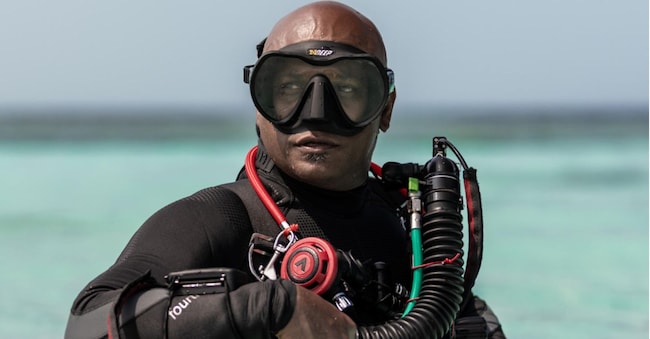
"I have made at least 50 dives in the Alimatha caves, with the right precautions and equipment. Each time was a fantastic experience but with the knowledge of the extreme risks I was taking". Maldivian diver and professional diving pioneer Shafraz Naeem is an expert in exploring sea caves in the atolls of the Maldives with 30 years of diving experience. He knows like a second home the caves of the tragedy where on 18 May the team of Finnish divers located the bodies in the third segment of the Alimathà cave.
'Expertise and precaution,' the former military diver, now Defence and Police Advisor in the Maldives, explains in an interview with Ansa, 'are necessary: for me, going down to Alimathà was not difficult, I am a specialised cave diver and every time I had the right gas mixture, the right equipment and a backup system.
Requirements and equipment that, according to Naeem, the five Italian divers did not have because 'we are talking about borderline environments', environments that Naeem knows well, having, among his many records, also that of the 'Across Maldives' expedition, an underwater journey of 335 kilometres through the atolls of Malé North, Malé South and Vaavu, more than 70 hours underwater in more than 35 dives.
"The authorities have confirmed that the operator exceeded the recreational depth limit of 30 metres in the Maldives and dived without the necessary permits," says Naeem. "Everyone knows that the rules were broken, they didn't even have a permit to do research at those depths. Naeem knows that cave well, he has visited and photographed it: "The entrance is between 55 and 58 metres deep, it goes down to about 100 metres, then forks and continues further down".
In short, literally a descent into the abyss through tunnels. "Deep cave diving is generally considered advanced technical diving that requires specialised training, rigorous procedures, proper gas planning and appropriate equipment configurations. Even the most experienced divers can face considerable challenges in such environments."

