The event

Standards, AI and governance: how healthcare is changing

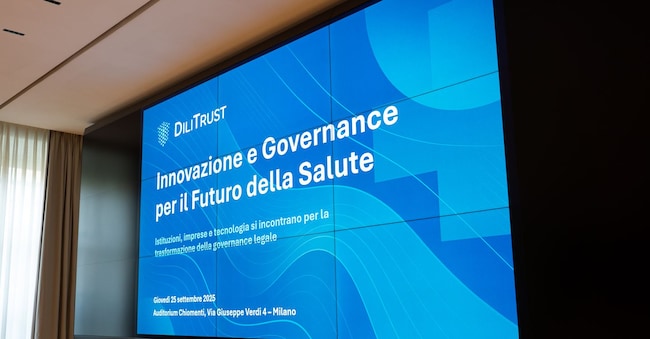
At the event 'Innovation and Governance for the Future of Healthcare', organised by DiliTrust with Chiomenti, Recordati, Regione Lombardia, AIFA and Il Sole 24 Ore, institutions and companies discussed how to integrate artificial intelligence, digital technologies and new regulations to build a more efficient, safe and transparent healthcare system

5' min read

Translated by AI
Versione italiana

5' min read

Translated by AI
Versione italiana

The health sector as a forerunner of the integrated relationship between technology, artificial intelligence and cutting-edge regulations. This is evidenced by Italy's pioneering decisions in this field and the initiatives of the sector's stakeholders, who are always ready to confront each other in order to find the best solutions to foster the synergy between administrative efficiency and patient health. An example of this is the event 'Innovation and Governance for the Future of Health', which on 25 September, at the Auditorium Chiomenti in Milan, brought together institutional and entrepreneurial stakeholders from the pharmaceutical sector. The event was organised by DiliTrust with the support of Chiomenti, Recordati, Regione Lombardia, AIFA - Agenzia Italiana del farmaco - and Il Sole 24 Ore. The meeting discussed how to update legal and corporate functions in the light of artificial intelligence (AI) and digital platforms. The aim was to disseminate good practices and strengthen efficiency, transparency and compliance in the health sector from a public-private perspective.

The opening was entrusted to Alessandra Bonini (Senior Manager DiliTrust), who recalled the technological acceleration experienced in recent years and posed the basic question of the conference: how to update government models to transform innovation into reliable processes. This was followed by institutional greetings: a video-message by Alessio Butti, Undersecretary to the Presidency of the Council of Ministers with responsibility for Innovation; speeches by Elisabetta Confalonieri, Director General for Universities, Research and Innovation of the Lombardy Region, and Emanuele Monti, President of the Welfare Commission of the Lombardy Region and Executive Board Member of AIFA.

Loading...

Butti proposed the image of healthcare as an 'organism' in which data, artificial intelligence and platforms/telemedicine operate in an integrated manner (the so-called One health model), while Confalonieri suggested three priority areas for the territory: a regulatory approach based on principles rather than on hyper-regulations; infrastructural adjustment (in particular data centres, energy and planning); the skills chain, from school to university, with the hypothesis of experiments and sandboxes. A discourse that ties in with what Parliament has approved in recent weeks, a national bill on artificial intelligence (the first in Europe), and with the European framework, regulated by the AI Act, which sets progressive deadlines. The rapporteurs linked these regulations to the need to translate guidelines into measurable processes.

In the introduction to the conference, the distance between innovation and administrative frameworks in some areas was highlighted. An example of this is the Italian telemedicine guidelines of 2020, which are perceived as not fully adapted to the current use of digital tools. The point is the need to accompany technological change with appropriate organisational and regulatory models, reducing the time needed to adapt rules and favouring an approach by objectives and monitoring.

The Position Paper released by the organisers on the eve of the initiative summarises the conceptual framework that emerged in the room. It defines "a new paradigm" in which AI and digital reshape models of care and organisation, with legal and corporate managements in a strategic position; it calls for clear rules, traceability of processes, strengthening of cybersecurity and public-private cooperation to build integrated innovation ecosystems. The document also emphasises the cultural dimension of the transformation, proposing a path that is both top-down (pushing legal managements and top management) and bottom-up (enhancing widespread digital skills), and recalls experiences already underway involving Recordati, DiliTrust and Chiomenti on boards, contracts and risk management.

In the panel, Fabrizio Gallotti (General Manager DiliTrust Italy) brought the topic back to an operational comparison: if functions such as sales, HR and supply chain have been using dedicated platforms for years, it is hard to see why legal departments should remain anchored to e-mail and spreadsheets. According to Gallotti, legal governance in pharma is played out on three intertwined levels: multilevel compliance, management of complex and transnational contracts, and risk control (clinical and reputational). The paradigm shift, he emphasised, consists in moving from 'contract as document' to 'contract as database', thus enabling research, correlations, metrics and predictive functions to support boards. As a corollary, Gallotti cited studies according to which the use of artificial intelligence in pharmaceutical development would reduce time and costs and could affect a significant share of the pipeline by 2030; the proposed conclusion is that, with the expected increase in contract volumes, the digitisation of legal processes may become necessary to avoid bottlenecks.

Among the speakers was also Silvia Signoretti, Group Corporate Law Counsel and Board Secretary of the pharmaceutical company Recordati. Signoretti described theinnovative procedures implemented by her company, including the adoption of board portals, which for over five years has replaced e-mail flows with dedicated environments that make materials, decision requests and tracking available. In addition, the centralisation of corporate data is enabling immediate reporting to authorities and internal functions. Signoretti linked these tools to a goal of efficiency at scale, noting that the use of platforms also affects professional activity. She was echoed by Lorenzo Michetti (Head of Corporate Legal Department at Recordati), who traced the process of the contractual digitisation project: reconnaissance of the existing, strong involvement of stakeholders already in the design and customisation phase, investment of time and resources; the return, he said, is measurable in reduced document search times and in the ability to prevent risks, with a direct impact on decision support.

The onus was placed onMarilena Hyeraci, Of Counsel at Chiomenti International Law Firm, to outline the risk picture. Recalling the latest data on the cyber threat to healthcare and the evolution of rules, Hyeraci pointed out security by design, pseudonymisation/anonymisation, segregation of environments and human control as indispensable. At the national level, the new AI regulation introduces principles and safeguards and, at the European level, the regulatory perimeter assigns distinct responsibilities along the technology chain. This is why Hyeraci emphasised the centrality of data quality, measurable through reliable datasets, interdisciplinary teams (technical and legal) and constant validation processes. He cited, as an example of application complexity, thefragmentation of regulatory transpositions between countries, recalling projects in which Italian teams lead the alignment of requirements such as NIS2 security requirements in multinational contexts. In relation to liability profiles, he noted that automation does not replace legal control: the legitimacy of choices remains with the organisation and its bodies.

Recent clinical research was also recalled during the proceedings. At the end of August, an algorithmic system capable of detecting signs of consciousness in coma patients days in advance of medical assessment was presented by analysing facial micro-movements. The reference served to show the proximity between technological frontier and clinical practice and to justify the urgency of validation and accountability procedures in the evaluation, adoption and use phases.

The focus of the event was operational rather than declarative. In view of the regulatory deadlines and national projects on telemedicine and health records, the need for platforms that make data usable and for documented roles and responsibilities along the supply chain and hybrid competences in legal teams becomes more and more pressing. We are already in the implementation phase: what has been presented as the direction of travel (digitisation of governance processes, risk control and coordination between functions) coincides with the ongoing activities in organisations called upon to translate technologies into traceable decisions.

Innovating does not only mean introducing new technologies, but building an ecosystem capable of welcoming them, integrating them and transforming them into value. A path that starts from institutions, crosses the enterprises and involves those who every day design more solid governance, more agile processes and more aware models. A collective challenge, therefore, that requires skills, vision and collaboration.

Copyright reserved ©
Loading...

Brand connect

Loading...

Newsletter

Notizie e approfondimenti sugli avvenimenti politici, economici e finanziari.

Iscriviti