
Melting ice: geoengineering seeks solutions
Experimental campaigns using pumps to recreate ice and clouds to block solar radiation

Key points
The situation regarding the polar ice cap has reached unprecedented levels. NASA satellite data confirm that 2025 and 2026 saw record lows in Arctic winter sea ice extent. Faced with the prospect of the first completely ice-free summer days as early as 2030, the scientific community and a number of tech start-ups have decided to go on the counter-offensive.
Water pumps for making ice
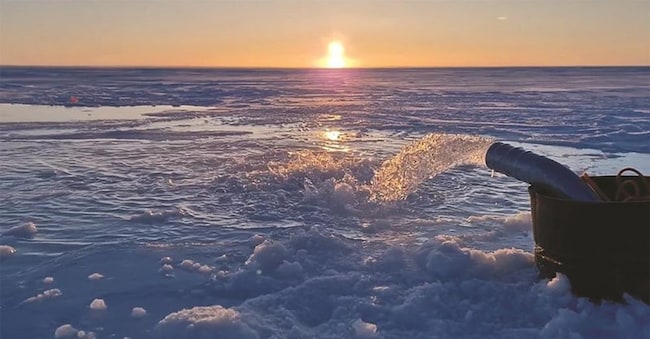
The most concrete and widely discussed initiative at the moment is being led by the British start-up Real Ice in collaboration with the Centre for Climate Repair at the University of Cambridge. The consortium has launched the Rasi (Re-thickening Arctic Sea Ice) project, a field-testing campaign in Canada involving the use of both surface and submersible water pumps.
The principle is simple: during the polar winter, when outside temperatures drop to -40°C, the pumps draw water from beneath the ice cap and spray it onto the surface layer of snow. Exposed to the extreme cold of the air, the seawater freezes rapidly, eliminating the snow’s insulating properties and creating a new layer of solid ice.
The latest winter campaigns in Cambridge Bay (Nunavut) have yielded promising results: just a few hours of pumping are enough to add between 20 and 30 centimetres to the ice thickness compared with untreated areas. The ultimate aim of Real Ice – founded and led by CEO Andrea Ceccolini – is to cover and protect large areas of ice in order to halt net summer ice loss.
Reflective clouds
Pumping water is not the only option on the table when it comes to polar geoengineering. The Marine Cloud Brightening project aims to block solar radiation before it even reaches the ice. This solar radiation management technique exploits a principle of atmospheric physics known as the ‘Twomey effect’: a cloud composed of a large number of very small water droplets reflects light much more efficiently than a cloud with a few large droplets.

