
If the Lion is hiding on Easter Island
The standout film at the Festival is *Wild Horse Nine*, featuring a sensational Malkovich. The Mara sisters are excellent in Herzog’s film. Moretti’s film was a disappointment.

Key points
It is hard to say what role a film festival plays now that Hollywood (with the exception of the ‘French’ Clooney) has decided to skip the costly red-carpet spectacle, in Venice as well as in Cannes, to avoid criticism and the considerable expense involved in a niche market. It may just be for this year, but the risk is that films will go straight to the cinemas, as Nolan has done. Even the Venice Film Festival will have to rethink its format: the many young faces in the audience offer hope for a move towards experimentation, alongside glamorous highlights such as Don’t Look Back in Anger, which brings the most beloved band since the Beatles to the Lido, with a documentary that – despite being cut by half an hour – ultimately offers an enjoyable reflection on forgiveness and the redemptive power of music, even for those who aren’t fans.
The Perfect Film
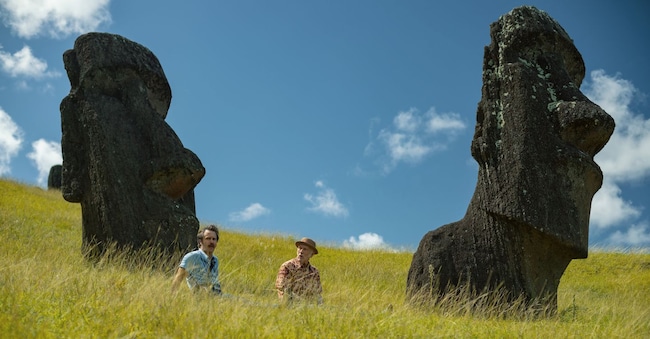
In any case, the Festival, at least in its first part, is anything but lacklustre, as had been predicted. On the second day came the perfect film, Wild Horse Nine by Martin McDonagh, a rare blend of a tight, flawless screenplay, a mix of genres (crime, action, memoir, comedy with touches of measured sentimentality), set design and costumes evoking the dusty 1970s, but above all, featuring sensational performances. Foremost among them is Chris—John Malkovich, a CIA agent responsible for many of the US’s ‘operations’ on the international stage, from the Bay of Pigs to the Kennedy assassination, and now on the eve of the coup in Chile. His terminal illness leads him to an unusual sentimentality towards young people and a reckless love of the truth, with many twists and turns on Easter Island. With cinematography reminiscent of *The Spirits of the Island*, it is certainly a more accomplished and well-rounded film than Three Billboards Outside Ebbing, Missouri, and it is highly likely that we will see *The Wild Horse* feature in the Venice Film Festival awards and at the Oscars.
The opening film
The opening film, as gritty as the ink in its title – Danny Boyle’s *i* – also gave the audience quite a jolt, with its portrayal of newspaper printing presses and maverick journalists. It tells the story of the 1969 takeover of the struggling newspaper ‘The Sun’ by Australian media magnate Rupert Murdoch (Guy Pearce). Murdoch harnesses the anger of a true underdog, the journalist Larry Lamb (Jack O’Connell), to outsell the *Daily Mirror*. The takeover, initially deemed impossible, becomes increasingly feasible thanks to voyeurism, the exploitation of suffering and the display of female nudity on the pages. Whilst Boyle’s intention may have been to showcase the dismantling of English classism and the modernisation of the media world, the bitter realisation is that it merely highlights the root of the disaffection between readers and newspapers, to which Boyle adds an implausible portrayal of Murdoch’s detachment from the line of extreme sensationalism. Yet the swaying camera in Trainspotting (1996), subject to shifts in perspective and abrupt movements, continues to exert its fascination.
The decline of journalism
The decline of the media world is also a central theme in Primetime, featuring a remarkable Robert Pattinson as Chris Hansen, the presenter of To Catch a Predator, a programme which, in the US, used to expose paedophiles live on air – with the police by his side – whom he had lured online using a decoy. The fine line between investigative journalism and the viewer’s morbid curiosity remains tenuous; what is particularly interesting is that this is the film of a thirty-year-old, Lance Oppenheim, who has never kept up with the news via television but only through social media. Despite this, he has managed to faithfully recreate a slice of old-school American reality TV – likely to be the future format for a programme of our own.
Maestro Herzog
Also based on a true story is Bucking Fastard by Werner Herzog, who, drawing inspiration from the Chaplin identical twins, went on to craft the story of the two symbiotic Holbrooke sisters, Jean and Joan, who speak in unison. The exceptional Kate and Rooney Mara deserve a joint Volpi Cup. The film gets off to a crackling start with the court case in which they stand accused of vandalism against Orlando Bloom, their lover of the moment; however, it loses its way somewhat as the story unfolds in the city and the Irish countryside, where the sisters find refuge. Here begins a somewhat over-the-top escalation into the surreal, which nonetheless bears Herzog’s masterful signature and is therefore remarkable.


