
If ruins are the starting point for new narratives

3' min read
3' min read
Lying for almost 500 years on the plains of Alessandria, the grandiose Monumental Complex of Santa Croce in Bosco Marengo was commissioned in 1566 by Pope Pius V Ghislieri (Bosco Marengo, 1504-Rome, 1572), first the feared Inquisitor and inspirer of the Counter-Reformation, then a pugnacious pope (he did not hesitate to excommunicate Elizabeth I of England, obviously rooting for her very Catholic cousin Mary Stuart) and decidedly warlike: it was he, in fact, who set up the Holy League, which defeated the fleet of the Ottoman Empire at Lepanto in 1571. But he was also a patron of the arts, and only time would overcome this great creation of his, founded to make it a propelling centre of faith and culture, which over the centuries would become a residence for veterans of the Napoleonic campaigns, then a military depot and, for almost the entire 20th century, a reformatory. Rescued from abandonment by the Associazione Amici di Santa Croce, which opened the site, the complex now sees the addition of the project of curators Tatiana Palenzona and Amina Berdin and entrepreneur Michelangelo Buzzi who, with the support of Intesa Sanpaolo, have created the non-profit cultural association MARES, in continuity with the founder, who was a patron of figures such as Giorgio Vasari.
The debut of MARES - which nominates the Complex for a role as a pole of contemporary art - is entrusted to the first edition of RUINS, a three-year project of artistic and cultural production that, after inviting artists Jade Blackstock, Giovanni Chiamenti, Luca Pagin and Teresa Prati and the curatorial duo Lemonot to a residency, from 20 September presents the first exhibition of the cycle, spread across the restored spaces of the Amici di Santa Croce and curated by Tatiana Palenzona and Amina Berdin with the collaboration of Lemonot.
On display are works resulting from the artists' confrontation with these places and their ancient and recent history, and from their dialogue with the curators.
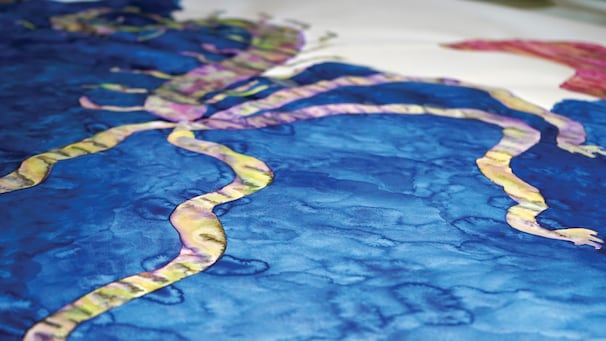
Of the four protagonists, Jade Blackstock chose a nuclear power plant that started up in 1973 and is now decommissioned, whose site has become a wound in the landscape and social context of the area. Because, she explains, "modern industrial ruins continue to exert their influence even when physically removed, hidden or 'renaturalised'". Giovanni Chiamenti, on the other hand, has focused on the geological nature of the soil in this area where in ancient times, as in the entire Po Valley, there was the sea and, by interweaving art, geology, biology, bio-technology and chemistry, he has generated a hallucinated world of hybrid and mutant beings, which he has called Genomic Chimeras, in which marine fossils found in some local rocks intersect with the (future) fossils that will result from plastic pollution: images that are not real but, unfortunately, more than likely, made to stimulate awareness of the damage we inflict on nature.
Luca Pagin's research has an anthropological slant. Entitled "Na sagra", it aims to identify the role that popular traditions, even those no longer practised, preserve in the life of communities: the focus of his investigation is the killing of the pig - a ritual in the rural civilisation - which not only drew sustenance for the entire year from this "sacrificed" animal, but also made daily tools from every part of it (bones, bristles, nails). Pagin has used pig scraps and, integrating them with aluminium elements, has made sculptures out of them, which are "contemporary archaeozoological relics, ruins of distant epochs that populate the present, suggesting new perspectives on understanding animal death and its relationship with individuality and sociality".

