The analysis

If violence breaks out in European democracies
by Adriana Cerretelli

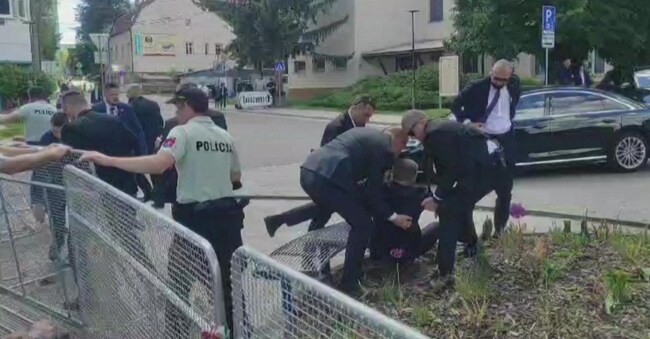
TOPSHOT - This image taken from video footage obtained by AFPTV shows security personnel carrying Slovakia's Prime Minister Robert Fico (C) towards a vehicle after he was shot in Handlova on May 15, 2024. Slovakia's Prime Minister Robert Fico was battling life-threatening wounds after officials said he was shot multiple times in an assassination attempt condemned by European leaders. (Photo by RTVS / AFP)

3' min read

3' min read

Three weeks before the European elections of 6-9 June, the unbelievable happens in Europe. Violence explodes in the election campaign with the impetuosity of an American-style script: Dallas, the assassination of President John F. Kennedy, an indelible trauma.

Robert Fico, Slovakia's controversial prime minister since last October, struggles between life and death riddled with five gunshots fired by a non-violent poet who was waiting for him among a friendly crowd. The exact motive for the act is unknown. After all, it is still not known who and why in 1986 killed Swedish Prime Minister Olof Palme on his way out of a cinema. Certainly, if compared to today's uncertain and unstable times and made the necessary proportions, the attack on Fico sends the memory back 110 years, to June 1914, when in Sarajevo a student discharged his weapon at the heir to the Habsburg throne, lighting the fuse of the First World War.

Loading...

The affair is also incredible for another reason. Paradoxically, it took place in the country that was the child, on 1 January 1993, of a 'velvet divorce': its perfectly consensual separation from the present Czech Republic. Those were tumultuous years, those following the fall of the Berlin Wall and the collapse of the USSR, when the former Yugoslavia dissolved in war, secessionist blood flowed in Ulster and the Basque Country of Spain drowned in terrorism, and Belgium and France, like Spain today in Catalonia, were and are fighting for national unity.

Slowly the flames died down more or less everywhere. The pacified Europe spread eastwards. Its democracies, a political class in tune with their societies and their need for security, were able to manage an economic miracle that redistributed wealth, produced social consensus, positive balances.

Today that Europe is prehistory, like the lost life of those democracies. It was not an earthquake that disrupted their tranquil routine but a gradual, almost imperceptible process that eroded their foundations, humiliating the pride of cathedrals considered indestructible.

The economic-financial crisis of 2008-12, indiscriminate austerity, globalisation as ungoverned as the waves of migration that overthrew societies unprepared to receive them, political parties distracted and increasingly distant from the real problems of their constituents, growing gaps between rich and poor, the disappearance of the middle class, demographic decline and uncertainties about the future have gradually eliminated the checks and balances that guaranteed the orderly living of democracies.

The onslaught of right-wing and left-wing populisms that has crucified the traditional parties, the ever more volatile and extreme consensus, anti-Semitism rearing its head again, the entry onto the scene of the social media transformed into unlikely but destabilising protagonists of an imaginary agora, but one capable of greatly disrupting consensus, have done the rest. By now, everywhere, even in the ex-paradises of Scandinavia, even in Germany, which believed itself definitively vaccinated from insane fanaticism, Europe is struck by the virus of opposing extremisms, of blind polarisations that criminalise dissent or different opinions. In a climate of radicalisation of ideas and behaviour that is increasingly driven, of blanket disinformation (new sanctions against Russia on the subject are ready), even freedom of expression is overflowing with uncontrolled licence to spew violence, whether verbal, physical or armed.

The attempted assassination of Fico is the tip of an iceberg that sees rampant beatings and personal attacks on politicians and activists of all colours in Germany, France and elsewhere in this European election campaign.

The drift could complicate Europe's governance in the next five-year period called to make momentous choices, starting with the solid financing of the recovery of growth, competitiveness and cutting-edge technological innovation, energy and green transition. And common defence. All the more so since the Russian advance in Ukraine risks making the war, and its possible encroachment on border countries, whether members or not of the EU and NATO, the fulcrum of crucial decisions for its future survival and independence.

An excess of nationalistic introversions, which promise to spread like wildfire after Geert Wilders' far-right in the Netherlands also managed to ally with Rutte's Liberals, the NSC Populars and the Farmers' Party, could end up blocking the radical change that Europe, in the Russia-China vice, vitally needs today. All the more so if, in deference to the new times that lapse even its democracy, America should decide to re-elect Donald Trump and his isolationist protectionism.

Copyright reserved ©
Loading...

Brand connect

Loading...

Newsletter

Notizie e approfondimenti sugli avvenimenti politici, economici e finanziari.

Iscriviti