If you stop looking, you stop living: the aesthetics of Alessandro Michele
A palette of objects and lives past, present and future. With a voracious and poetic approach. Fashion, for Valentino's creative director, is above all freedom.

The rain falls thinly on Rome's Piazza Mignanelli, transforming the cobblestones into black mirrors reflecting the late Renaissance façade of the palazzo where Valentino Garavani has been creating his creations for more than 40 years. There is a strange light today, an ashen gloom that seems suspended between the past and the future, charged with that all-Roman yearning that anticipates spring. In front of the entrance, the sculpture I'll Be Your Mirror by Joana Vasconcelos - a tangle of bronze and reflective surfaces that fragment the world - greets those who enter. It is a powerful image that immediately brings to mind Alessandro Michele's debut as the maison's creative director two years ago with Pavillon des Folies: models walked on a floor of shattered crystal to the notes of a 17th century aria, La Passacaglia della Vita, celebrating the transience of existence. A call of fragmentation and rebirth that today, in front of the Portuguese artist's work, seems to take on a meaning of continuity. Yet the installation has little to do with the brand now led by Michele. In fact, the work was strongly desired by the PM23 Foundation, a new chapter in the path imagined by Valentino Garavani and Giancarlo Giammetti before the couturier's death: not only a museum venue, but a commitment to give back to the city a space dedicated to art and culture.

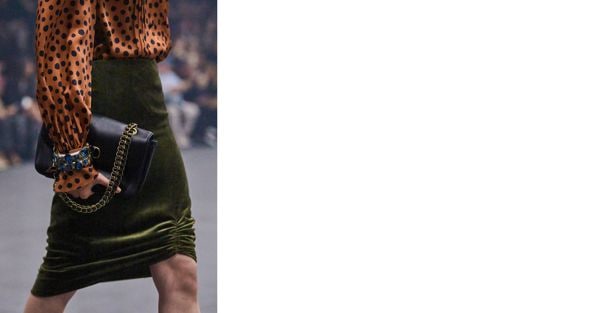
There is, however, a red thread uniting the maison, its founder and Michele, woven of nostalgia, noble indolence, but above all love for the Eternal City. It is a question of crossed destinies, of ties that are reknotted in the place where the stratification of time celebrates beauty: a perimeter that the creative man defines as "therapeutic, narcotic like that unbearable lover who forces you to stay". The decision to present the autumn/winter 26-27 collection in Rome, abandoning, for this season only, the Paris Fashion Week, was thus born. Strongly desired by the creative director, it marks a return to his origins. A rapprochement that, the designer confesses, is part of a bigger plan: "Sometimes destiny works in a precise way, nothing happens by chance. Showing in Rome had already been decided before the death of Mr Valentino. I think it is nice to be able to tell this maison in the place where it was founded'.
The brand was born in Rome in 1960 from the genius of Valentino Garavani and the entrepreneurial intuition of Giancarlo Giammetti, a companion in business and affection, debuting with an elegance that blends the allure of French haute couture with Italian sensuality. Despite its roots in the capital, the relationship with Paris has always been visceral: in 1975, the fashion house moved its prêt-à-porter shows to the Ville Lumière, consolidating a cosmopolitan aesthetic that united the two luxury metropolises. For almost four decades Garavani and Giammetti retained ownership, leading the expansion into accessories and perfumes, before deciding in 1998 to sell the company to Holding di Partecipazioni Industriali (HdP), which four years later sold it to the Marzotto textile group. In 2007 a new change, the entry into the portfolio of the Permira fund, until the most significant turning point in 2012: the Qatar-based Mayhoola for Investments S.P.C. acquired control, giving new life to the brand. In recent times, the corporate structure has been further redefined: in July 2023, the French giant Kering, owner of Gucci, Bottega Veneta, Balenciaga and Saint Laurent, bought 30 per cent of Valentino, with an option to acquire the whole by 2029.

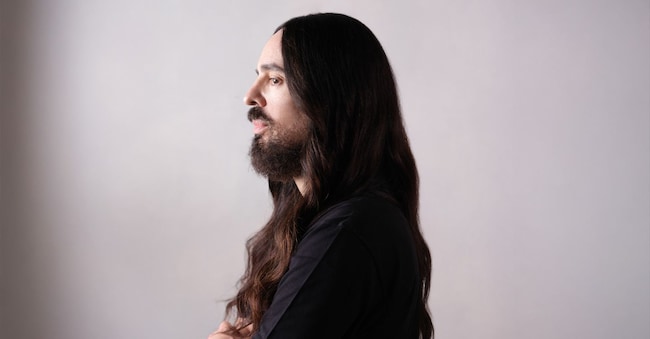
Crossing the threshold of the studio that was once Garavani's, then Maria Grazia Chiuri's and Pierpaolo Piccioli's, from 2008 to 2016 in tandem, and then only the latter's until March 2024, is like entering a chamber of wonders. The largest reception room in the Baroque palace, converted into a private studio by the founder, has now become a domestic interior, a kind of animist temple. The room is a stratification of the aesthetic taste of its previous occupants: from the late 17th-century coffered ceiling to the 19th-century frescoes, to the boiserie-like wallpaper commissioned by Valentino Garavani in the 1980s and now worn away by time. "It is a kind of eerie conversation with this beautiful ceiling. I like délabré environments,' Alessandro Michele explains, inviting me to sit next to him on an 18th century dormeuse with yellow satin cushions. He wears a jumper with embroidered sheep, brown velvet trousers and trainers. Her long raven hair is loose on her shoulders and frames her pale face, her deep black eyes a little dreamy, but with a curious sharpness. Her fingers sparkle with antique gold rings and large gold and coral bracelets come out of her wrists. Amidst 18th-century consoles, screens with archaeological whimsy and Capodimonte vases, neoclassical wreaths and antique fans are arranged on the tables, as well as a lucky pig and a large ceramic cat, gifts - the designer will later confess to me - from his friend Elton John.