
If you turn the knob, you cross the border
Seven valleys of Friuli Venezia Giulia are told through language and landscape at the museum in San Pietro al Natisone

6' min read
Key points
- Krivapete and the Natisone Valleys Carnival
- No notice boards, but sound and visual installations
- Donatella Ruttar's project
- The eight stations
- The memorable Topolò festival
6' min read
When, in the woody cold of February in the Natisone Valleys, a stone's throw from Cividale del Friuli, a pinch on your bottom makes you jump up and, turning around, you see the arm of a very long pincer, it means that carnival has arrived. Already from the name of the terrible retractable pincers, kliešče, it is clear that these valleys with their verdant and shadowy backs, full of water and smells of smoke and fog, are physical, but above all philosophical, margins, or friable faults of linguistic admixtures and customs. They mix Latinity, claimed by the seal of Forum Iulii - the ancient toponym of Cividale that gives its name to the region, Friuli Venezia Giulia -, Slovenian traditions and Nordic magical rituals.
Krivapete and the Natisone Valleys Carnival
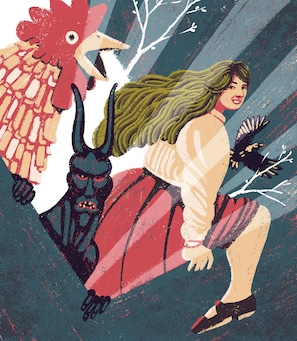
Here live the krivapete, prescient women with green hair and twisted feet, transgressive and wild, who use herbs to cure or take revenge. During the Pust, the carnival of the Natisone Valleys, black devils and white angels chase each other with a great flapping of chains, and all that is Mediterranean is the merriment of the pranks of the pustùovi, men and women masked with pointed hats and dresses adorned with long ribbons and flowers; or by giant cloth roosters and chickens (in Mersino), or by blumari (in Montefosca) figures who, in white overalls and cowbells tied on their backs, run around the village along a ring-shaped route. A photograph of the cowbells can be detached from the wall of one of the sections of Smo (Slovensko multimedialno okno). This is the (free) museum of landscapes and narratives in San Pietro al Natisone, in the province of Udine, dedicated to the cultural landscape that runs from the Màngart, a mountain in the Julian Alps, whose crests snake along the Italian-Slovenian border, to the Gulf of Trieste.
No notice boards, but sound and visual installations
No traditional notice boards, but sound and visual installations to be activated by passing a hand inside a niche, placing a book on a table or pressing buttons. An archive to be discovered by virtually leafing through the contents presenting the history, music and traditions of seven areas of Friuli Venezia Giulia (Val Canale/Kanalska dolina, Val Resia/Rezija, Valli del Torre/Terske doline, Valli del Natisone/Nediške doline, Gorizia and the Collio/Gorica in Brda, Karst and the sea/Kras in morje and Trieste and Istria/Trst in Istra), where until the First World War - as the Germanist, writer and translator Hans Kitzmüller explains in an installation - Italian, Slovenian, German and Friulian-speaking peoples coexisted peacefully with 'prolific' pollination: a rarity, if not a uniqueness, in border areas.
Donatella Ruttar's project
.Conceiving, designing and coordinating the museum was architect Donatella Ruttar, who realised the project in 2013 with a (finally) successful use of European funds. The work behind the scenes lasted three years and saw the collaboration of a cohesive team, including Paolo Comuzzi, who curated the video work, Antonio Della Marina together with Samuele Polistina (lecturer at the Milan Polytechnic) for the interactive digital project of the eight installations. The last one, Meja (boundary), designed during Covid, was realised with the collaboration of Paolo Solcia from Ied in Milan and Valerio Bergnach. The museum is an environment of refined minimalist architecture, which aims to be silent and archaically poetic, but at the same time contemporary, so that young people can recognise themselves. The visitor is greeted by the three letters, Smo, one metre high, in the rusted stone of which so many beautiful Collio cellars a few kilometres away are clad. San Pietro is the capital of the now depopulated mountain community, where a Slovenian dialect is predominantly used, different and older, due to geographical isolation, than that spoken, for example, in Trieste. Ruttar was already president of the local artists' association and it came natural to her to think of her village of two thousand inhabitants as an ideal place to represent Benecia, the Friulian Slavic region, faithful to the idea that a cultural offer is more constructive and lasting than the hit-and-run tourism of the summer cold bath in the icy waters of the Natisone river or the gastronomic allure.
The eight stations
.Ruttar's idea was that of an environment capable of astonishing, making people feel at ease, stimulating the guest on a very thorny terrain, language, that is the most intangible and delicate heritage that exists, the one that loses a little piece with the death of every elderly person. A witness in a totem pole explains, in fact, how the word earthquake -a well-known phenomenon in Friuli in 76-, does not render as well as the word potres, where every single letter 'trembles'. Slovenian poet Alenka Rebula explains: 'Poetry speaks through images in a language that is somehow old, but always new, and helps to render what is unclear because it is buried'. At the same time, the museum wants to bind itself to the landscape with its own ethical dimension, because the territory tells this border people with a predominantly oral history. The forest of the Natisone Valleys, now abandoned, contains, for example, traces of terracing revealing a forgotten agricultural culture. And then, in a land of conflicts such as this, the landscape composes the philosophical and non-philosophical 'margin'. The first installation, 'Cultural Landscapes', is a triptych in which three screens propose as many visions with the same point of view slightly offset to generate more questions than answers. Eight hours of film clips of about 15 minutes each that present visions of the seven valleys through little-visited views, from votive churches on the Trieste border at Fernetti, to abandoned landscapes in which to dive like divers. Then there is the 'Talking Library' with its 'magic' books: you can take Piazza Oberdan (nuovadimensione, 2010) by Boris Pahor, read it, or put it down on the table: the Slovenian writer will appear in a full-length dialogue. And so with Claudio Magris, leaning his Danube (Garzanti, 2015). And many others.On seats that look like huge, shiny stones, one can look at artistic photos to detach and take home, such as the one of cowbells; in the 'Sound Postcards' and 'Musical Landscapes' one can 'hear' the sound of the Bora wind in Trieste through headphones. In a small cinema, one can 'plunge' vertically into the belly of the earth with the miners of Cave del Predil in the Tarvisio region. The sharp, modern drawings of Cosimo Miorelli's 'Illustrated History' explain the 0rigin of the Slovenian language from Methodius to the prohibition of its use by fascism. Then there is a big radio with a knob, moving it to switch between different frequencies that can offer visions of horizons or the listening of ancient songs, such as those from the Resia Valley, where it was long believed they spoke in Russian; and, again, sounds of accordions and scampanii. "Memoria della voce" testifies to the variety of dialects: if you reach out your hand towards an object in a niche, e.g. a ladle, a voice starts telling a traditional recipe. "Meja" is activated by touching buttons in the shape of the currency of the chosen era: one can "see" the arrival of the Lombards, based on the account of Paul the Deacon, or witness the abolition of the Italo-Slovenian border in 2007. "Atlas" is a large map that makes it possible, by clicking on the name of the town, to "look at it", to "feel it" and to understand whether the place names have Latin origins or are, instead, phytotoponyms, as in the case of Topolò, which derives from topol, poplar in Slovenian.


