
Iit and Leonardo computers for the advancement of medicine
Algorithms. Supercomputers are at the heart of the development of science and new treatments In the pipeline is the davinci-1 upgrade

2' min read
2' min read
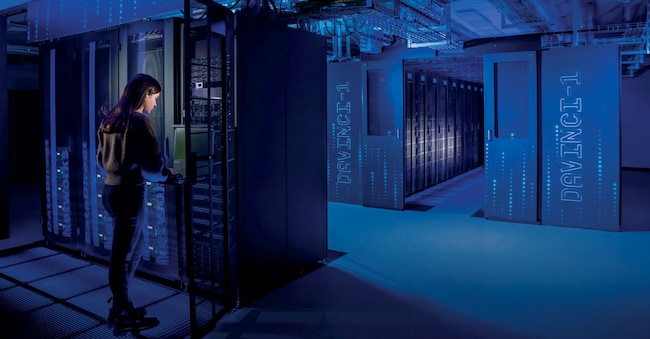
Those who fear artificial intelligence, seeing it as a sort of prelude to a robotic mind capable of supplanting that of man, will have to think again. At least for now, Ai is helping humanity to advance science and, above all, medicine, at a pace never seen before. The supercomputers of Leonardo and Iit, respectively davinci-1 (capable of performing 5 million billion operations per second) and Franklin (1 million billion operations per second) are working in this direction in Genoa.
"Ai', explains Carlo Cavazzoni, head of digital infrastructures at Leonardo, 'is software that needs hardware to replicate the cognitive faculties of man: to do so requires great computing power, without which generative Ai cannot be created. Leonardo, in 2020, with great foresight, equipped itself with davinci-1, one of the first machines in the world to have the same hardware cards that Microsoft would later use to make ChatGpt, those of Nvidia. This allowed us to independently develop a very sophisticated artificial intelligence. We were the first to start, and we are now working on enhancing davinci-1, to bring it to the point where it can do billions of operations per second. With the aim of developing algorithms independently of the big majors, for confidentiality reasons'.
In the meantime, however, davinci-1 is working. 'A few months ago,' Cavazzoni continues, 'among others, a project started, called Sinisa (after Mihajlovic), which aims to study haematoncological and cardiovascular diseases. In this field, artificial intelligence is used to study the genome and to find precursor signals or identify predispositions to these diseases. In the project, davinci-1 supports the processing of the genomic data, which needs a great deal of computing power, and the development and training of artificial intelligence algorithms created ad hoc, on the instructions of the researchers, which also cross-reference the genomic data with other elements of the population being investigated, e.g. lifestyle.
On the IIT side, artificial intelligence is used, among other things, for the development of new drugs. Iama therapeutics is a start-up of the Institute, created by the research units coordinated by Laura Cancedda and Marco De Vivo, with the aim of bringing new drugs to the market, in order to provide treatments for patients suffering from neurological diseases, such as certain forms of autism and epilepsy. To discover new drugs, artificial intelligence is exploited, used to generate computer simulations of the molecules of interest. Starting from these simulations, possible new drug molecules can be discovered or constructed, to be tested in the laboratory and in clinical trials. The start-up has currently begun, 'with excellent results', say the IIT, the first phase planned for the clinical trials on humans of the drug candidate, which could reduce cognitive retardation in certain forms of autism.
Not only medicine, however, is the focus of attention. The Atomistic simulations team, coordinated by Michele Parrinello, has used artificial intelligence and the Franklin supercomputer to facilitate the production of hydrogen from ammonia: it has discovered the mechanism of a catalyst that facilitates the conversion, at a lower temperature than usual. Thanks to this system, the aim is to reduce the problems of hydrogen distribution and storage by facilitating its transport in the form of ammonia.


