Carnegie Hall

Cameron Winter’s concert is being made into a film by Paul Thomas Anderson

Premiered at the New York Film Festival, an intertitle appears that resembles an obituary: Cameron Winter, Dead at 23

by Filippo Brunamonti

Aggiungi Il Sole 24 Ore
ai preferiti su Google
Janus Fims

5' min read

Translated by AI
Versione italiana

5' min read

Translated by AI
Versione italiana

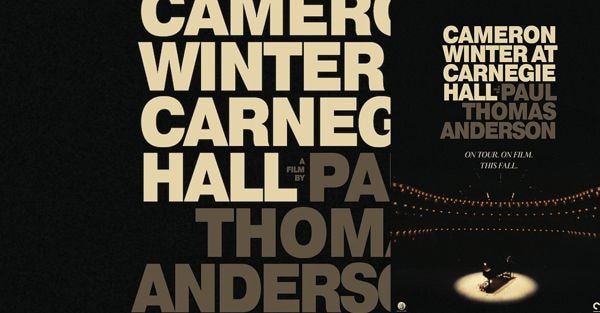
“The man who had his back to the audience” has died. Towards the end of *Cameron Winter at Carnegie Hall*, which premiered at the New York Film Festival, an intertitle appears that resembles an obituary: Cameron Winter, Dead at 23. It is a joke, and in the cinema we take it as such. But the “boy dressed in skeletons of leaves and the resin that drips from the trees”, on 11 December 2025 – the date the concert was recorded – has truly gone elsewhere. A Barrienian ‘elsewhere’ reminiscent of Neverland, perfect for flying without wings.
Janus Fims

The performance at Carnegie Hall, ‘Second Star to the Right’, treats us to 71 minutes of one of the most versatile singer-songwriters on the new New York indie-rock scene. Frontman of the band Geese and creator of the solo project Heavy Metal, Winter blends words of madness, introspection, faith and a cocktail of love.

Loading...

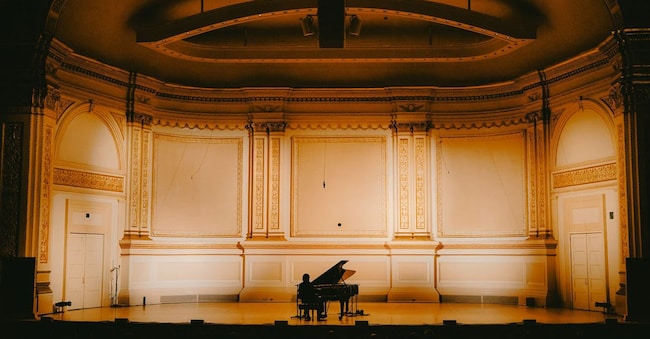
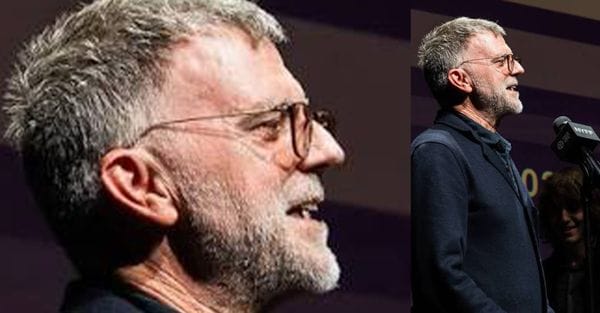
Last year, Cameron Winter – with the auditorium packed to the rafters, right up to the highest gallery – suddenly became one of the youngest artists ever to have performed solo in the temple of music that has welcomed Tchaikovsky, Rachmaninoff, Duke Ellington, Benny Goodman, the Beatles, Bob Dylan and Lenny Bruce. Whilst in the studio he blends art rock, post-punk and folk, on stage Winter strips things down to the bare essentials. There is just a piano and two microphones held together with a strip of adhesive tape. In the audience and behind the scenes, director Paul Thomas Anderson is wandering about, three months before his Oscar haul for *One Battle After Another*. He has a Panavision camera slung over his shoulder, manoeuvring it like an athlete. At his side is Benny Safdie, co-producer and second cameraman. It is no coincidence that the rough, unmistakably New York grain of the images bears the scratchy imprint of that legacy of filmmakers.
Film at Lincoln Center

The result is a concert film characterised by moments of pause and immersion: Winter seated at a Steinway grand piano, stripped-back versions of the songs from his solo album (Heavy Metal), slow, contemplative melodies that have the texture of a tattered prayer.

Janus Films

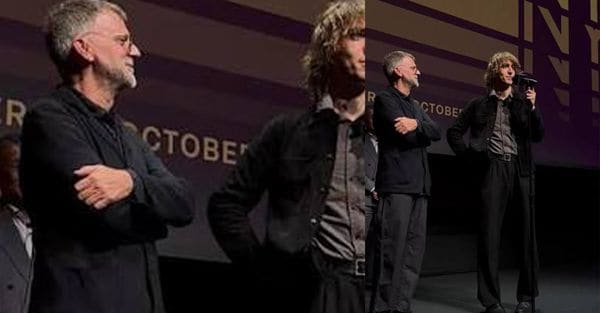
Janus Films will be releasing *Cameron Winter at Carnegie Hall* in cinemas across North America from 20 November, ahead of its inclusion in the Criterion Collection. Paul Thomas Anderson eschews excess and portrays Winter with understated precision, capturing his lolling gait – the stride of someone who has not yet decided what to do with his wings. He is as tall as a giant, dressed in black from collar to ankles, with long, glossy, tousled hair. Thick eyebrows and a heartbroken gaze. He pauses beside the piano and gives a slight bow. PTA is a ‘militant of the impossible’ and chooses to position the piano slightly askew on the bare floorboards of Carnegie Hall, with his musician, Winter, with his back to the audience. His fingers touch the keys, and everything is bathed in light. Entirely absorbed in his own songs, like a goldsmith bent over his work, Winter is illuminated by a silent current. The piano is transformed into a vessel; the music spreads like a rhapsody, a sound never heard before.
Film at Lincoln Center

To understand what’s happening at Carnegie, we need to take a step back to 19 November 2024, when Winter announced his first solo album. Ten tracks and a sound that delves into chaos and existential anguish. It’s produced by Loren Humphrey, who has previously worked with the Arctic Monkeys and Lana Del Rey. The first taste is titled $0: six minutes of balladry, frenzied strings and the voice of a narrator who feels like a banknote clutched in the hand of an outcast. A man-child not even worth a dollar. *Heavy Metal* is a blend of 1970s folk, Waits, Dylan and “Weird Al” Yankovic, the king of parody-polka. When asked about his influences, Winter replies: “As a lad, I took an unknown number of blows to the head, and amidst those concussions, a love for Waits blossomed. But Weird Al came before all the others: a sort of foundation upon which the whole range of my influences rests.”

Paul Thomas Anderson has always had a knack for bringing music to life and giving it a certain radiance. He cut his teeth in the late 1990s, when, fresh from *Boogie Nights*, he was shooting Technicolour music videos for his then partner Fiona Apple – videos that were small yet magnificent works of art – and when, in *Magnolia*, he entrusted the songs of Aimee Mann with the soul of the entire San Fernando Valley, even going so far as to have his characters sing them in unison, each trapped in their own solitude. Later came Radiohead, Joanna Newsom and HAIM, one of whom, Alana, went on to become an actress through his influence. Not to mention Jonny Greenwood, Radiohead’s guitarist, with whom he has created highly personal soundtracks: *There Will Be Blood*, *The Master*, *Inherent Vice*, *Phantom Thread*, *Licorice Pizza* and *One Battle After Another*.

As the director of a film entirely devoted to a concert, Anderson has only one previous example to draw upon: *Junun*, 2015. A turning point for the director, who on that occasion followed his regular musical collaborator, Greenwood, during a session in Rajasthan, north-western India, whilst he was recording an album with the Israeli composer Shye Ben Tzur. Anderson knows the lexicon of old music documentaries by heart, and makes this clear from the very first minutes of *Cameron Winter at Carnegie Hall*, but it is his focus on the ever-changing human landscape (which Winter sings about) that draws him in, to the point of zooming in on the musician’s fingers and nostrils. In this concert film, at certain points, the camera turns and surveys the hall: four superimposed tiers of the Carnegie Hall, separated by three rows of lights, ‘like the tiers of a secular cathedral’. Everything is shot on film, in 35 and 16 millimetres, and bathed in an orange and amber light, as if the hall were illuminated by a thousand flickering flames, and the galleries were holding their breath so as not to extinguish them. The backbone of the work consists of long close-ups. Within each song, Anderson and editor Andy Jurgensen extract a few drops of poetic alchemy and bring us straight back to reality. Anderson and Safdie may well have taken their cue from the way Jonathan Demme transformed, right from the very first frames, a classic Talking Heads performance into an immortal vision (*Stop Making Sense*, 1984). Even the very first image – the shadow of a guitar neck silhouetted against a white wall – wittily evoked the menacing, mechanical qualities of their music (in the words of Janet Maslin in the New York Times). Like Demme, PTA has woven the film with grace and menace around his musical ‘shadow’, the Peter Pan of the indie scene. Through long, fluid camera movements and extraordinary audio clarity, Anderson proves himself once again to be a humanist.

Copyright reserved ©
Loading...

Brand connect

Loading...

Newsletter

Notizie e approfondimenti sugli avvenimenti politici, economici e finanziari.

Iscriviti