
Meloni’s thaw in relations with Trump. But Rome’s approval of the mission to Hormuz is conditional
In Évian-les-Bains, the first meeting between the Prime Minister and the US President since the rift. Regarding the deployment of the two minesweepers in the Strait, Italia is waiting to clarify the details of the agreement and the operational framework
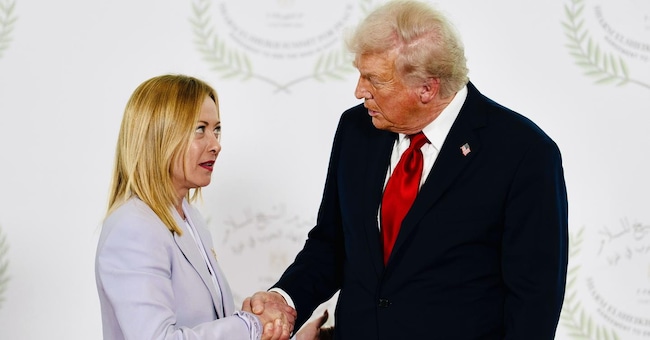
Uncertainty and mistrust hang over the first day of the G7 summit in Évian-les-Bains on Lake Geneva: regarding the details of the US-Iran agreement to be signed on Friday in Geneva, the possible defensive mission in the Strait of Hormuz that France and the UK, along with the Netherlands and Italia, say they are ready to launch, the Iranian nuclear issue and the fate of Lebanon. Giorgia Meloni lands in Geneva shortly before 6pm, whilst Donald Trump and Emmanuel Macron speak to the press ahead of their meeting, which will last over an hour. The welcome, with Macron and the First Lady Brigitte greeting the Prime Minister immediately after Trump (shared on social media by Macron to the tune of ‘Felicità’ by Albano and Romina), is composed. Meloni smiles only for the cameras.
The first face-to-face meeting with the US President takes place following the signing of the agreement in Sharm el-Sheikh for peace in Gaza and, above all, following the tycoon’s attacks on her and the Pope and the chill that has settled over relations with Washington: the customary greetings are exchanged, then there is laughter and banter. ‘Partial thaw’ is the interpretation. The process of clarification has begun.
Mistrust of Trump’s announcements continues to weigh heavily, certainly not dispelled by the manner in which the tycoon arrived in Évian: threatening new 100% tariffs on wines and champagne if Macron does not scrap the 3% digital services tax, and asserting via Truth that ‘unfortunately, if you import people from Third World countries, you quickly become a Third World country’. A broadside against Europeans on immigration that echoes the one launched by Vice-President JD Vance in Monaco in February 2025.
The Prime Minister has in fact issued a statement early this morning regarding the US-Iran agreement, following the joint statement with Macron, Merz and Starmer issued at midnight on Sunday. ‘This opportunity for peace must be seized,’ Meloni stated, thanking all the mediators, particularly Pakistan and Qatar, and confirming her willingness ‘to contribute to an international naval presence to accompany the full reopening of the Strait’. But, she adds, ‘the principles are clear: Iran cannot acquire nuclear weapons’ and ‘hostilities must also cease in Lebanon, where Italia will continue to work to support Lebanese sovereignty’. A message to Israel, even though at the Foreign Affairs Council in Luxembourg, attended by Deputy Prime Minister Antonio Tajani, there was a deadlock over sanctions against Israeli Minister Ben-Gvir (unanimity was lacking), which Rome had also advocated following the Flotilla incident.
Italy’s stance is clear, however: the external ‘preconditions’ for committing to mine clearance in the Strait of Hormuz, which Defence Minister Guido Crosetto – currently in Washington to meet with Secretary of War Pete Hegseth – believes are not yet in place. These preconditions are compounded by internal ones: parliamentary authorisation. The Navy’s two minesweepers, the ‘Crotone’ and the ‘Rimini’, are already in port in Djibouti, attached to the EU’s Aspides mission operating in the Red Sea to provide protection against the Houthis.


