
The Giornale dell'Arte passes to the consortium of Banca Intesa, Fondazione Sanpaolo and F. CrCuneo
The publishing house founded by Umberto Allemandi sold to a pool of banks and foundations, CEO Cerutti remains in charge

3' min read
Key points
3' min read
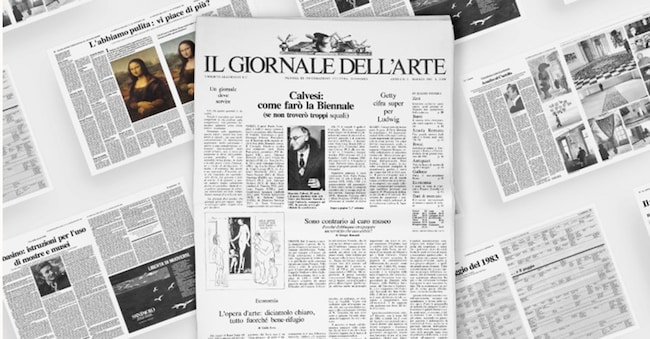
Umberto Allemandi Editore passed from the hands of its founder Umberto Allemandi to the "consortium" made up of Banca Intesa Sanpaolo, Fondazione Compagnia di Sanpaolo and Fondazione Cassa di Risparmio di Cuneo to relaunch through the acquisition of 100% of the publishing house's industrial branches. The company publishes the historic monthly magazine Il Giornale dell'Arte, on newsstands for the first time in May 1983, under the direction of founder Umberto Allemandi. The aim of its indefatigable founder has always been to propose an innovative editorial product in the field of art, updating the Italian art system with news, reports and analyses on national and international market trends. The magazine is produced in Turin and has a monthly circulation of more than 20,000 copies. Luigi Cerutti, managing director of the Turin-based company for the past three and a half years, will continue to lead. The publishing house has long had suitors, not least the attentions of CoopCulture and, in the past, other publishers.

Since 1983, the GdA, for those in the know, has constantly informed on what has been happening in an area that is extremely rich in culture and art, but also lacks constant attention on a national level, always emphasising the most controversial topics and reporting on its protagonists, its economy, its stories and its everyday life. The main novelty of the Giornale dell'Arte was that it was formally conceived as a traditional daily newspaper but with a monthly periodicity and dedicated to news from the various sectors of art and culture: from archaeology to photography, from books on art to museums and foundations, from exhibitions to restoration and protection, from cultural policies to the economy of art, giving the floor to opinion leaders and curators of weight. Then over the years to the magazine full of inserts (Vernissage', 'Il Giornale delle Mostre', 'RA. Annual Report', 'Vademecum' and 'See a') has naturally been joined by the website, which provides a daily update on art.
The Italian format was also a model for autonomous versions of the magazine in other languages such as the authoritative English The Art Newspaper, Russian The Art Newspaper Russia, Chinese The Art Newspaper China, French Journal des Arts and Greek Ta Nea Tes Technis. Umberto Allemandi and Anna Somers, for many years director of The Art Newspaper, from Federico Zeri to Massimo Montella, from Francesco Poli to Renzo Piano and Nicholas Penny. Many curators and artists have accompanied and are accompanying this long narration of the Italian art system without ever losing sight of what is happening in the world around. "For a publishing house like ours," explains Umberto Allemandi, "this passage marks an extraordinarily important moment. For forty years we have invested every effort in the affirmation of an absolute editorial quality identity, in form and content, always innovative, first and foremost the Giornale dell'Arte, an entrepreneurial world record that had not been achieved by any other Italian newspaper, a model that has generated twin replicas in Great Britain, the United States, France, China, Russia and elsewhere". For Michele Coppola, who was appointed by the shareholders' meeting as chairman of the new Allemandi publishing company, "Continuing a history of Italian excellence is the will that has united the country's leading bank and two of the largest banking foundations in this initiative, sharing a commitment to art and culture as an inalienable part of their DNA. For Intesa Sanpaolo, the importance of investment in this area, explicitly reaffirmed in the Business Plan, has led to the transformation of buildings owned by the Group into the four Gallerie d'Italia museums and the constant care of the Group's and the country's artistic heritage, with results that make our Culture Project a unique case in Europe".
Publishers and Banks
.For Banca Intesa and the two Foundations, their perimeter linked to art is expanding. Intesa already has the Progetto Cultura to its credit, which brings together the initiatives that promote art and culture in Italy through the museum system of the Gallerie d'Italia with its four branches in Turin, Milan, Naples and Vicenza. The Compagnia di Sanpaolo Foundation is strongly active with calls and projects in sustainable development, especially in the cultural and citizenship spheres, just as the Cassa di Risparmio di Cuneo Foundation also issues calls and promotes heritage management projects in support of the territory.


