
The Pierre Cardin Museum in Venice: a fashion show into the future
Palazzo Bragadin, Pierre Cardin’s Venetian residence, is set to become the first museum dedicated to the Italian-French couturier

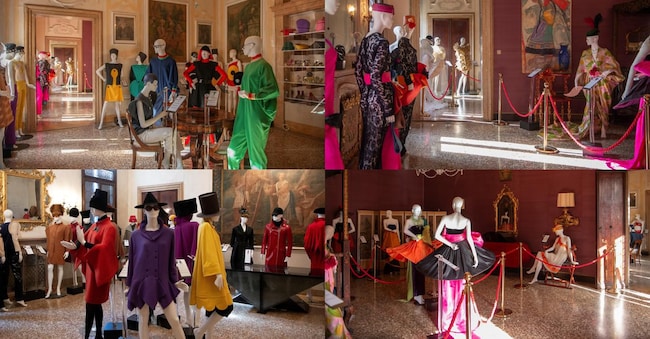
He was thinking about the future. The past was of little importance to him; it was almost non-existent. His gaze was always fixed on what lay ahead – on what he would achieve tomorrow – imagining what did not yet exist. Perhaps this is why he never considered creating a comprehensive archive of his creations. In fact, very few of his papers, drawings and patterns have been preserved, despite a vast legacy – tens of thousands of items – comprising prototypes, models and one-off garments.
Pierre Cardin preferred to create his garments directly from the fabric; he had a thorough understanding of the tailor’s craft and knew exactly how to cut, sew and fit a design simply on the mannequin. His ideas were then transformed into architectural forms, into sculptures made of fabric.
This 20th-century fashion giant, who was revolutionary in a thousand different ways (he was responsible for the miniskirt with slits and the collarless jackets also worn by the Beatles; he invented prêt-à-porter and the licensed production of hundreds of products worldwide) – the first museum dedicated to him has been opened in Venice. Or rather, to be precise, the house-museum, because Palazzo Bragadin, in Calle della Regina, was Pierre Cardin’s Venetian residence, and he loved to return to the lagoon frequently.
His roots, after all, were here: Pietro Costante Cardin, as he was registered at birth, was born in 1922 in Sant’Andrea di Barbarana, a few kilometres from Venice, but his family moved to France very early on, where Cardin lived for the rest of his life, without ever forgetting his roots.
Venice was his spiritual home, the place where Pierre Cardin would retreat to recharge his batteries; it was also where his fortune began, in 1951, when Christian Dior commissioned him to design some thirty costumes for the ‘Ball of the Century’ organised at Palazzo Labia by the Mexican billionaire Charles de Beistegui. It was a global success, which enabled him to open his first atelier.

