
‘Neoliberalism has failed’: Schlein shifts to the left, with an eye on social unrest and young people taking to the streets
The Democratic Party secretary brings the three-day ‘correntone’ event in Montepulciano to a close and speaks as the prime ministerial candidate-designate. “It is right to support Ukraine, but diplomacy is needed: Europe’s voice is missing.”

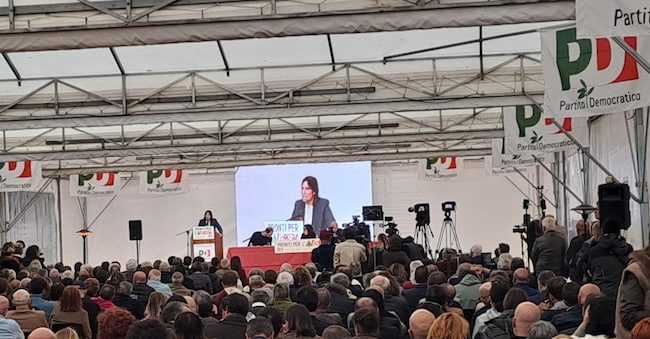
Key points
- In Montepulciano, Schlein speaks as the prime ministerial candidate-designate
- ‘You can’t win by taking the middle ground; we need radical change – neoliberalism has failed’
- The fight against privilege, starting with the big energy companies, the housing plan and the right for young people to stay in their homes
- ‘It is right to support Ukraine, but diplomacy is needed: Europe’s voice is missing’
- A left-wing programme focusing on social hardship and young people taking to the streets
- Businesses also have their say in Montepulciano: China, tariffs, energy and the exodus of young people are the priorities
‘Faced with a right-wing that brings chaos, war, inflation and recession, we must offer protection and peace of mind. We must build the peace of mind needed for a better future – the peace of mind enshrined in Article 3 of the Constitution on equality.’ And again: “After four years of Meloni’s government, Italia is poorer and more furious. It is up to us to listen to that suffering. It is up to us to answer this call, to do so together with our allies, steadfastly united. We will do so swiftly, because we are not starting from scratch. Most of the proposals are already the result of joint work in Parliament and across the country. Now we face the final crucial stretch. We will tackle this challenge together. Together we can defeat the right and shape a fairer future. Let’s go and win. Thank you. Long live the PD and anti-fascist Italia.”
In Montepulciano, Schlein speaks as the prime ministerial candidate-designate
Elly Schlein’s speech, which brings to a close the three-day meeting in Montepulciano of the ‘correntone’ – the faction within the PD aligned with Dario Franceschini, Andrea Orlando and Roberto Speranza, which supports the party leader but which, just a year ago, sought to form a federation to carry more weight within the party and in the forthcoming drawing up of the electoral lists – is a speech befitting a prime ministerial candidate-in-waiting. The PD leader had already sought to demonstrate her strength against the leader of the Five Star Movement, Giuseppe Conte, at the national assembly on 18 October, which extended his term by a year (“‘I am ready to stand as a candidate for Prime Minister’”) and now, speaking to the bulk of her party that has supported her from the outset, she seems to be treating the transition as though it has already taken place.
He does not dwell on the timetable and does not respond to Conte’s calls to act swiftly on both the programme and the primaries. He had left the task of setting out the roadmap to his right-hand man, Igor Taruffi, the day before: a joint programme by the end of the year and primaries in the early months of 2027 (January, as the M5S wants, or February–March, as the PD wants?). And he again left it to Taruffi to remind the reluctant allies (not only the M5S but also the AVS) that victory is impossible without the centre – that is, without Matteo Renzi: ‘Let us remember that last year we contested seven regional elections in which the PD, the Five Star Movement, AVS and the centrist forces stood together: this is the alliance we will take into the elections.’
‘You can’t win by taking the middle ground; we need radical change – neoliberalism has failed’
The question of the scope of the progressive alliance – or the centre-left, if you will – is, in short, settled as far as Largo del Nazareno is concerned: Renzi will be there, as will Più Europa and the other ‘centrist’ groups wishing to join (from Ernesto Maria Ruffini’s Più Uno to Alessandro Onorato’s Progetto Civico Italia). She, the prime ministerial candidate-in-waiting, is focusing on her vision for the country’s future and on what the coalition’s programme should be. And, as if to reassure the party’s left wing – who are listening – as well as her allies, she makes it clear that opening up to the centre does not mean a return to ‘neoliberalism’. No, the response to the people’s discontent must be a radical one. “You don’t win by sitting in the centre, but by having the courage to imagine a different model of society,” Schlein emphasises. After all, it is time for the primaries, and the identity-based vote must be strengthened by taking it away from the M5S and AVS; as for the ‘secondaries’ – that is, the actual elections – there will be time for that after victory at the polling stations.
‘Neoliberalism has failed on every front; we must focus on a new model of development. This is our mission,’ declared the Democratic Party secretary, to the applause of those gathered under the marquee set up in the Poggiorfanti Gardens in the beautiful Tuscan town. ‘The real fear lies with those who wish to preserve privileges they lack the courage to challenge. I have never seen a right generously granted from above, but only one won through a great collective mobilisation. We have always been on that side of history.’


