
The Po and the lakes have run dry. Emergency in the Po Valley
Water levels in the river are at a third of normal. Rice, maize and fruit crops are at risk. 101 local authorities are in a state of emergency, including for domestic use. Water is being supplied via 24 tankers

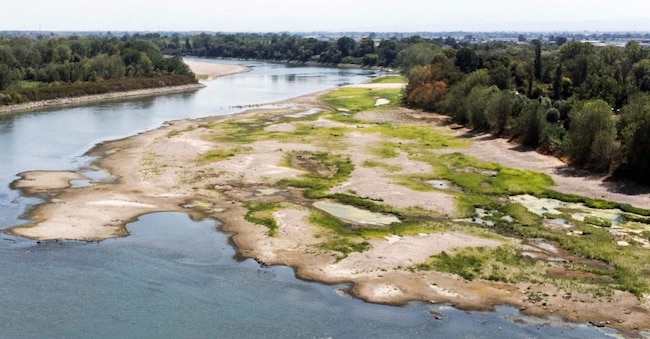
The worst is, in all likelihood, yet to come. Although the River Po in Turin has already been reduced to a quagmire from which algae and rubbish are emerging, and at all the key monitoring points the river’s flow rates are well below historical levels. Piacenza, Cremona, Reggio Emilia, Mantua, and the Delta, where saltwater intrusion threatens to jeopardise harvests and the use of the river’s resources, including for irrigation purposes.
The worst part is the weather forecast, which predicts that weather systems passing through over the next few days will bring only sporadic summer thunderstorms. A drop in the ocean. Thunderstorms may bring temperatures down slightly, but they won’t affect the flow of the Po, which is very likely to decrease further. Thunderstorms, not steady rain for hours on end – that’s what the whole Po Valley desperately needs right now. With these forecasts, alongside the Great River – the ‘father of the Plain’, as Gianni Brera called it – the lakes, with the exception of Lake Garda, are also set to remain at below-average levels, and consequently so too are the other rivers and canals of the irrigation system across the entire region.
According to data compiled by the Permanent Observatory on Water Use in the Po River Basin, coordinated by the Po River Basin Authority (which covers the entire Po Valley, from the river’s source to its mouth), it is precisely the weather conditions of the last thirty days – with temperatures significantly higher than average and, conversely, lower rainfall – that have led to the current state of serious alert in Piedmont and Lombardy. In Emilia-Romagna and Veneto, however, a number of heavy thunderstorms have led to localised water accumulation, thereby alleviating the emergency. Consequently, the high temperatures expected over the coming days will not help to improve the situation.
The transitive property of water is elementary. High temperatures encourage evaporation. The lack of rainfall prevents reservoirs from filling up. Lakes are drying up and are not supplying water to the tributaries of the Po. A vicious circle that began in mid-June and continues unabated. The Great River has run very low indeed. The figures speak for themselves. Lake Maggiore is at 5.3 per cent capacity, with record-low water levels and record-low water discharge into the River Ticino, itself a tributary of the Po. The reservoir volume index – that is, the quantity of water stored – calculated for the period between 5 July and 3 August, indicates, according to the Observatory, ‘conditions attributable to extreme drought’.
This is a critical situation given the strategic importance of the Ticino-Lake Maggiore system in supplying Europe’s largest rice-growing region – comprising the Vercelli, Novara and Lomellina areas – at the height of the season when there is a high demand for water for irrigation.


