Steel industry

Former Ilva site, Milan Court of Appeal: hot area to be shut down within 90 days if emissions are not reduced. Government confirms loan

The judges have upheld the appeal lodged by the citizens’ associations: the application is justified by the risk of prejudice to the right to health

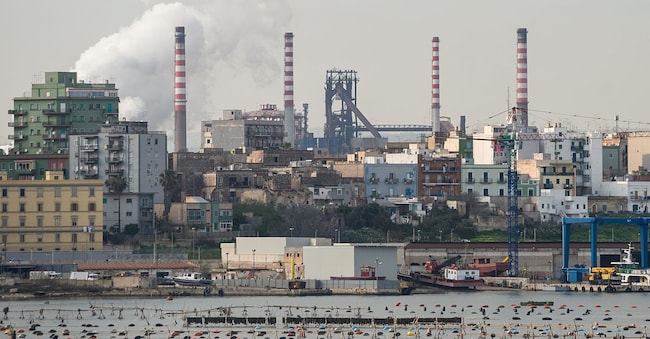
Una veduta dell’ex Ilva di Taranto (Foto di Alfonso Di Vincenzo/KONTROLAB /LightRocket via Getty Images)

5' min read

Translated by AI
Versione italiana

5' min read

Translated by AI
Versione italiana

Deflagra the former Ilva case on the eve of tomorrow morning’s summit on 28 July at Palazzo Chigi between the Government (the issue is also on the agenda of today’s Council of Ministers meeting, ed.) and the trade unions. Today, the Milan Court of Appeal ruled to halt operations at the Taranto steelworks. The Court’s civil division, as stated in the ruling, ‘grants the application for an injunction and, consequently, in partial reversal of the contested decree, orders Ilva spa, Acciaierie D’Italia SpA and Acciaierie d’Italia Holding SpA, all under special administration, to suspend production activities in the hot section of the Ilva plant in Taranto, granting them a period of ninety days, starting from the date of the final notification of the ruling, to complete the suspension operations under the supervision of the supervisory authority’.

Appeals and the Court of Appeal’s response

The Court of Appeal has ruled on the appeals lodged in recent months by a group of citizens from Taranto and the association “Genitori Tarantini”, as well as by the companies concerned, regarding the ruling by the Court of Milan which, in February, ordered the steelworks to halt production by 24 August if the company failed to review and amend a series of environmental requirements set out in the Hague Convention issued last year, which the judges deemed inadequate in terms of protecting the environment and public health.

Loading...

In the Court’s view, ‘it is clear that the citizens’ claim, as set out in the statement of 30 September 2025 and reiterated in the complaint, was in any event based – both before and after The Hague 2025 – on the risk of harm to the right to health and the right to a healthy climate. The citizens’ claims cannot be regarded as generic because the reasons why the operation of the plant poses a risk of harm to health have been clearly set out, with specific reference, amongst other things, to various identified harmful substances’, as well as ‘the inadequacy, at various times, of the measures taken by Ilva to avert the risk of pollution-related diseases”» and ‘the unjustified delays in implementing appropriate measures to avert the risks, as permitted by provisions of the 2025 Hague Convention, which are, in theory, unlawful’.

‘The 90-day period is appropriate’

“AdI and Adih, as well as Ilva SpA, must therefore be ordered to suspend operations in the hot area,” writes the panel. To this end, the Court considers it appropriate to grant the aforementioned entities a period of ninety days to complete, under safe conditions, the operations to suspend the operation of the installations, under the supervision of the supervisory authority. This period shall commence from the date of the final notification of the decree to the addressees of the order.”

‘It is left to the discretion of the plant operators and owners to resume operations,’ states the Court, ‘once they have completely removed all asbestos still present in the plants; adopted the necessary measures to bring emissions of fine particulate matter within safety limits, with reference to the authorised production scenario of 6 million tonnes per year, and in any event within the administrative procedural framework provided for by Legislative Decree No. 152/2006 and Directive 2010/75, in accordance with the terms specified in the ECJ judgment.” This is the judgement of the European Court of Justice which, in June 2024, ruled that an industrial installation causing damage to the environment and human health must be shut down.

Greenhouse gas reduction and asbestos removal

The Court of Milan further states that ‘the citizens’ complaint must be dismissed with regard to the claim concerning the reduction of greenhouse gases’. It must, however, be upheld ‘with regard to the injunction, both in relation to the claim concerning asbestos and that relating to particulate matter, each of which is decisive in its own right, even when considered individually, and subject to the incidental disapplication of The Hague 2025’.

‘The Court – in response to an explicit and reasonable request from the citizens – considers it necessary to depart in part from the order issued by the Tribunal to the opposing parties. Indeed, the granting of the citizens’ claims, on the terms set out, necessitates, quite simply, the suspension of operations in the hot zone of the plant. On this point, the ECJ judgement has in fact ruled that the operation of the facility must be suspended where, as in the present case, health risks are identified”, the judges write.

Harmful fine particulate matter: a health risk

Furthermore, the ruling states: ‘it must be taken for granted that fine particulate matter is harmful and poses a risk to health. Suffice it to say that the various AIA (Integrated Environmental Authorisation) procedures carried out over time have required continuous monitoring: clearly, this would not have been necessary if the emissions were harmless. The public administration itself has therefore recognised the existence of a health risk and the need for monitoring, which is carried out precisely because it is a prerequisite for the adoption of precautionary measures’.

According to the judges, the Health Damage Assessments (Vds), ‘which have been carried out over time, have acknowledged that, despite the fact that the limit values set out in Legislative Decree 155/2010 were not exceeded, there have been excess mortality and hospitalisation rates in the at-risk areas that are significantly higher than in other areas further away from the plant. This occurred even though the production level was far lower’ than the 6 million tonnes per annum authorised (including) under the 2025 AIA. The most recent production levels have settled at around 3 million tonnes per annum and are even lower given the most recent production levels, in which only two blast furnaces are in operation, sometimes alternating between them. From the foregoing, it is easy to conclude, as the Court rightly held, that compliance with those emission limit values is not sufficient to avert the serious health risk’.

Palazzo Chigi: funding approved

Following the ruling by the Milan Court of Appeal, the Prime Minister, Giorgia Meloni, has called an emergency meeting at Palazzo Chigi, emphasising that those affected by the measures are ‘the facilities essential to the plant’s production capacity, where the majority of Acciaierie d’Italia’s workers are employed’. She added that “the ruling comes at precisely the moment when we were on the verge of finalising the agreement for the sale of the entire industrial complex to a leading steel producer”.

Loading...

The meeting convened by Giorgia Meloni was attended by Ministers Marina Calderone, Tommaso Foti, Giancarlo Giorgetti, Gilberto Pichetto Fratin and Adolfo Urso, and by Under-Secretaries Alfredo Mantovano and Giovanbattista Fazzolari. According to a statement from Palazzo Chigi, the Government “takes note of the measure, which comes on the eve of the talks with the trade unions scheduled for tomorrow and which, in light of this decision, makes such talks even more necessary. Despite these new developments, the Council of Ministers, confirms the allocation of a further tranche of the loan necessary to ensure the company’s operational continuity pending the finalisation of the sale of the cold-rolling division”.

Copyright reserved ©
Loading...

Brand connect

Loading...

Newsletter

Notizie e approfondimenti sugli avvenimenti politici, economici e finanziari.

Iscriviti