
Imperial Age and new Made in Italy: the docufilm that pays homage to Rome, yesterday and today
The story traces the realisation of the casket-hotel inaugurated in front of the Mausoleum of Augustus: between local craftsmanship and innovation. Under the gaze of the first emperor.

3' min read
3' min read
The Golden Age shines in its polychrome marbles. Those that embellished the Theatre of Marcellus and the Baths of Agrippa - the first in the Urbe - or the Pantheon, the temple of the great. The phrase attributed to Rome's first emperor - 'I found a city of bricks, I give it back to you in marble' - describes an ascending climax punctuated by monuments that are still among the most precious and best preserved in the city. The apex of this parabola is the mausoleum that bears his name, begun in 28 B.C., after the conquest of Egypt, and now undergoing redevelopment. Today, and for the past year, Octavian Augustus has been peering at it from the vestibule of the Bulgari hotel in Rome. The marble statue depicting him holds the globe in one hand and is dated 1st-2nd century AD. It belongs to the Torlonia Collection, and to be displayed in this new location it has undergone a lengthy restoration: the cleaning of the surface has brought back the splendour of the white Pentelic marble, and the expertise of the interventions has evened out the grafts that followed its creation. A jewel that has shone again and a symbol of the patience and skill of the restorers who took care of it.
And also a starting point, that of the story that the Roman maison wanted to weave to retrace the behind the scenes of the hotel's realisation. A narrative collected in a docufilm, 'An Emperor's Jewel - The making of the Bvlgari Hotel Roma', directed by Andrea Rovetta, produced by Atomic and sponsored by the Italian Ministry for Made in Italy, the Capitoline municipality and the Altagamma Foundation (available on Amazon Prime Video from 7 June), just presented in another Augustan gem, the Ara Pacis, right next to the hotel and in front of the Mausoleum. The documentary draws a parallel between the construction of the hotel and high jewellery, Roman heritage and Italian creativity and design. It does so by giving voice to the dozens of artisans involved in the operation, intercepted thanks to the scouting of the architects who signed the hotel project, ACPV Architects Antonio Citterio Patricia Viel. "Once we had found the right location, Morpurgo's 1930s rationalist palazzo, we asked ourselves the crucial question: how to make the hotel a real jewel? Rome is our home, the history of our brand was born here, and so the idea was to design a treasure chest, open to our guests and the city," explains Silvio Ursini, Bulgari's vice president. "To do this, we hired the best expertise of fine Italian craftsmanship, who adapted their productions to totally tailor-made requests and often declined in unique pieces".
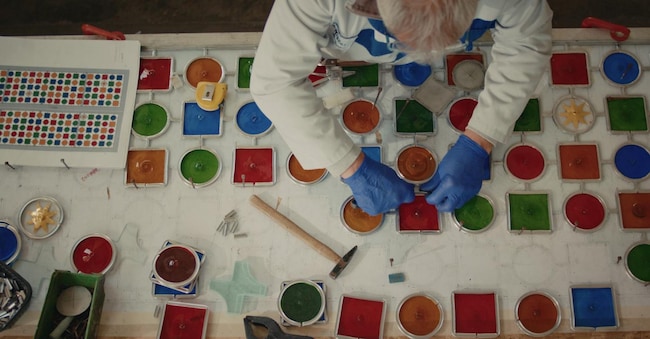
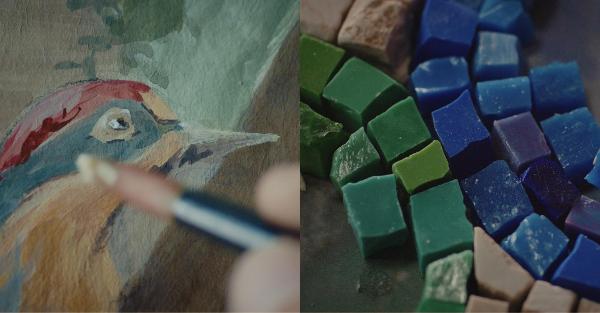
The images of the film follow one another like a countdown that, starting more than two years before the inauguration, traces the excellence of the craftsmanship of the blown-glass chandeliers made in Murano by Barovier&Toso and the mosaic art works created by the Friuli Mosaic School and the Friuli Mosaic workshop, which embellish the spa and the rooms. But also the hand-painted porcelain by Ginori 1735 and the spiked terracotta tiles of the terraces, made with a technique typical of ancient Rome by the Lazio-based Fornace Sugaroni, founded in 1685. It also shows the choices made by the landscape designers of P'arcnouveau, who took care of the greenery, including native flowers and medicinal herbs, and the decorators of the Pictalab atelier, who painted the wallpaper of the Champagnerie. But also the chef Niko Romito, who looked after all the catering with the aim of declining the full-bodied dishes of the Roman tradition in a new key, and, of course, the restorers of the Torlonia Foundation, who worked on the statue of Augustus.
The reference, everywhere, is Imperial Rome. From fabrics to stained glass, from mosaic columns to woodwork: the decorations reproduce the designs that adorn the Pantheon floor and play with gold, or recall bucolic scenes from Pax Romana.
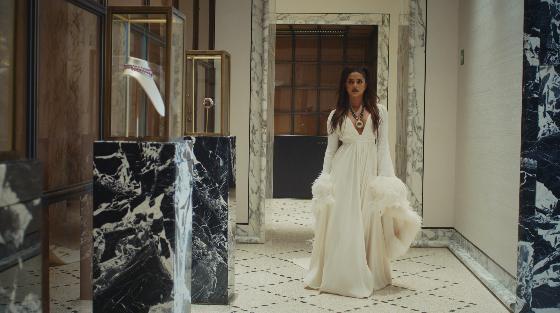
Godmother of the film, which concludes on 8 June 2023, international star Priyanka Chopra Jonas, who wears an emerald and diamond sautoir created for the occasion and composed of an original Roman coin depicting Emperor Augustus.

