
In 3,000 local authorities, the only primary school is at risk. 1,571 schools have closed in the last 10 years
The new edition of the Atlas of Childhood has been published. Here are the effects of the falling birth rate: there is an increase in multi-year-group classes and school mergers, and over a third of nursery schools have classes with few pupils (and are therefore at risk of closure).

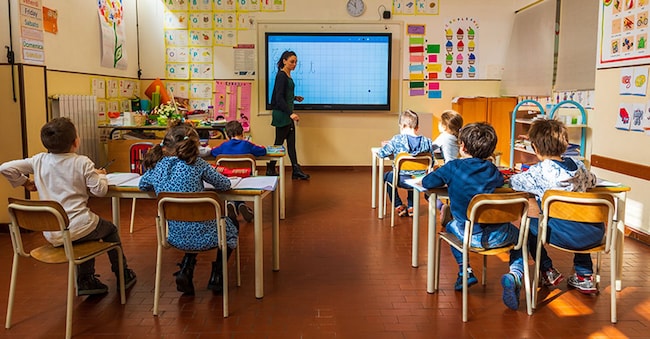
In ten years, 1,571 schools have closed, and in 3,000 local authorities the only primary school is at risk. There has been an increase in multi-year-group classes and school mergers; over a third of nursery schools have classes with few pupils, which are also at risk of closure; and one in three young people aged between 14 and 19 lives in a municipality without a secondary school. Spending on education, which has risen to just over 4 per cent of GDP thanks to funds from the National Recovery and Resilience Plan (PNRR), is at risk of falling below this threshold again from 2027, settling at levels significantly below the European average. This is according to Save the Children, which, ahead of World Children’s Day on 20 November, is publishing the 17th edition of the Atlas of Children at Risk in Italia, entitled ‘Scuola liberatutti’.
The publication
The report also highlights the challenges facing the education system today, ranging from inclusion to the use of artificial intelligence – which 9 out of 10 teenagers already use and 69 per cent would like to see incorporated into teaching, compared with 45 per cent of teachers. However, awareness of the risks associated with the use of AI remains limited amongst both pupils and teachers. In this school system, only 21 per cent of 15-year-old girls and 30 per cent of 15-year-old boys say they feel supported by their teachers – one of the lowest percentages in Europe. At the same time, the teachers themselves are often in precarious employment, with almost a quarter of them working as supply teachers (on fixed-term contracts) during the 2024–25 academic year.
The population decline
One particularly interesting point of focus is the demographic decline which, over the past ten years, has led to a 16.7 per cent reduction in the number of children and young people aged up to 14. Primary schools have seen a drop of 388,000 pupils and, according to Istat forecasts, the school-age population (primary and lower secondary) is set to fall by around one-fifth by 2036, representing around 1 million fewer children aged between 3 and 13 (with the most significant decline in Sardinia – 35 per cent), with 3,000 local authorities at risk of losing their only primary school, almost half of which are in the South and on the islands. It is estimated that by 2036 there will be 19.6 per cent fewer children in the 5–9 age group and 22.9 per cent fewer in the 10–14 age group.
From 2015–16 to the present day, 1,571 schools have been closed, mainly in the south: Campania (-277), Calabria (-263), Puglia (-174) and Sicily (-172), with the highest proportion in Calabria (10.7 per cent) and Molise (10.2 per cent), whilst it is lowest in Emilia-Romagna (0.3 per cent), Piedmont (0.2 per cent) and Umbria (0.5 per cent).
35.7 per cent of nursery schools have empty classes or very few children, putting them at risk of closure, with figures ranging from 9.6 per cent in the province of Monza and Brianza to 66.7 per cent in the province of Caserta.
Brand connect


Newsletter Scuola+
La newsletter premium dedicata al mondo della scuola con approfondimenti normativi, analisi e guide operative
Abbonati