Formula 1

In Baku, Russell holds off Verstappen by two tenths, whilst Antonelli stages a comeback and remains in the lead

Russell became the eighth different winner at Baku on the tenth anniversary of Rosberg’s first Grand Prix victory. A narrow victory over Verstappen, with Hadjar in third. Leclerc followed, whilst Antonelli’s comeback fell short.

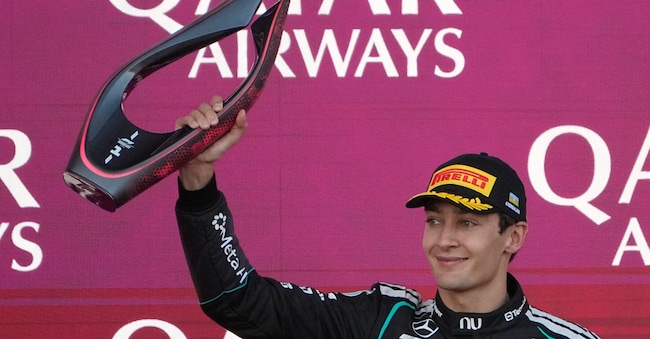
Il pilota britannico della Mercedes George Russell festeggia dopo aver vinto il Gran Premio di Formula 1 dell'Azerbaigian, a Baku, in Azerbaigian, sabato 26 settembre 2026. (Foto AP/Darko Bandic) APS

4' min read

Translated by AI
Versione italiana

4' min read

Translated by AI
Versione italiana

The race in Baku on an unusual Saturday at the end of September was a rather dull affair, but at least it ended in a photo finish. There was no Italia presence on the podium: Russell and the two Red Bulls, with the now ‘familiar’ spectacle of Verstappen, who is always there but never quite manages to achieve what he is capable of. The reason is easy to explain: the Mercedes are infinitely stronger. This time round, however, Antonelli had ruled himself out of contention for the top spot through his own mistake: a poor Friday saw him qualify terribly, and there was no repeat of the miracle already witnessed at Monza.

The dominance of this race, at least for the Italian public, was record-breaking. George Russell won the Azerbaijan Grand Prix without ever relinquishing the lead: pole position, a clean start, 51 laps in the lead and a 196-thousandths lead over Max Verstappen at the chequered flag. Isack Hadjar, returning from injury, finished third, securing Red Bull’s first one-two finish since 2024.

Loading...

Don’t be fooled by the close finish. For around thirty laps, the race was a procession, with gaps remaining steady and the only thing to manage being the tyres. It was the two safety cars, appearing in quick succession – as is typical on tracks ‘not suited to Formula 1’, or rather, tracks full of kerbs and lacking the sort of corners for ‘real drivers’ like this one – that reignited the race. The field bunched up again; those who’d changed tyres regained their pace, and the gaps that had built up vanished. A finale shaped by the safety car periods.

Verstappen, as mentioned, seemed to have the pace to win. He had already overtaken Hamilton and Norris in two consecutive laps; having switched to soft tyres during the first safety car period, he was the fastest on the track during his second stint and was right on Russell’s tail. That was as far as he got: the Mercedes pulled away under acceleration out of every slow corner, and, crucially, the British driver’s car gave up just enough ground to allow Antonelli’s team-mate to approach the first braking point without having to defend his position.

Ferrari is holding its own

Starting second on the grid, Leclerc finished fourth, playing his cards right under braking, where he was able to defend his position and attack with precision. Hamilton’s race – starting sixth on the grid – was not outstanding but acceptable: hampered by engine issues, he had to concede fifth place to Antonelli. Hamilton moves up to 199 points and, thanks to Norris scoring zero, consolidates his third place with a 13-point lead over the British McLaren driver.

Antonelli: limited damage. McLaren: an unprecedented disaster in 2026

Antonelli’s fifth place is worth more than the result itself: the British would call it a ‘damage limitation’ performance. The world championship leader started sixteenth following a collision at Turn 1 in Q1 – a mistake of his own making. At least he stayed out of trouble and brought the car home, which was by no means a given on a day like this. His comeback, however, was slower than at Monza, where two weeks earlier he had started nineteenth and gone on to win. It remains to be seen whether an undisclosed technical issue played a part.

It was a heavy defeat for McLaren, who failed to score any points. Norris, who had already gone wide into the run-off area at the first corner after locking up, was caught up in the crash triggered by Colapinto; Piastri, who had been running behind Russell for a long time, locked up whilst defending against Hadjar and plummeted to fifteenth. Haas performed well, with both cars scoring points, finishing eighth and ninth with Ocon and Bearman. Arvid Lindblad finished seventh: it wasn’t a podium finish, but a respectable result coming two days after he crashed his Racing Bulls into the Castello barrier in FP2.

With Russell’s 51 laps, Mercedes has now surpassed 8,000 laps in the lead: the third constructor to achieve this after Ferrari and McLaren. A record set in 1954 at Reims by Fangio and Kling, who finished first and second on the W196’s debut. Antonelli’s run, however, has come to an end; from Shanghai to Madrid, he had led for at least one lap in thirteen consecutive Grand Prix races – the sixth-longest such streak in history; the record is held by Hamilton, with eighteen.

Loading...

Set-backs and comebacks: two races in a row that haven’t gone down well with everyone

Baku followed the debut of Madrid, a track characterised by a fast single lap but with few overtaking opportunities during the race, to the extent that the organisers have already announced changes to turns 5–6, 13 and 20 for 2027. Commenting on Madrid, Carlos Sainz had specifically cited Baku and Macau as negative examples that the organisers had failed to improve upon: just a single overtaking opportunity, preceded by a very long straight. The problem isn’t the walls, but what lies between them. In Madrid, the risk discourages an attack even before it is attempted; in Baku, it arises after the decision has been made, when the car must be brought to a halt before the concrete barrier. Macau holds the grim record of nearly twenty deaths in its history among drivers, marshals and spectators, as well as a particular incident in the FIA GT World Cup which saw 16 out of 20 starting cars involved on the very first lap of the 2017 edition. An amateurish mess that a modern top-flight circuit simply cannot afford. And it’s all down to geometry.

The Azerbaijani contract, due to expire this year, has been extended until 2030; Istanbul will also return from 2027, under a five-year agreement. Formula 1 can race amongst the buildings and within a medieval city, provided we remember that there are twenty-two cars on the track, not just one racing against the clock. For years, the ‘tilkodrom’ circuits – Sepang and Shanghai in particular – have been criticised for having an abundance of run-off areas and coloured tarmac instead of gravel traps or kerbs. There was certainly no shortage of boredom, but perhaps it was a compromise that made the races more spectacular and interesting.

Copyright reserved ©
Loading...

Brand connect

Loading...

Newsletter

Notizie e approfondimenti sugli avvenimenti politici, economici e finanziari.

Iscriviti

Tutto mercato WEB