At the homes of the great photographers

In Beijing, at the home and studio of the artist, portrait painter and graphic designer Chen Man

Far removed from the clichés about fashion and her country, China. Hyper-realistic and eclectic, she does not seek style, but precision. And she works by manipulating light as if it were an ingredient.

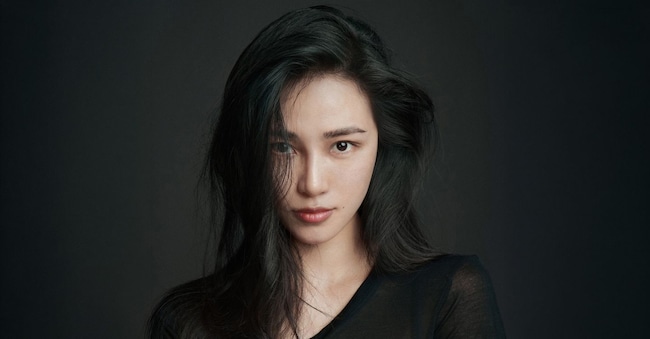
Autoscatto dell’artista cinese Chen Man.

7' min read

Translated by AI
Versione italiana

7' min read

Translated by AI
Versione italiana

Even trying to define her is already a misstep. Who is Chen Man? A photographer? A painter who uses her camera like a brush? Or a graphic designer who has transferred her artistic language to the world of fashion? I find myself wondering as I watch her move with an almost Zen-like grace in her cream-toned home-studio in Beijing: behind her, a traditional Chinese sideboard in cinnabar-red lacquer, decorated with peony and lotus branches; all around, photographs capturing a lifetime, propped up against the books. She is wearing a white wrap-around shirt and a very fine green necklace, barely noticeable here. A subtle yet revealing detail: green often recurs in her work, a common thread, or rather, vert. A colour which, for her, is linked to memory and the legacy of her ancestors. Looking at her, one is struck by her simplicity. Yet she is a photographer who has collaborated with some of the most prominent international luxury brands, including Dior, Gucci, Louis Vuitton, Piaget, MAC and Adidas, producing editorials and covers for major international magazines and photographing figures of the calibre of Nicole Kidman, David and Victoria Beckham, Rihanna, Sophie Marceau and Isabelle Huppert.
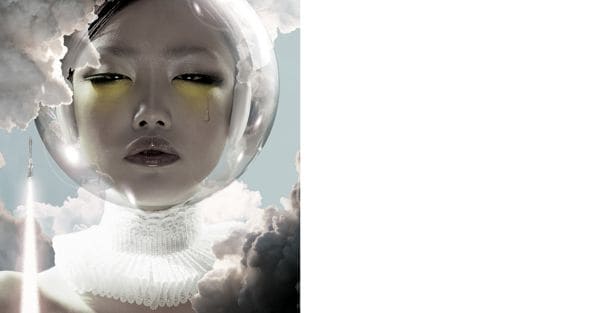
Un progetto che indaga il senso e la funzione della memoria; “Vision N°6”, copertina della rivista “Vision Magazine” con l’opera “The Astronaut” inclusa nella collezione permanente del Victoria and Albert Museum di Londra (circa 30.000 €).

But at the root of this imagery lies a much simpler, almost primitive scene. ‘My parents were part of the generation sent to the countryside during the Cultural Revolution. They were relocated to Inner Mongolia: that’s where I was born. My earliest memories are of a small, almost rural house. One day my mother saw me drawing a mouse on the wall; a simple, childish gesture. That was enough for her: she took it as a sign and, with that determination typical of Chinese mothers, decided that I would study painting. Over time, I’ve come to realise that it’s all about repetition. Like Sisyphus: a gesture that seems identical, but is never quite the same. That’s how one becomes a craftsman.”

Loading...

For over twenty years, Chen Man has been creating images that only appear to be photographs at first glance. The longer you look at them, the more different layers emerge: digital retouching, Chinese history, fashion, painting and memory. From the very beginning, her work has proved difficult to categorise: too constructed to be photography in the traditional sense, yet too closely linked to the commercial world to fit within the contemporary art system. During her university years, she collaborated with Vision Magazine, then a fringe publication, but already avant-garde. With a background in graphic design, using Photoshop came naturally to her: she scanned film, radically altered the shots, and created a hyper-realistic and opulent aesthetic. The result was something the public had never seen before, and which, within a short space of time, helped to redefine the visual codes of Chinese fashion.
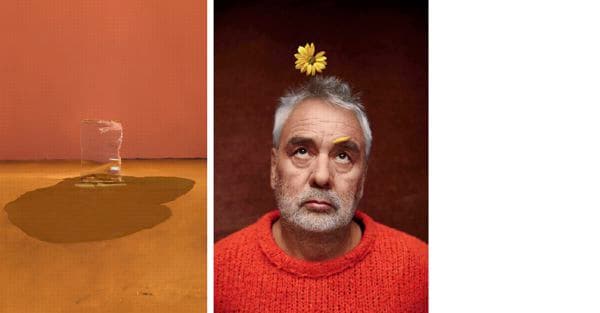
Ritratto del regista Luc Besson con accanto un mattone di ghiaccio per la serie “Memory brick”.

‘In my early creative years, I was very shy. The camera was a way for me to hide, to keep my face out of view, yet at the same time to connect with others. Growing up, I had neither a telephone nor a television, nor even many books. Even a bicycle was a luxury. But there was silence – a boundless silence – populated by the lions and dragons of my childhood, the ones I used to see standing in pairs by the doors, protecting families. That’s where I learnt to use my imagination, and that’s where it all began,” she recalls.
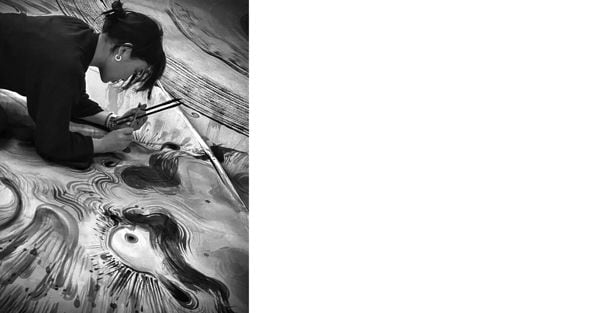
Autoscatto dell’artista al lavoro.

The Astronaut (2008), now part of the permanent collection of the Victoria and Albert Museum in London, belongs to this phase; it established Chen Man as the first Chinese fashion photographer to be included in such a prestigious collection. It is an image that encapsulates China’s transition from an agricultural power to a nation looking towards a technological and space-age future. The female figure, her muse from those years, Dan Ni, wears a futuristic glass helmet; a tear runs down her face, lending the image a human, fragile and indomitable quality. When asked how the outlook of Chinese fashion – which for years had been focused on the West – has changed, Chen Man avoids any oversimplification: ‘China is too vast to be encapsulated in a single image. We have completely different dialects, foods and traditions. For me, it’s important to find a harmony – the lowest common denominator amongst all these things. But I’m not interested in clichés, dragons, opera or what people expect. Contemporary China is constantly changing. I’m not looking for style, but for accuracy. I like to think of myself as a chef: when I’m faced with a person or a story, I have to work out how to handle it. I use light as an ingredient.”
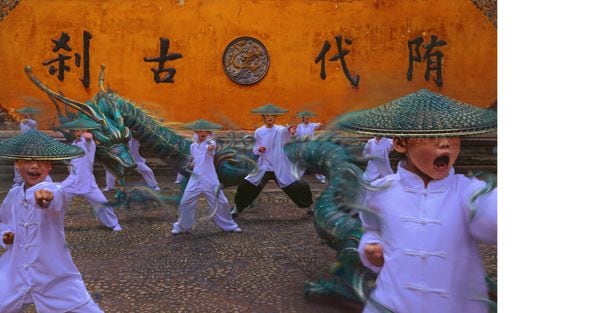
“Hòu! Hà! Hèi!” (2022): la foto è stata scattata nel monastero di Shaolin, noto per essere la culla del Kung Fu, per “Cosmopolitan China” (10.000 $).

At a certain point, however, her hyper-constructed style encounters resistance. In China, she explains, the public struggles to accept images that are too elaborate, too far removed from reality. And perhaps that is as it should be. Because, beneath the polished surface of her works, Chen Man has always held a very clear conviction: ‘Perfection is not of this world. Humanity is, by nature, made up of flaws. I learnt this through my contact with the world of fragrances: essences, in their concentrated form, often have a pungent, almost unpleasant smell. And yet it is precisely from there that perfume is born. It is the same with images and with people: what truly moves us is often that which is imperfect.”

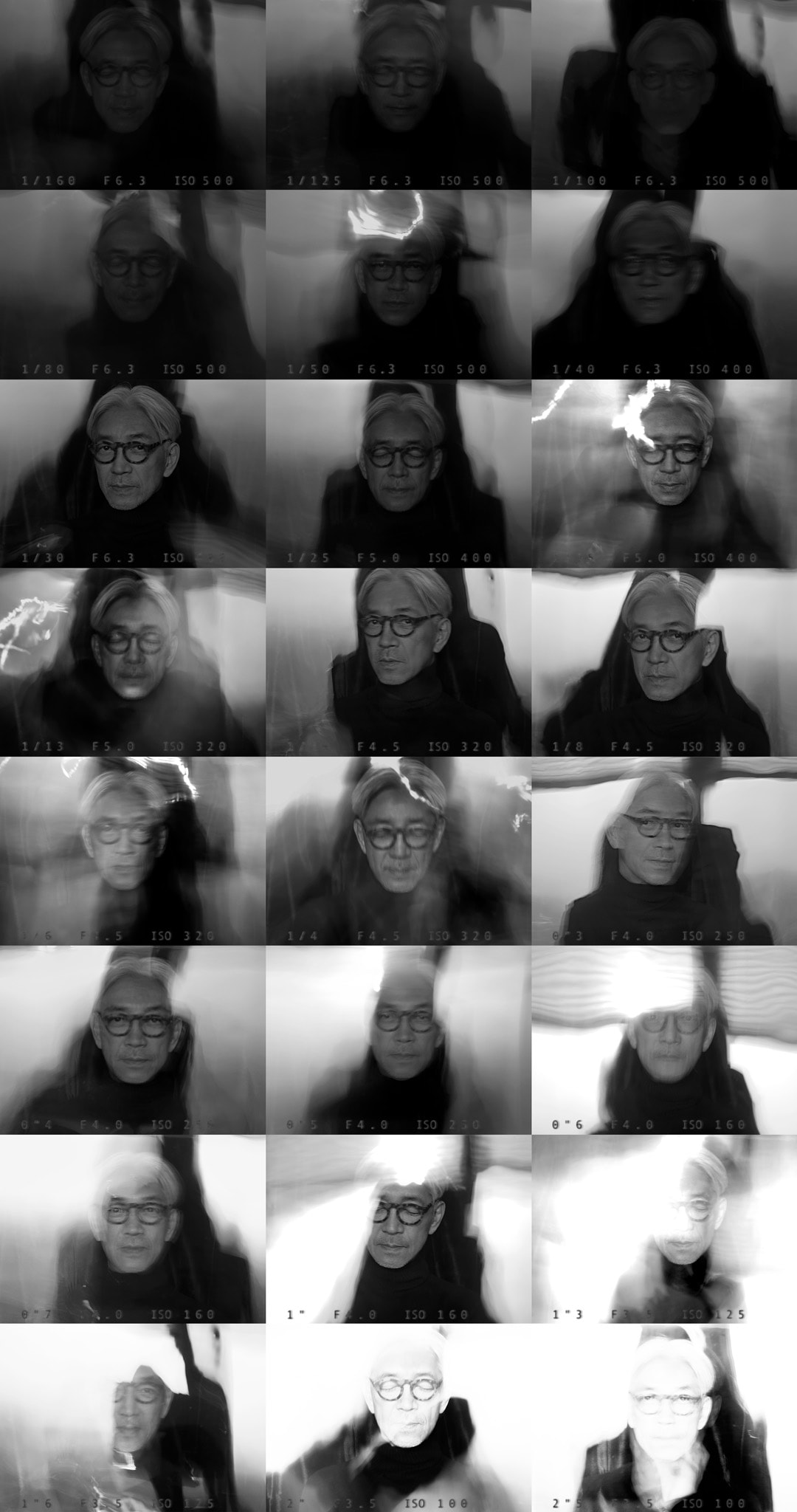
Provino del servizio fotografico a Ryūichi Sakamoto (2018).

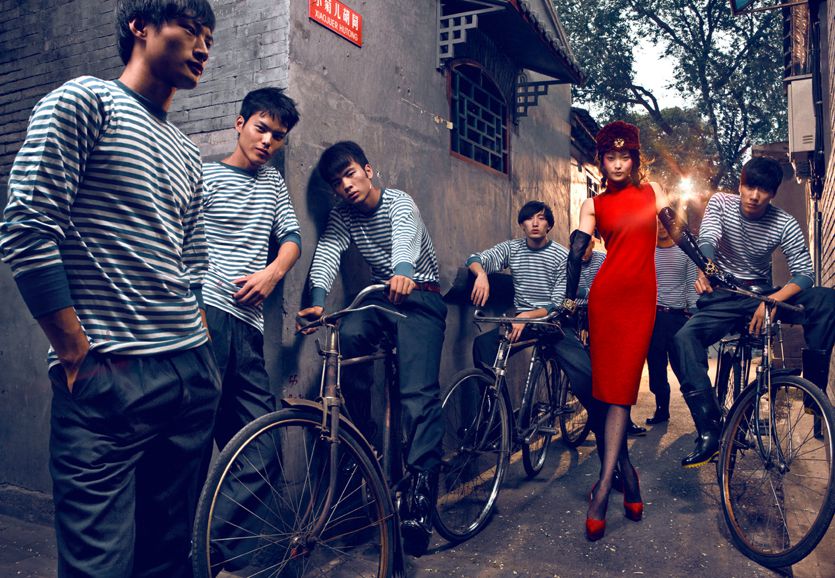
Chen Man then decided to change her approach and leave the studio to work in the physical landscape of the country, moving from the Great Wall to Tiananmen Square, from temples to parks, creating images orchestrated down to the smallest detail, yet rooted in the real world. This gave rise to projects such as Long Live the Motherland (2009), in which models dressed in red become almost archetypal figures, set against the country’s most iconic landmarks. Years later, around 2011, the philosophical heart of her work emerged. She returned to technology, but with a broader, existential, almost lyrical scope. ‘In Taoism there is a fundamental book, the I Ching: it says that everything is constantly changing. My work stems from this principle. During the pandemic I couldn’t photograph people, so I began to frame ancient tea trees, some over three hundred years old. I am fascinated by the way they endure through time. Around the same time, I was invited to one of the oldest Zen temples in Kyoto: the abbot asked me to paint a golden screen, giving me complete freedom. It was there that I felt this connection between everything – trees, architecture, people – most clearly.”

“Long Live the Motherland” (2009), realizzata per “Vogue China” a Pechino, in uno degli storici vicoli noti come hutong.

One of his signature styles is dressing models in a blend of traditional Chinese attire and haute couture: hanfu, armour, imperial silks and couture styling, demonstrating how tradition is not a static concept, but a fluid aesthetic language to be continually revitalised. Burgundy red, sage green, midnight blue: his colours are intense and enveloping, the contours sharp and calligraphic, the quality cinematic. Some editorials, featuring famous Chinese actors for Vogue China, evoke the aesthetic of Zhang Yimou’s Hero and House of Flying Daggers, where colour forms the narrative structure. Others feature children, already skilled in martial arts, immersed amongst three-dimensional AI-generated artefacts and Chinese ritual objects made of copper. In her images, one seems to sense the earth shaking off its leaves, the whistling of arrows through the air, the water of a waterfall in the distance, the smile of the Tao. Chen Man shows that, just when you think you’ve understood China, its identity has already moved on. ‘Look, for example, at this piece.’ She points behind her to a painting in phosphorescent colours. ‘It’s a photograph that I’ve reworked with paint. It’s the same approach I use in my portraits. I start from memory. I always ask two questions: if you could keep just one memory on earth, what would it be? And what colour is that memory? I follow whatever emerges – be it pain, love, complex moments… Then I build a brick of ice, a fragile structure that I paint and photograph as if it were an abstract image. I’ve called this project Memory Brick’.

On the subject of memory and identity, in 2012 Chen Man shot twelve covers as part of her long-standing collaboration with the British magazine i-D, for the Pre-Spring issue no. 317. This is one of the most iconic projects of her career, celebrated for its ability to capture the complexity of beauty in contemporary China. Instead of relying on the usual supermodels, Chen Man chose twelve young women from various Chinese ethnic minorities, including some Tibetan students. She captures them all with one eye closed and the other open – a stylistic hallmark of the magazine (the logo is a graphic representation of precisely this). ‘One eye on the future, the other on the past,’ she tells me, as the late-afternoon light in the studio begins to fade. As we speak, she pauses to look at another shot taken from above, depicting two actors draped in fabric – one in white, the other in black – dancing in a spiral that evokes the Yin and Yang symbol. It is an image that embodies cinema, painting, dance and even the ancient art of Chinese calligraphy, which Chen Man has been practising for years. ‘In that image there are two bodies, two men, but to me they are like the lions and dragons I used to see as a child. Yin and Yang, masculine and feminine, good and evil: different energies that are not mutually exclusive, but complement one another, because within each there is always a trace of the other.’

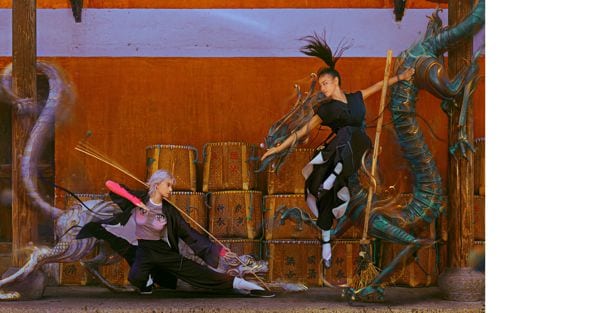
“Dragons Rising Tigers Leaping” (2022), con la nota modella cinese Du Juan per “Cosmopolitan China” (10.000 $).

When I ask her if there is a portrait that has stayed with her, she replies without hesitation: ‘Ryūichi Sakamoto. I had the opportunity to work with him on an NHK documentary. It was one of his last projects. I asked myself: how do you photograph someone who has already been captured in every possible image? If I intervened in post-production, it would be excessive; if I imposed my own oriental-style approach, it would be out of place. So I decided to work with different exposure times, to capture the master in different moments: a thousandth of a second, a hundredth, a second, ten seconds, up to a minute. He arrived on set after two operations, looking very thin, in a matt black shirt, his white hair neatly combed at the sides, wearing large-framed black glasses. I set up a shot of him, but he smiled and asked me to change it. I chose some Chinese guzheng. He closed his eyes and listened in silence. It was March 2018. We took photographs until evening. Before leaving, he whispered to me: “Don’t forget to look at the moon in the sky tonight.”

Copyright reserved ©
Loading...
Loading...
Loading...

Newsletter

Notizie e approfondimenti sugli avvenimenti politici, economici e finanziari.

Iscriviti