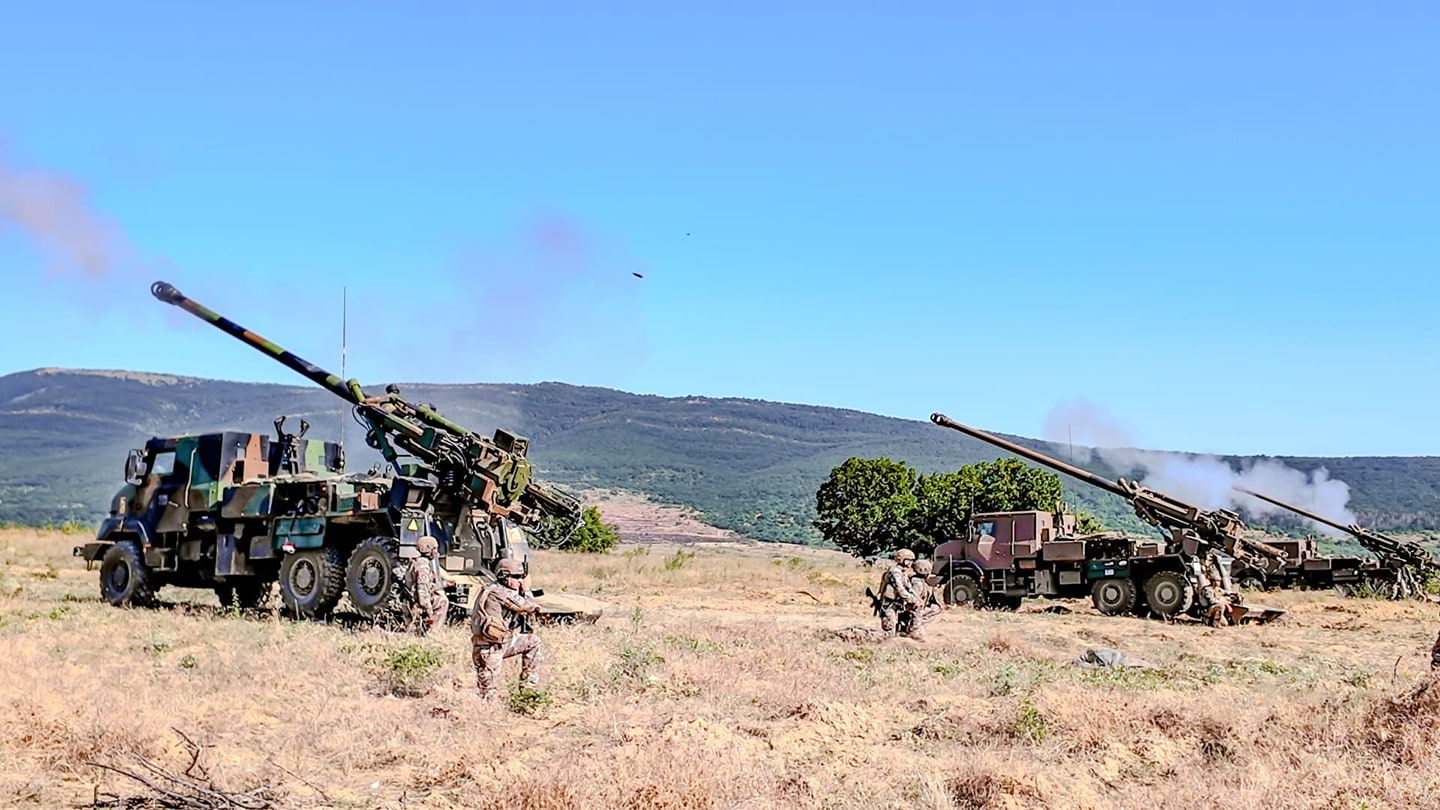
In Bulgaria, NATO allies and the Americans are working side by side in a large-scale exercise led by Italia
Colonel Matteo Epifani, commander of the Multinational Battle Group Bulgaria, who led the exercise, said: “The same level of cooperation – nothing has changed with the Americans.”

Key points
MOKREN (BULGARIA)
FROM OUR CORRESPONDENT – Dirt tracks. Dust everywhere, the sort that gets up your nose. And then mortars. A barrage of explosions. Thick smoke. Tracks rumbling along. Drones gliding overhead. At exactly the same time as in Ankara, in the heart of Anatolia, US President Donald Trump is reiterating to NATO allies his accusation that they are not doing enough to fund the Atlantic Alliance’s defence expenditure, some 800 km from the Turkish capital, in the village of Mokren, at a US-run Bulgarian firing range in the hinterland of south-eastern Bulgaria, a large-scale multinational exercise is taking place, conducted under the NATO umbrella by the Italian-led Multinational Battle Group Bulgaria. Code name: “Alliance Wall”, where “Alliance” refers precisely to the one the US President intends review from top to bottom. If Trump were here, and were to witness these military manoeuvres planned down to the smallest detail – American troops moving in unison, shoulder to shoulder, with soldiers from other NATO countries – he would probably give it some thought. Or perhaps not.
It goes without saying that the aim of everything that has been undertaken over the past two weeks, during which the exercise took place, was precisely to consolidate the ability of the forces of the 32 members of the North Atlantic Alliance – and therefore also of the US – to operate together effectively on the Alliance’s eastern flank.
The Italian commander: ‘We are working with the Americans; nothing has changed’
And what about Trump? What’s the atmosphere like? “On the ground, to be honest, I’ve never sensed any change in the level of animosity between us; I’ve always had excellent relations with the Americans. We’re in daily contact, because I’m not the commander of the infrastructure within which we’ve carried out this exercise,” explains Colonel Matteo Epifani, commander of the Multinational Battle Group Bulgaria, who led the exercise. “The infrastructure we operate within is US-run, so naturally I have to coordinate on a day-to-day basis. There’s no problem. From a military point of view,” adds the commander, “the Americans aren’t permanently stationed here but use this base to conduct an advanced training cycle for new recruits who, after a training cycle at home, come here – and not just here – to undertake slightly more advanced training.” How long does this programme last? “Between eight and nine months. The American rotation does not overlap with ours; it is staggered and lasts eight or nine months. The last rotation took place two and a half months ago. We have never had any sort of problem, either with previous rotations or with the current one. The clearest proof,” emphasises Epifani, “is that we invited them to take part in this exercise and they accepted.”
“Ours,” continues Epifani, “is a mission that appears to be essentially a training exercise, but in reality it is a mission that fits naturally within the broader framework of initiatives that NATO is developing on its eastern flank to contribute to collective security and to ensure the deterrence and defence of this part of Europe.”